Going West

Have you ever noticed that sometimes the people who appear to have the least, are the most generous? In Nepal, I noticed this plenty, particularly when I headed off the tourist trail and headed out into the country. For example, I spent a couple of weeks in a small village called Meghauli, which is in the Terai region near Chitwan National Park – it’s in the lower, flatter region of the country near the border with India.

I stayed at an eco-farm where I helped out around the farm in return for food and accommodation, along with six other travelers. It was monsoon season, so most days involved a couple of hours of work in the mornings and evenings, resting through the heat of the afternoons and sharing a meal in the evenings.  The monsoon rains came and went most days, and it was always a trick trying not to get caught out in the fields when the rain came in – first you would notice a change in the wind, then the sky would change to a deep blue-grey, and then you knew you had about five minutes to get undercover, or you could forget about staying dry!

Everything was green and lush and the air was clean and fresh. We planted beans and pineapples, pulled weeds and did some painting. In our free time, we helped with cooking, played cards and often walked into the village, where the friendly villagers would always greet us with a smile, if perhaps a curious one, and often the offer of a cup of tea. They lived a simple life, trading their wares or services, growing a lot of their own food, taking the bus to town when they needed to. There was a school, and a health post, and not much else. But they were happy, and they made us welcome. None of the shopkeepers tried to charge us more because we weren’t Nepali. Even the lady who owned the only grocery store kept her generator running so we could get a cold beer and an ice cream in the afternoons.

When I left the farm, I wanted to head west, to a place called Lumbini. It is known to be the birth place of the Buddha, 2,500 years ago, and curiosity was nagging me to go there. I couldn’t go on the day I planned as there was a general strike (that happened at least once a week) and Bishnu, our host at the farm, was concerned about me going at all, because of strikes going on in that part of the country. He wasn’t sure I would be able to get there at all, and was urging me to take the tourist bus back to Pokhara.

I found his concern very sweet, but I was determined to go. So the next day, I packed my bags, said goodbye, and hopped on a local bus, with Bishnu next to me, who was determined to see me off as far as he could. When we got to town, he walked me to the next stop, found the right bus and told the driver where I wanted to go. Three and a half hours later, with very cramped legs, I arrived in yet another town, and here, to my great surprise, the driver took the bus all the way into the bus station to make sure I could get another one. He got off, found my next bus, told the driver where I was going, and paid my fare for me! Nearly an hour later, we arrived in yet another town, the closest one to Lumbini. Here it turned out I couldn’t get another bus, as from this point the country was still on strike. There weren’t even any taxis – the only way to get there was by rickshaw.  To further my surprise, this final bus driver got off the bus, found me a rickshaw and negotiated a good price for me. I hopped in, feeling a little overwhelmed by the kindness of these people, who didn’t know me at all and could have got much more money out of me if they had wanted to – but it was in their nature to be helpful, and I was grateful. Even the rickshaw driver, who hauled me and my backpack along for two whole hours in the blazing sun, insisted on buying me tea and a snack when we stopped half way for a rest. It was a long day of traveling, but thanks to the help of these strangers it was easy and unstressful and I felt blessed to have spent the day among them.

It occurs to me, thinking about it later, that Nepali people live much more in the moment than we tend to in the west. They are never in a hurry, and never stressed about what they have to do or where they have to go next – so taking a few minutes to help someone out is no problem, because it’s not taking time away from something else. It’s the same with hospitality (especially with tea!). Partly it’s cultural – not offering refreshment to a guest would be incredibly rude – but also, I think, it’s because they know that the same will always be offered to them in return, and that they understand in their subconscious that there is always enough to go around. It is so different from the western mentality of lack, and of competition – the idea that giving something away means having less, or that sharing means letting someone get ahead of you. They just don’t think that way in Nepal, and I found it liberating and refreshing.

In Nepal, everyone calls everyone else by a family name. Young men and women are called sister or brother, uncle or aunty, grandmother or grandfather. Up in the mountains, the girl who did our cooking, Jamuna, always called me sister. She would knock on my door in the morning if I wasn’t up, and call out ‘Sister, breakfast!” Our host’s mother also lived at the lodge. She helped to maintain the crops and animals and would tut very loudly if we didn’t finish our meals. We called her Ama, which means grandmother.

Perhaps it is this inherent sense of other people as family that makes the Nepali people so generous – after all, why would you refuse to help your brother, sister, uncle or grandmother? And if everyone you meet is your brother, or sister, your aunt or your uncle, you need never fear that you won’t have enough, or that your kindness won’t be returned. So the young girl traveling on her own from Meghauli to Lumbini isn’t a stranger – she is kin. Surely, this is what it means to live in peace.
Livin’ Like A Local

One of the good things about having friends in other places is that you get to visit them sometimes. And when you’re traveling, there’s nothing like staying with a local. Traveling solo, I do get to meet a lot of locals, but most of the contact I have with them is as a customer, and even staying in hostels, where you are thrown in with everyone, you’re still surrounded by other travelers. This is still a good thing – I’ve made many friends this way, from all over the place – but there’s nothing like actually staying with a local, in a local community, in a local home.

My first experience of this was in reverse. When I was 17, my family hosted an Italian exchange student who stayed with us in our home for two months. She was the same age as me, and we became, and still are, good friends. We hosted others over a period of a few years, and I have been able to visit a few of them since. And there are always, inevitably, those awkward but funny situations when you’re navigating around foreign customs and stumble over what you should do or say, who does what, what happens at meal times and so on. But mostly it’s fun, though challenging, and exciting, though scary. And sometimes, you get to do something really cool that you can only do if you know a local. Like go to a festival.

For example, every year in Venice, on the third weekend of July, there is a festival known as ‘Il Redentore’ – the Feast of the Redeemer.  This festival celebrates the liberation of the city from a devastating plague in 1576. This was when Venice was a republic, independent from the rest of Italy, and the plague killed around 50,000 people – nearly a third of the population. To give thanks for its end, a new church was commissioned by the Doge, to be designed and built by the renowned architect Andrea Palladio. And to celebrate, a great festival was held every year on the Feast of the Redeemer – a tradition which continues to this day and now includes a great firework display on the Saturday night. There is also a great pontoon bridge constructed over the lagoon, which stays up for just 24 hours, so the locals can walk from the main island over to the steps of the Church of the Redeemer on the Island of Guidecca. It happened last weekend. And it also happened ten years ago when I was there, staying with a local.

I was staying in Venice with two friends who had both once stayed with my family in Adelaide. One of them had family in Venice, and they invited us to join them for the celebration. When we arrived his cousin and one of his uncles were busy decorating their gondola with vines and paper lanterns, which were hanging from a string they had set up between poles at either end of the boat. It was the same shape as a gondola, but wider, and it had seating built in around the sides, with various boxes and containers stored in the bottom. About ten of us hopped in, and we set off along the canals heading out to the main lagoon. On the way we had to pass under the famous Bridge of Sighs, which I thought was very cool. We reached the lagoon and joined hundreds of other boats, similarly decorated with flowers, vines and lanterns, all gathering together for the festival. We joined a row of boats and I watched as the people in the boat next to us threw ropes and the boats were tied together, and then again as we threw ropes to the next boat to come up on our other side, so we were all joined in a long row of boats. I thought this was a very practical way of fitting as many boats into the lagoon as possible, while also reducing the amount of bobbing and rocking. But I was struck by the symbolism as well, of all these boats, being tied together for this one occasion, much like the Venetian people, so few of whom are still seen in Venice any more, coming together for this one night of celebrating.

We sat there together in the boat for several hours, as the day turned to evening and the evening turned to night. We had food to share, which was passed around, and drinks, which were warm but welcome, although I was careful not to have too much as the toilet facilities were naturally somewhat limited. There was much talking and laughing, and sharing with the boats around us. I didn’t understand most of the conversation, as they spoke in the local dialect which I couldn’t follow, but I was happy to sit back and relax, taking in the sounds and colours and the festival atmosphere. We enjoyed a small diversion when one of our paper lanterns caught fire – there was an initial cry which caused everyone to jump up suddenly, which caused several more cries as the boat, and the ones next to us that we were tied to, started rocking, followed by a general panic as the flame grew bigger and bigger. Eventually it was put out by someone simply ripping it off and throwing it into the lagoon. And so the party went on.

Finally, when it was fully dark, there was a spectacular firework display lasting nearly an hour. It really was something I’ll never forget – sitting in a gondola, bobbing in time with boats tethered to us on either side, watching a glorious array of fireworks and their reflections in the lagoon.

It was a quiet ride back – the Italians seemed to have worn themselves out and I was tired from translating in my head all day. But it was an experience I am still grateful for, because it is one I would never have had as a tourist. So here is my advice if you ever go traveling – don’t just travel with people from your own country. Make friends from everywhere – from places you’ve always wanted to go and from places you’ve never even heard of. And if they invite you to visit – say yes.

Disconnecting

Two years ago, when I was in one of my ‘I-don’t-want-to-talk-to-people’ moods, I signed myself up for a Conservation volunteering project in the mountains of Nepal. I wanted to go somewhere where there would be peace and quiet, and I could do something useful. By the time I arrived, it had been two months since the devastating earthquakes, and the monsoon season was just setting in.

It took two days to get from Kathmandu up to Ghandruk, a small village in the Annapurnas, where the project was based. The last two hours of the trip was an uphill hike following my porter, a little old lady who could have fitted into the basket she was carrying. I arrived hot and sweaty and looking forward to a hot shower and a cold drink. Until I was told that there was no power, as a monsoonal deluge had caused a landslide which had taken out the power lines. That meant cold showers and no warm drinks. It also meant there was no wifi.

My first thought was how was I going to let people know that I had arrived. My second was, ‘well, I did come here to get away from it all’. And so I did. I sent a text message to my parents and hoped that anyone else who wanted to know if I was alive would get in touch with them. And then I forgot about the outside world and got on with enjoying my mountain retreat.

20150703_101916

For that first week, the only company I had was the three other volunteers at the lodge, our project manager Raj, his parents, who helped run the lodge, and Jamuna, a cousin of Raj’s, who cooked our meals. She had a gas cooker that she cooked on and boiled the kettle for tea, and as there was no fridge she cooked only enough for one meal at a time, no nothing was wasted. When we went out on projects – bird surveys, checking cameras etc – we took our phones, in case we got separated, but the rest of the time they stayed switched off.

IMG_4512

At home, we played table tennis, read books, helped with the cooking, and, with some help from the others, I practised using my camera. In the evenings we played Uno by candlelight and then went to bed early. Playing table tennis was particularly amusing because the table was in such a bad state. In some places it had moss growing on it, and in others the concrete surface had chipped away, so that the ball would often veer off at a bizarre angle, either to the left or right and even once catching the edge of the table and looping all the way back over the other side and into the corn field behind us.

The funny thing was, I didn’t miss being connected or having power at all. I particularly enjoyed the evenings, eating a meal and playing cards without any phones going off or people getting distracted. Jamuna had more fun than any of us – perhaps it had been so long since anything had happened up there, or maybe she just liked Uno, but her enjoyment was contagious, and her company made all the difference. Her English wasn’t great – when we tried to explain the rules she would nod and say “Ah, ok, yes!”, play a completely wrong card, and then collapse into a fit of giggles when we told her she had to pick another one. It was peaceful, and companionable – it reminded me of family holidays when I was young when we would sit around the campfire or play cards with no phones or television to distract us. You realise how precious and important human contact is when you are 100% present and in the moment.

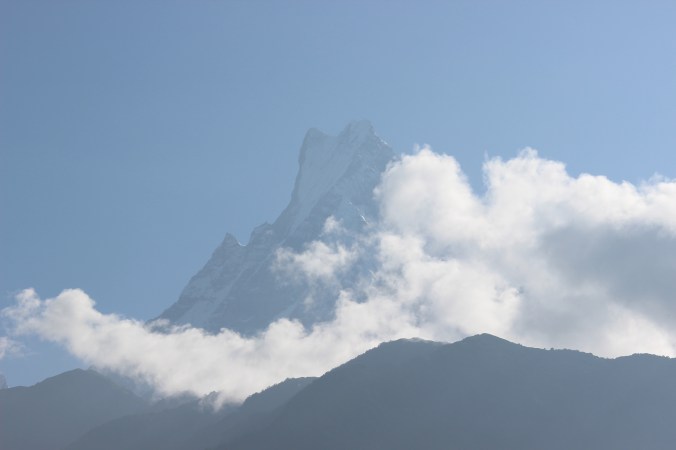
I found the absence of the outside world calming and liberating. I was much more aware of the environment around me, of the lush greenery flourishing in the monsoon, the sound of running water, of birds, frogs and insects that weren’t competing with phones, cars and televisions, the smell of damp earth tinged with the faint aroma of animal manure and the ever-present monsoon mists, which crept in and out of the valley, occasionally giving us spectacular views of the snow-capped Annapurnas and the mighty Machhapuchhare, also known as the Fishtail because of it’s disctintive double peak. All this I took in because I didn’t have my nose in my phone.

IMG_4517

Isn’t it interesting what technology does to us? When we finally did get power back, the effect was remarkable. Suddenly all our phones were plugged in all the time, we were all sitting around the table with our laptops, our feet getting tangled in all the cords, uploading photos so we could show to others what we should have been looking at ourselves. Suddenly, after being perfectly happy checking my phone only once a day, I needed to have it on all the time, in case I got a message or notification.

Isnt it funny how this happens? I’m sure I’m not the only one. I even felt a bit sad about it, even as I realised it was happening. Still, I think it was good for me to learn that the world could cope without me for a few days, and it was especially nice to know that I could cope without it – beforehand, I would never have thought that I would manage so well for so long without power of any kind. I even managed the cold showers without complaint. It was just a pity we couldn’t chill the beer.

Fools, Fears and Freedoms

Ten years ago, I did not have a Facebook account, nor was I a member of any other social media – in fact, I had never even heard of Facebook, and whatever other forums that existed at the time all seemed like too much bother. Which was a good thing really, because at the time I was in Italy making a regular fool of myself, and it is a great relief to me (and to the other parties I’m sure) that there is no Google-able evidence of it.

I arrived in Padua, in the Veneto region, much earlier than expected after a very uncomfortable train ride up from Rome. I had landed in the early hours, dashed on to the train with seconds to spare, and as a result failed to obtain sustenance or relief of any kind. So for most of the four hours or so that I was on the train, I was desperate for the loo but too afraid to leave my bags to go and find one, wearing far too many clothes for the warm weather and sitting next to a man who snored for the whole trip and spoiled the countryside views by drooling all over the window. The only snack I had was a packet of Mentos, which I chewed very slowly, with almost indecent relish. I don’t think I have ever felt more appreciation for wrapped confectionery.

To top it all, my early arrival meant that my host, a friend I hadn’t seen in seven years, was still several hours away up in the mountains. So I was picked up from the station by his parents, who I had never met before, welcomed into their home, showed to their kitchen table and given one of the most delicious roast chickens I’ve ever had. It was one of the most peculiar days of my life so far, especially with jet lag setting in. But despite the strangeness, I felt completely welcome, and completely safe. Until, that is, I tried to speak to them in Italian and informed them that “sono partita d’Australia domani” – I left Australia tomorrow. Then I just felt completely stupid.

Later that day, when my friend had returned, he took me for a ride on the back of his Vespa, and the day went from peculiar to terrifying. Zigzagging between cars on the wrong side of the road while he kept turning around to point out various buildings and features, I was convinced I was going to die. The ride home was worse, because it was dark and I was sure there were all manner of cars and lorries and buses heading straight towards us that we couldn’t see. (In fact, it took several days for me to completely relax on the Vespa. After that, I began to love it, zipping around the city, or cruising around the countryside with the wind in my face. It was the feeling of freedom.)

The next day, I spoiled a perfectly good moment, looking out over Verona from a window of the Roman arena by putting my hand down in a pile of pigeon droppings. The next day I fell over coming down the stairs, causing my hostess some considerable alarm, and the next I dropped food all over someone else’s coat. On another day I slipped on some water from a leaky fountain in Venice and skidded along the cobblestones, arms flapping madly, until my friend recovered from laughing long enough to catch me. The children playing in the fountain were similarly amused. It wasn’t all bad for me though, my friend had his share when he dropped his brand new USB stick with his just-completed thesis on it down into the drain outside the printer’s office. We went back a couple of days later and rescued it with a garden hoe and some chewing gum. Well he did, anyway. Mostly I just laughed and took photos.

So, all in all, I’m very glad there was no Facebook at the time to document or share any of this. I do have, however, a journal I kept at the time, full of all the details of how I embarrassed myself on a daily basis and all my amazement at the many things wonderful and new. I have a flick through it every so often, and am rewarded with memories like being assaulted with a barrage of different smells every time I opened the fridge, zooming around the Venetian countryside on the back of a Vespa, and being looked after by someone who seemed to regard feeding the guest as a full-time job. I discovered then that if an Italian woman asks you “do you like pasta?” she actually means “would you like me to cook you some pasta right now?” There were a couple of very awkward scenes before I figured that one out.

I guess, if Facebook had been around then, it would be asking me about now if I want to look back on my memories from ten years ago, which, as it happens, I do. I may have made a fool of myself quite a lot, but I would have been more of a fool if I hadn’t gone in the first place. It felt like a risk at the time, traveling on my own and staying with people I hadn’t met before, but it was worth it, and because I did, my courage has grown and today I can do those things without a second’s thought. It’s one of those things my current self would thank my past self for, if that sort of thing was possible. I like to think that my past self, as she zooms by on the Vespa, would wave and say, “you’re welcome”.