Hunger and Hope

Sometimes when traveling among other cultures, we experience things that are so far removed from our own experiences that it’s difficult to put it into any context, and even witnessing it doesn’t seem real.

While I was in Nepal, I spent a few weeks working on a rebuilding project, which was organised through an agency. Something like 52,000 schools were destroyed in the earthquakes, affecting the education of 1.7 million children, so we were there building new classrooms so that children could return to school. It was tough work – most days we were working in blazing heat, laying bricks, mixing cement and moving sand, and most nights it rained, so that we started each day bucketing out water from the foundations we had dug the previous day. We would go home each day covered in a mixture of sweat, sand, sunscreen and cement, but knowing we were doing our part to get children back into school, in classrooms that would be much more likely to withstand another quake. It was tough, but worth it.

As part of the program, we were given a presentation one evening by two members of the Nepal Youth Foundation, which is a local charity that works closely with the organisation I was there with, founded by an American lady named Olga Murray. This is a lady who traveled to Nepal one year, saw children suffering from malnutrition, homelessness and not going to school, decided she could do something about it, and went back to Nepal every year after that. I can still remember the words of a young man in a video they showed us, who said: “My education has given me empowerment and independence. Now I can say I’m a productive member of society. That is a gift no one can put a price tag on”.

Other work of the NYF includes abolishing the practice of Kumlari, the selling of daughters into servitude. The NYF, led by a man named Som, who was here telling us about it, set up a program called ‘Indentured Daughters’, aiming to rescue girls from being sold and instead get them into education. They showed us a video, which I have found the link to, and which I highly recommend you watch now, if you can:

http://www.nepalyouthfoundation.org/media/videos/freeing-enslaved-girls-in-nepal-the-indentured-daughters-program/

I was moved almost to tears watching this video, not just because it made me sad to think of these poor girls pretty much being sold as slaves at such a young age, but because of the success they have had with the program. It works for three reasons: one, by providing an alternate means of income to these families in the form of a goat or a pig; two, because they are working to change the mentality behind the practice, teaching families to value their daughters just as much as their sons, and; three, because there are people, like the ones from the NYF and all those girls who protested against weak law enforcement, who are willing to commit so much time and energy to their cause. It made me feel proud to be a human being, but it also forced me to think of what else I could be doing. I remembered what Olga said at the end of the video about money going so much further in Nepal: “When I think about what it costs in San Francisco, to go out for dinner, or to get a new dress – I can save a child’s life for that amount of money here”. A hundred dollars really doesn’t seem like much, to save a girl from servitude and send her to school. And of course, when a girl gets to go to school, it’s much more likely that her daughters will go to school, and her daughters, and so on and so on.

After the presentation we had dinner and I went over to Som to talk to him about the Indentured Daughters program. “I just wanted to congratulate you on the work you’ve done,” I said as we shook hands. “Saving 11,000 girls from being sold, that’s really something.”

“Oh, it’s more than that now.”

“Really?”

“Oh yes. That video was made in 2011. It doesn’t happen anymore. We’ve completely abolished the practice in Nepal.”

My mouth dropped open and I struggled to find words.

“You’ve abolished it? But that’s amazing!”

“Oh, yes,” he said simply.

What a difference a few passionate people can make. I had to wipe tears from my eyes as I walked out to get on the bus home.

Other aspects of the work of the NYF includes providing education for children with disabilities, who are often shunned by society, and running nutrition rehabilitation centres for malnourished children and their carers, to bring them back to health and educate them about proper nutrition. About half of Nepali children under 5 are malnourished, Som told us, and this is a major cause of death in this age group.

A few days after that presentation, I was able to spend a day at one of these centres, nearby in the Kathmandu Valley. The centre was set on a hill overlooking plains and farmland on one side and mountains on the other. If it wasn’t such a sad and lonely place, it would have been beautiful. There were about 6 or 7 children who were running around, excited to see us, the rest were either too young or too weak keep up. All of them were alarmingly thin, but some, at least, had more of a glow about them, but all of them had a pinched, gaunt look about their eyes. There was one small child lying in one of the nursery rooms, who could have been a month or a year old – it was impossible to tell – lying awake, but unresponsive. It was heartbreaking.

From what I could gather, the centre had taken in a number of children after the quakes who had been injured, orphaned or both, including a teenager who had lost both legs. Most of them had been moved to another centre the day before, but one remained, a young boy suffering from cerebral palsy who had lost both parents. At the time I was there, representatives from the centre were trying to negotiate with people from his village, who did not want to take him back – as he could not work, they did not want the responsibility of caring for him. I listened to one of the other volunteers telling me this while I watched him, watching the others play, laughing and calling out as if he was having as much fun as them. I never found out if he was able to return home.

However, despite all the sadness and despair, there was hope at this centre. On the walls were before and after photos of children and infants who had come in on the point of starvation and left a couple of months later with healthy baby glows and pot bellies. And best of all, the centre also admits the parents of the children, to teach them about proper nutrition. One of the ladies who works for the foundation, Sajini, told me stories about how many of the children come to be there not through neglect, but through ignorance. Much of the food donations they receive, she told me, were things like biscuits and two minute noodles which were cheap, but low in nutrients. And many families were feeding this cheap food to their children and selling their home grown rice and vegetables. There was one lady who was brought in with her child who had diarrhoea, because she thought she shouldn’t feed him anything while he was sick.

It was stories like these that made me fully appreciate what these charities and foundations do. There are some, it is true, that are there mainly to bring in tourist dollars, but some, like the Nepal Youth Foundation, truly are doing life changing work – because they are providing education, and treating the cause, not just the symptoms. Of course, in the aftermath of an event like the 2015 earthquakes, there are many children and families who will fall through the gaps and some that will simply miss out due to lack of resources. But it’s good to know that there are people like Sajini and Som working for a better future for Nepal. It gives me hope.


What’s in a moment?

This week while I was pondering what my blog post would be about, I looked at my page and saw the quote I use as my subtitle – “Be happy for this moment. This moment is your life”, and wondered if anyone had wondered why I put it there. No one has asked me, but I thought it would make a nice blog post topic, so here it is.

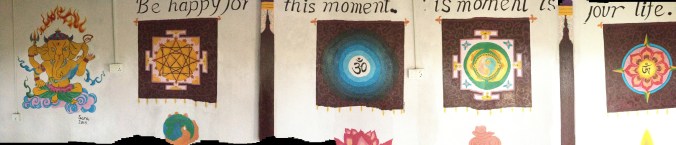
While I was staying at the eco-farm in Meghauli, Nepal, our host asked us to paint the inside of a long room he wanted to use as a meditation room. One day, when I came back from some early morning weeding, I found two of the other volunteers, Sajeena and Alba, sketching some designs for the room. They were both very good – they had come up with a series of mandalas and Buddhist knot designs, but needed something to link it all together. I suggested painting them as a row of tapestries, like I had seen in a monastery I had been staying in the previous week. So they had their link, and I felt pleased because I was able to contribute something.

But we also wanted a quote, a saying of some kind, that we could paint along the top of the wall, for people to read when they entered the room and also to think on when they were using the room for meditation or yoga. We came up with a long list, but the one we finally all decided on was “Be happy for this moment. This moment is your life.”

The job of sketching and painting the words fell to me and I took it on with enthusiasm. Sajeena turned out to be a brilliant artist – she had even brought her own brushes – and so was Alba, and the two of them got cracking on the walls while I got on with the quote. It was a companionable few days, if uncomfortable at times, because we were working in a concrete building in summer, with fans that only worked when the power was on, and the paint fumes were sometimes overwhelming. But we had many stories to share while we worked, we had music playing, and Bishnu our host would often bring us freshly cut pineapple to snack on.

While I painted, I thought about the quote that I was copying, and it got me thinking, what does it mean by ‘this moment’? And so I took a deep breath and made a list of all things I knew at that instant. To begin with, I knew that at that moment I was in Nepal, at a farm in Meghauli, painting a mural. I knew that Sajeena and Alba were also in that room painting. I knew that there were two buffalo grazing outside, because I could see them through a window, and I knew that there was a bird singing somewhere outside, because I could hear it. I knew that it was summer, and the sky was blue, and it wasn’t raining. I knew that I was warm, almost uncomfortably, but not quite, and starting to feel a little thirsty. And I knew that the time was about 2.15 in the afternoon. And that was about it. There were other things I could make a good guess at, of course – like the fact that I had family and friends who were safe and well in their various corners of the world, and possibly missing me. That Bishnu, who had just left us saying he was going into town, was probably now on his way into town. That outside in the world people were still going to work, going home, eating, sleeping, carrying on their usual lives. But none of that I could be sure of. All I could be certain of was what I could see, hear and feel in that room, at that moment. I found it incredibly grounding.

We carried on our painting, and sometimes Sajeena’s husband Neal joined us, or Sara and Justin would join us when they returned from the health post, and Sara’s partner Edgar – and so there were seven of us in there at once, and although it was hot, and sweaty, and messy work, we had good company and the satisfaction of seeing the results as we worked. After I finished the writing, I painted the pillars, in a style something like what I saw at the monastery, and helped Sajeena finish off her tapestries. The work was satisfying and engaging – I had missed that feeling of teamwork and camaraderie while I had been traveling solo, and that week was one of my favourites in Nepal.

The night that we finished the wall, we decided to have a dress up party at the farm. You know, it’s really amazing what you can come up with when resources are limited. Sajeena used a pair of tracksuit bottoms and some gloves to build a kind of octopus on her head; Alba found some banana leaves and attached them to her clothes in the manner of Eve; Sara found a sarong and tied it up like a toga and Edgar borrowed a pair of Sara’s shorts, found a wig and a tennis racquet and called himself Kournikova. It was simple, but fun, and it’s a memory I treasure.

Since that time, I have often used that quote as a kind of meditation when I’m feeling impatient or flustered, like when I’m stuck behind a slow-moving vehicle or find myself stressing about all the things I have to do and worrying about things several steps in advance. I ask myself, what do I know, what can I be absolutely 100% sure of at this very moment? And I think about where I am, what I’m doing, all the things I can see. And there’s usually plenty of good things, even if it’s just that the sun is shining and there are flowers growing along the side of the road. I find it incredibly calming, and a great way of bringing myself back to the present moment. I challenge you to try it, the next time you find yourself losing your temper, or stuck in traffic, or in a flap about your to-do list.

And if you do, I hope you will find plenty of things to be happy about. Just as, when I was dancing and playing games in a silly outfit, in the middle of nowhere in Nepal, I looked around and reflected that this moment was indeed my life. And I was happy for it.

IMG_3085

Getting on my Soap Box

It’s a common theme in country towns, villages and small communities that everybody tends to know everyone elses business, but there are usually at least some people you can rely on for confidentiality – medical practitioners, for example. Not so in Nepal.

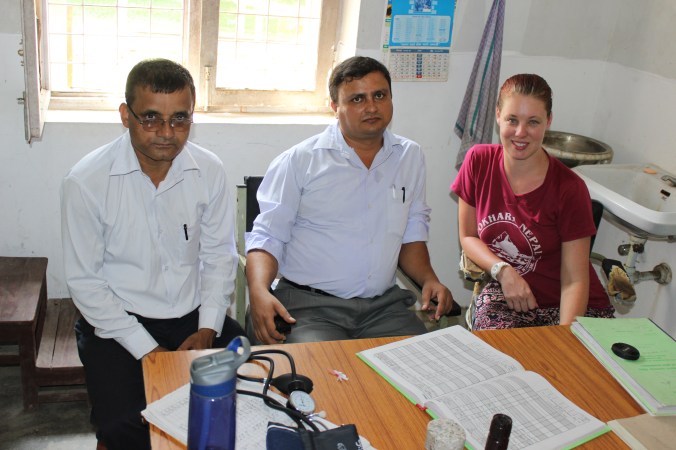
When I was staying on the farm in Meghauli, near Chitwan, there were six other volunteers who were all from Spain and the United States. Among the others were Sara, who was a qualified nurse, and Justin, a trained paramedic. The two of them were volunteering at the local health post, which was at the other end of the village. Each morning they would head off after breakfast (at whatever time that happened to be) and come back a few hours later in the afternoon, often with several horror stories about how basic the facilities were and how backwards some of their methods seem to be. (On one day, Sara came back one day in a mild state of shock after witnessing the doctor remove a boil by injecting it directly with anaesthetic and then immediately piercing it with a scalpel, so that all the anaesthetic drained out with the pus, without any chance to take effect – it must have been extremely painful.) I was curious to see the place for myself, so in the second week, after Sara had left, I headed down with Justin and we told them I was a nursing student so they were happy to have me with them.

The building looked like an old school building. We entered through a side door into a waiting room, with two ladies behind a desk and several people sitting in chairs along the opposite wall. The first thing I noticed, when we entered the doctor’s office, was that there was no door – only a curtain, which was tied up, so that the people sitting opposite the door could see straight in. There was a bed in one corner, which had a curtain that could be drawn around it, but that was the only sign I saw of any possible privacy.  From what Justin told me, people coming to the doctor had to first check in at the desk, where they had to tell the ladies there what their problem was, which the ladies would write on a slip of paper, which they then had to bring into the doctor’s office and place on his desk before going back out to wait. There were even people waiting in the room itself, so basically nothing anyone said to the doctor was private. There was also a sink in the corner, which was filthy, an old set of scales, and a ceiling fan which didn’t work because there was no power. The open window doubled as a back light for examining x-rays. The walls had been painted, but they were grimy and covered in cobwebs. A poster on the wall listed the ten most common complaints, which included mostly recognizable conditions like boils, abscesses, eczema and skin infections, gastritis, conjunctivitis, toothache and chest infections. But underneath that was a chart which listed all possible complaints with their corresponding codes, including quite a few that I’d never heard of, and some that just sounded downright alarming, like ‘Neck Floppy’ and ‘Genital User Disease’.

I was introduced to the doctor, who turned out to be a paramedic and not fully qualified. There was another man, who I think was a doctor but I couldn’t be sure as he spoke with a very high-pitched, nasally voice, and he punctuated all his syllables so much that he reminded me cartoon villain. “Aaare you from Sid-neeee?  Or Melll-boooorn?” He asked me. “My sissss-terrr lives theeeere!” I half expected him to add a sinister “mwahahahaaaaa” on the end.

So here I spent an interesting, if somewhat tedious day. The doctor (if that’s what he was) would pick up a slip of paper from his desk and call out the name, the patient would come in, the doctor would perform a few checks, and then in most cases, write a prescription. There were no individual files for each patient – instead, on his desk was a large ledger, in which he would record the patients’ name, age, caste, ethnicity, whether there was any referral, what was prescribed, and a code for whatever condition they supposedly had (I’m pleased to report that no one was suffering from Neck Floppy or Genital User Disease on that day). I say supposedly, because I witnessed some very bizarre methods of diagnosis, and even with my basic knowledge of physiology and medicine, I was sure they could not be right.

He examined a man’s ear by holding a torch about a foot away, pronounced an ear infection and prescribed antibiotics. He used a stethoscope to examine a lady who complained of stomach cramps, but held it over each spot for about a millisecond like he was doing a speed demo. He didn’t use it at all on the lady who apparently had a lung infection. Several people had their blood pressure measured, but it was never written down. Thermometers went from underarm to underarm without being wiped in between and throughout all this, patients were coming in and out of the room to bring their slips, sometimes putting it at the top of the pile if the doctor wasn’t watching (Justin was on the case, however, and moved them to the bottom). One man had a good read through all of them before adding his own to the pile, and one older woman, slip in hand, came in and sat down at the desk, glaring at the doctor as if daring him to make her wait.

What amazed me the most was that the doctor seemed to be doing so much guesswork. A child was brought in with fever and a runny nose, and without any examination the doctor pronounced that he had pneumonia. He may have been right, of course, but it also could have been so many other things. And it occurred to me, as he wrote this in his ledger, that it must be virtually impossible to train professionals and equip facilities properly if the statistics are all incorrect, which they must be. Everyone who came in, whether it be for a cough, sprain, or even a skin infection, seemed to leave with a prescription for amoxycillin, paracetamol and antihistamines. If there is an extreme opposite to the nanny state, I’m sure I was witnessing it there in Nepal.

I felt quite sorry for Justin, as I could see that there was very little for him to do. Mostly he took people’s blood pressures, and organised the slips on the doctor’s desk. I could see that he wanted to do more, and wanted to make suggestions and share ideas for doing things differently, but the staff were simply not interested. We did spend some time in a small treatment room, which was down the corridor and although it didn’t have a door, was at least at an angle where no one could see in. there was a small bed and a bench equipped with cotton and gauze, gloves, tape, tongs, iodine and saline, the basic tools for treating wounds. We dressed a few infected blisters and replaced a few dressings, then sat watching as one of the nurses re-dressed a wound in the armpit of the old lady (it was the same lady who had had the boil removed without anaesthetic a few days before). It was a hot, humid and sticky day and without the fans on it was swelteringly hot in the surgery, and I can only guess at the state of that woman’s armpit – yet the dressing was removed and replaced without the surface being dried, disinfected or wiped in any way. I would have been surprised if it had still been in place by the time the lady had walked home. Yet there was nothing we could do – as an observer, I could only watch and take note.

IMG_7703

Talking it all over with Justin that evening, I reflected on how much better their system could be if they directed their resources a little differently. So many of the complaints that people came in with were things that could be prevented with proper hygiene and basic first aid. If only they could teach some first aid, and supply households with basics like antiseptic and plasters, then so many visits to the health post could be avoided. And goodness knows how much gets spent on antibiotics, which were being handed out like confetti, and the waste of anaesthetic.

Even the young boy who stayed on our farm ended up with an infected sore on his leg from where he had fallen off his bike and scraped it. His mother, who was a very good cook, clearly lacked knowledge of how to treat it, and it was left uncovered for several days until he came down with a fever, at which point Justin marched him down to the health post, dressed it and wrapped it up as tightly as he could with strict instructions not to touch it. As far as I know he recovered with no problems, but it should never have been that bad, and it was not the only case we saw – in that one day at the health post I saw several infected blisters which had been left uncovered in hot and humid conditions until they became too painful to walk on, and then they had no choice but to visit the doctor. There was one story, of which I will spare you the most gruesome details, of a man who had developed a nasty boil between his buttocks. Poor Justin had to lance it, dress it, and then change the dressing each day for several days afterwards. Justin, who was highly disgusted by the whole thing, reported that the man had returned each day in the same clothes as the day before. Recall what I said about the hot and humid conditions, and you might get an idea of how the boil came to be there in the first place.

I felt very sorry for Sara and Justin who had come to Nepal to help, and found their ideas and suggestions falling on deaf ears. It must have been very frustrating. I found it saddening, and enlightening at the same time – for it was here, more than anywhere else in Nepal, that made me fully appreciate the value of a decent education and a proper health care system – things that we often complain about, and nearly always take for granted. And thanks to Justin, I will never again underestimate the benefit of a simple change of clothes and a bar of soap.