It was a bright but cloudy Friday morning when I set off from the East Dart Hotel in Dartmoor, and tempted as I was to stay another day and explore the moors a bit more, I had plans for other things, and so I decided to get going. My original plan was to drive to Tinatgel and explore the castle ruins on that day, but as it happened, I got distracted by other, equally fascinating things.
First of all, I headed south towards Plymouth with one destination in mind: the Black Friar’s Distillery, makers of Plymouth Gin. I have toured plenty of wineries, breweries and whiskey distilleries in my travels, but never a gin distillery, and although it was a slight detour, I wanted to go and have a look.

I’m pleased to say it was definitely worth the side trip. The building, with its very seaside-looking white façade, is tucked in between market shops and cobbled streets in an area called The Barbican, close to the harbour. Quaint though it is, there wasn’t much in the way of parking and by the time I found a space and made my way back to the shop, I had just missed the start of the tour. That was no trouble though, as the very friendly staff member ushered me through a series of locked doors and onto the back of the tour, and told me, very trustingly, that I could pay afterwards. Isn’t it just nice when that sort of thing happens?
The tour turned out to be quite fascinating, although the poor girl giving it had to talk at about 500 miles an hour to cover it all in 40 minutes. I kept expecting her to blow a tire. But anyway, from her I learned that the building has existed since 1431, and was first used as a monastery, hence the name Black Friar’s. The monastery was closed after the disillusion of the monasteries and it was converted to a distillery in 1793. After this very speedy and condensed history lesson we were escorted into the distillery room which has so much alcohol vapours wafting around that we had to turn off our phones and touch an earthing bar on the way in. Inside were three enormous copper vats, two of which are used for making gin, and a third, which no one has any idea what it’s for or how it came to be there, a fact which I found highly amusing. They don’t know how long it’s been there either, as most of their offices, along with all their documentation, were bombed during the war – fortunately they missed the distillery itself. It’s possible that it was brought in to make vodka during the war, but as they have no records, they can’t be sure. They can’t get rid of it either, as it would cost too much. So if there’s anyone out there who wants an enormous Victorian copper vat, and is willing to go and collect it, it’s yours for the taking – or so we were told!
From there we were given a lesson in botanicals and smelling dried things in small jars, all good fun, especially as we had some gin to sample with it. There were lots of other facts and figures all imparted at top speed and most of which I’ve since forgotten, but here’s an interesting fact I did retain – Plymouth Gin have been suppliers of gin for the Royal Navy almost since they opened, but rather than the regular 41% gin, they get the special Navy Strength Gin which is 57% – a significant difference. Apparently this is because once upon a time, barrels of gin were stored on the same level as the cannons, and the lower strength gin would ruin the gunpowder if it spilled. But at 57% – apparently – the alcohol content is high enough that the gunpowder will still light, even if it is doused in spirit.

We finished the tour with a gin and tonic in the Refectory bar, which has a very stunning, partially restored wooden beam ceiling. By the time I finished I was feeling quite relaxed, not exactly in a hurry but keen to get on with my sight-seeing. I drove out of Plymouth, across the Tamar bridge and into Cornwall.
I was heading in the direction of Tintagel but there were a few things I wanted to check out along the way – the first was a small stone structure which I found in one of my guidebooks, which turned out to be another gem well worth the detour. Dupath Well Chapel is a small chapel built over a spring, although apparently it’s quite a large example of its kind. It’s in the middle of a farm, in a small fenced-in field now run by English Heritage. I had to park outside a barn and walk down a short driveway to get to it, feeling like I was intruding on someone’s back yard, but eventually I walked around a corner and there it was, stunning and peaceful, completely out of place and yet eerily separate from the modern life that’s sprung up around it.
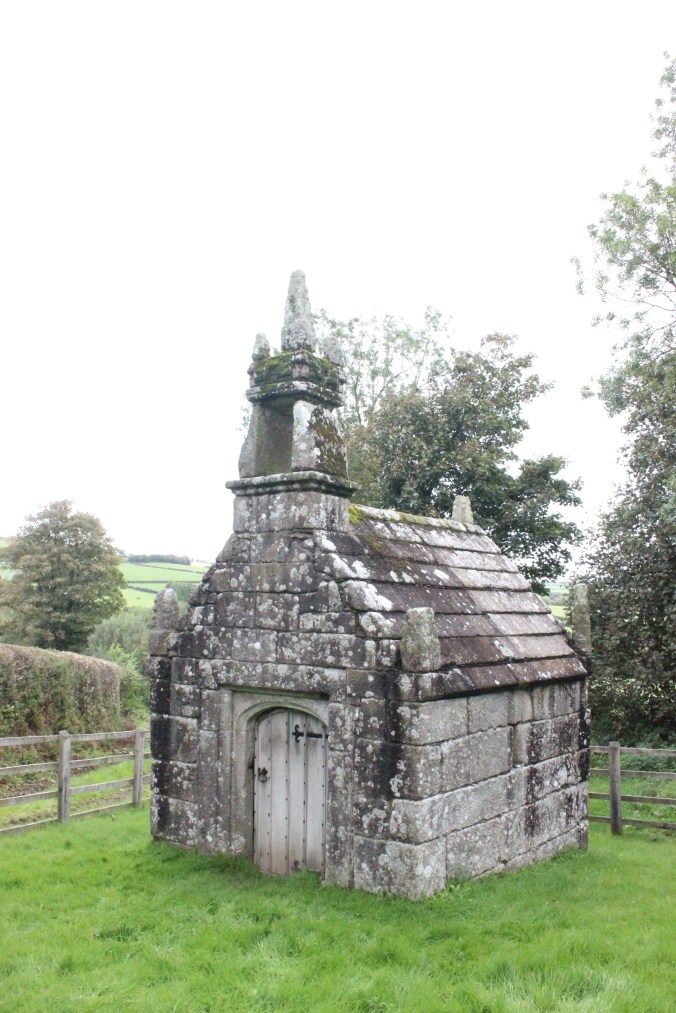
The spring, which has probably been a place of worship since celtic times, is apparently the site of a famous duel between two Saxons, Colan and Gottlieb, who fought over a woman and both subsequently died – or so the legend goes. The current building is thought to have been built by some local Augustinaian monks in around 1510. It’s a simple structure of Cornish granite, with a pretty canopy and bell tower above the door, and I found it utterly charming. I wandered around it, then wandered in and sat down for a while. I leaned against the cool stone feeling as though I could have sat there for hours, as the sunlight slanted in through the narrow windows and the water trickled in merrily – but I had more places to go, so I got up and set off again, feeling grateful that there are still such evocative and untouched places in the world.

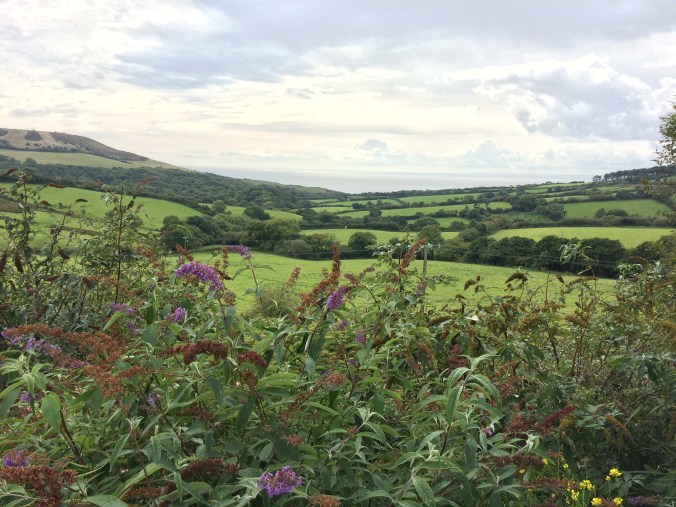
My next destination was Bodmin Moor, but I took another stop on the way to enjoy an essential local delicacy – a Cornish cream tea! Because of my detours the day before, I missed out on one in Devon, but I was determined not to miss out in Cornwall! I found a café up on top of a hill and sat enjoying my scones, taking care to do it the Cornish way – jam first, then cream!! I had given up my plan of making it to Tintagel that day, so as I sat there, looking out over green fields, criss-crossed with their darker green hedges, I felt as though I had all the time in the world – and the rain drizzling down steadily didn’t dampen my spirits at all.

From there I drove to the Village of Minions on Bodmin Moor. The highest village in Cornwall, almost all of it was built within a twenty-year period between 1863 and 1880 to service the local mines, quarries and railway. From its centre you can still see the pump houses and other buildings dotted around the surrounding hills and fields, all in various states of disrepair. These were not what I had come for, however – I was looking for the Hurlers – in other words, another pile of ancient rocks.
I found a car park which had a lot of fields and walking trails leading off it, but couldn’t find any kind of signpost, map or notice anywhere, so I employed my trusty method of heading in the same direction as other people. I wandered around for a while over the pretty but soggy moor before I found them, and what a sight they are. The Hurlers, one of the largest prehistoric sights in Britain, are a series of three stone circles linked by a 2-metre-wide pathway on a large, flat bit of the moor. According to local legend, some men were out on the moor on a Sunday playing an ancient game called hurling. As a punishment for playing on the Sabbath they were all turned into stone where they stood.

It’s hard to describe, after the fact, just how mysterious and amazing these stones are. Archaeologists date them to around 1500BC, and believe they were originally all cut to the same size and shape, with a quartzite crystal floor in the central circle. Most of the stones are still there, though some are now much smaller and most of them lean drunkenly one way or the other. There’s no trace of the floor, but from the middle you can see a clear trail of upright stones leading off in one direction and reaching up to the Cheesewring – another gravity-defying stone formation – in the other.
As I approached them and wandered into the first circle, the rain stopped and the sun made a rare appearance, giving them a mysterious and colourful glow. Once again I marveled at the industriousness of our bronze age ancestors, and felt a kind of awe at the faith they must have had in whatever it was they believed in. I wondered what kinds of rites and rituals could have been performed here, what occasions and ceremonies had these stones stood witness to?
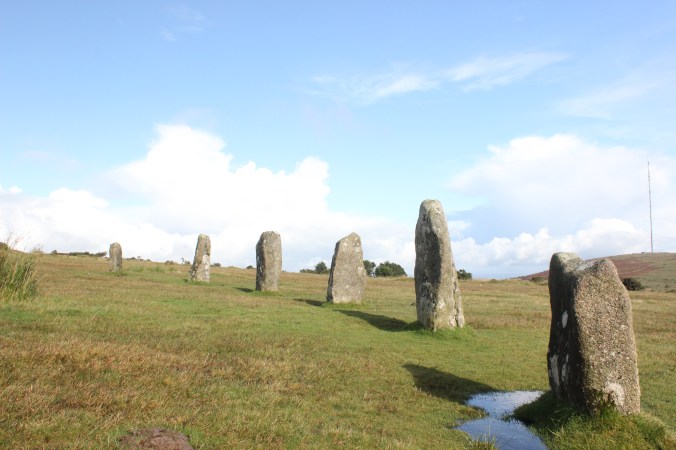
Like the stone rows and formations at Dartmoor, the Hurlers aren’t restricted in any way. They’re just there, standing silently on the moor, for anyone to approach, touch, appreciate. I walked around them for a little while, then squelched back to the car feeling quite satisfied. The Hurlers, I decided, where well worth getting soggy feet for.
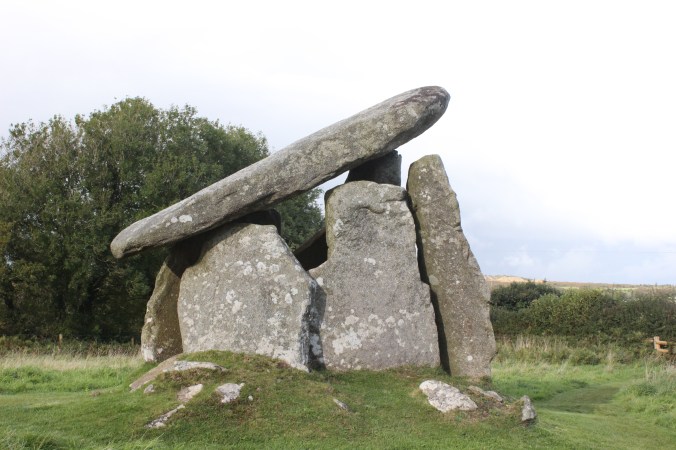
There was just one more stop I wanted to make that day – although I was very tempted to drive towards a village called ‘Harrow Barrow’, purely out of curiosity – and that was to yet another ancient monument: Trethevy Quoit in the village of Darite. It took me about ten minutes to drive there, and I pulled up in a tiny layby on the top of a very narrow and windy road, with no clue as to anything remarkable being nearby except a small brown sign with the English Heritage logo and an arrow on it. I followed the sign across the road and through a kissing gate, stepped up into a field and there it was – one of the largest Neolithic burial chambers in the country.

Like the other monuments I’d been looking at, it was not restricted in any way – it was just there, standing at least twice as tall as me, with its large side stones and even larger capstone, which sat at a jaunty angle and gave it the appearance of an oversized outhouse. Originally, most of it would have been buried by a mound of earth, but that has disappeared leaving it mostly exposed. Right next to it is a row of houses, and several of the locals passed by with their dogs, taking no more notice of it than if it were a peculiarly shaped tree. It really was quite remarkable.
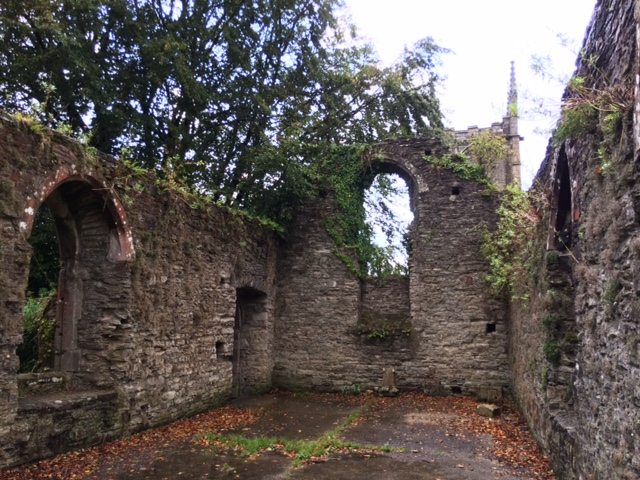
I stayed that night in a small pub in the village of Bodmin, which unfortunately didn’t serve meals, so the girl who showed me to my room sent me to a nearby pub called the Weavers. It was drizzling again, but not cold, so on the way I took a detour around the local church where I discovered yet another ruin, this time most of the walls and floor of an old chapel. The evening light reflecting off the wet stone made it pleasingly atmospheric, and once again I felt a deep gratitude for ancient builders and unexpected discoveries.
My dinner that night was disappointing, but well supplemented by the local lager, Korev (the Cornish word for beer), and I enjoyed the company of a lively boxer called Dixie, who was in a much more sociable mood than her owners. Although I missed the company of the East Dart Hotel, I couldn’t help feeling, as I hopped into bed later, that it had been a full and satisfying day. And although I hadn’t made it to the place I’d originally been aiming for, where I had been had definitely been worth the side trips. And I was definitely going to Tintagel tomorrow.






 karleenstevens.blog