Those of you who are familiar with the legend of King Arthur will know that there are several versions of the story – however, you will also know that they all begin in Tintagel. Tintagel, or so the legends say, is the place where Arthur was conceived, thanks to the magic of Merlin. There is, of course, no evidence that any King Arthur ever existed, or that any king or Arthur is linked to the place we now call Tintagel. But standing there, on the windswept headland and rocky outcrops on the exposed north coast of Cornwall, it’s easy to see how so many legends have sprung up about this place – mysterious caves and waterfalls, dramatic sea and skyscapes – and the fact that much of the evidence of human settlement has, over time, been claimed by the sea.
Let’s consider the facts of this place. Some sort of settlement existed here during the dark ages, probably the residence of some local Cornish ruler. Archaeological evidence suggests the site was in use from the 5th to 7th centuries, and trading with ports as far away as Greece and Turkey – but by the 8th century it seems to have fallen into ruin. A few centuries later, in about 1138, Geoffrey of Monmouth wrote his History of the Kings of Britain, and in it, he mentions a King Arthur, a ‘youth of unparalleled courage and generosity’ and victorious battle leader. He places him in sixth century Britain, where he was apparently conceived in an island fortress named Tintagel. Roughly a century later, in 1233, Richard, Earl of Cornwall (younger brother of King Henry III) bought the headland, had his castle built on it, and called it Tintagel – probably to associate himself with the legendary king and knight of old, as there is no evidence that this piece of land is in fact the Tintagel mentioned in Monmouth’s essay. The ruins we can now see on this sight (and there are still plenty left) are the remains of Richard’s castle.
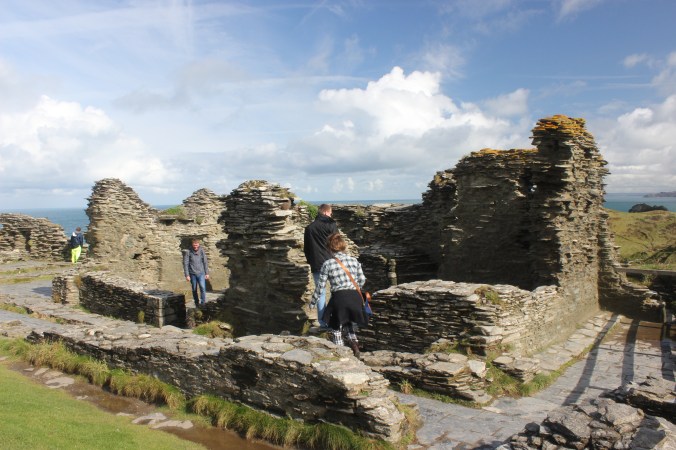
The site is now run by the National Trust and despite the fact that tourists arrive busloads at a time, it’s still worth seeing. To get to it, you have to park in the village and then either walk or pay for a jeep to take you down a long driveway. I arrived on a Saturday morning just before it opened and snuck past the first load of tourists who were still at the top of the driveway, presumably getting their ‘you’re about to see a historical site and let me tell you all about King Arthur before we go down’ talk – I can’t be sure though, as it was in German. But anyway I felt quite pleased with myself for getting there first, and as I had no time limit on my visit – and I was cold – I went first to the café and treated myself to a coffee. Then I went exploring.
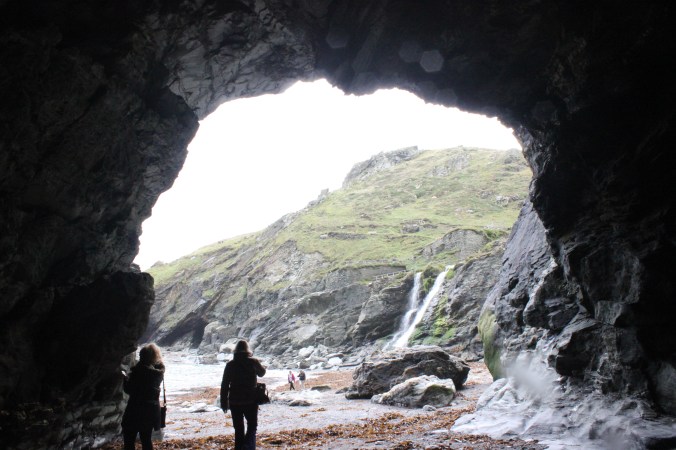
The Germans by this time were heading up to the cliff top so I headed down to the beach. It’s a marvelously secluded cove, with two small headlands reaching around it like arms with the cliff face at its back. On one side a waterfall tumbles down joyfully, and on the other is Merlin’s Cave, which I wandered into as the tide was low. The most popular story of the conception of King Arthur is of the King of Britain, Uther, who fell in love with Igraine, the wife of Gorlois, Duke of Cornwall. When Gorlois was away, fighting Uther’s army elsewhere, Uther, disguised as Gorlois by the magic of Merlin, stole into the castle and seduced Igraine. There is another story, however, of Merlin finding the baby Arthur washed up on the shore by the sea.
Standing in the cave, I could easily see how it has inspired such legends. It has a wide opening, exposing a rocky floor and walls which glistened in many colours, but would be mostly submerged during high tide. In the distance the walls tapered to another opening, leading out of the rock to the south, but it was cut off from the beach side by water. From inside the cave looking out, I could see mostly sand and the cliff face, and a small piece of the sea, hinting of far horizons. I could hear water tricking down the rock surfaces, and the wind whistled in and echoed around the cave, hinting at fiercer weather to come.
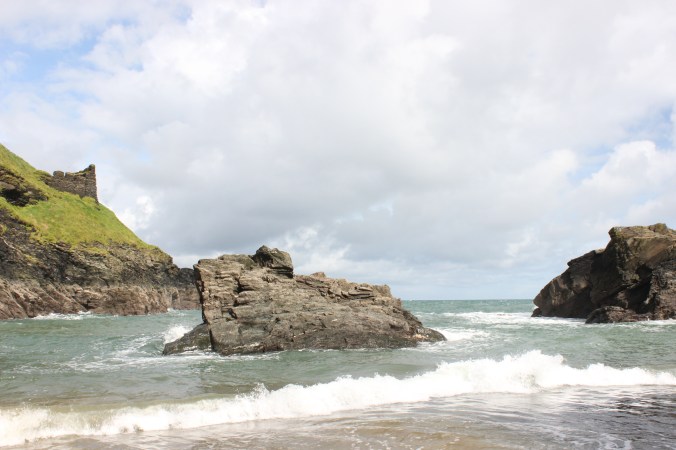
By this time the tide had started coming in, and several more people had ventured down, so I headed back up again to explore the castle ruins. The sun was out, and quite warm by now so I removed my middle layer – a woolly jumper and tied it round my waste. I had chosen wellies that morning and was feeling a bit uncomfortable in them by this point, but I was determined that nothing would bother me – the sun was out, I had plenty of time, and I was exploring the birth place of King Arthur (or so I imagined for the time, since it was much more interesting than imagining it as the never-visited castle of an Earl with a younger-brother complex.
I headed up to the headland and over a modern bridge, built fairly recently as most of the bit of land connecting the headland to the mainland has now collapsed into the sea. Up some more steps, through an arched gate, and I emerged into a stony courtyard, and in front of me stood the remnants of a medieval great hall. Not much is left except the foundations and a few walls, but it’s enough to get an idea of what it would have been like to live here, in this exposed and dramatic setting. It is grand, and intimidating – I could almost imagine sitting in the great hall, with its rough stone walls, probably hung with tapestries, huddled around a fire, and through the small windows hearing nothing but the wind, and seeing nothing but endless, churning ocean.
I spent an hour or so exploring the top of the cliff. There were rows and rows of stone foundations, mostly small rooms which may have been store rooms, stables, or cottages. There were remains of a small chapel, a well and a tunnel through the rock face, its purpose unknown. Perhaps most intriguing was the walled garden, associated with another legend: Tristan and Isolt. It was supposedly in this garden that the two met in secret, away from Isolt’s husband, Mark of Cornwall.
I could see clouds coming in as I wandered around the old settlement, but I didn’t want to miss anything so I crossed my fingers and headed up to the other side of the cliff, to some more buildings, in much more preserved condition, that are believed to be former guests quarters. I was up there when the rain hit, and there was absolutely no cover whatsoever. I whipped my jacket off to get my camera underneath it and got quite wet in the process, then dashed behind one of the higher walls for cover, where I found a couple having a raging argument about something, probably who forgot to pack the umbrella. I waited a few minutes hoping that either the rain or the couple would let up, but neither did, so I decided there was nothing for it but to head back down.
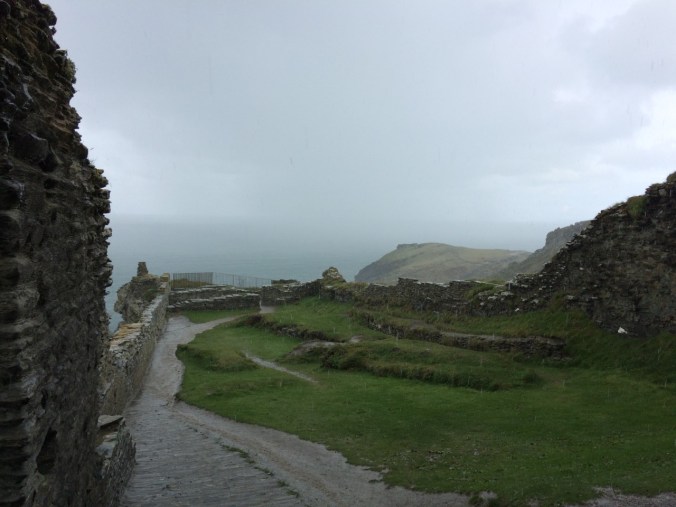
I arrived in the gift shop dripping wet but with dry feet, and a dry bottom thanks to the woolly jumper that was still around my waist. There were several others there who had clearly made wrong shoe choices that day. Feeling a bit pleased with myself, and now that the rain had finally stopped (mostly), I walked back into the village, where I found a satisfyingly hot Cornish Pasty for my lunch.
I spent the afternoon wandering around the village, which was quite charming and full of the kind of gift shops that sell what I call ‘hippy stuff’. Dragon statues and fairy dust, incense and crystal charms, celtic pattern jewellery and every kind of fortune telling you can imagine. I felt quite at home – apart from the wet clothes. I stopped in a pub for a quick change and a swift half and used my mobile phone to find a book a room for the night in a nearby town called Wadebridge – the wonders of modern technology! Then I headed off from Tintagel.
I had an interesting evening in Wadebridge. I checked into my pub and then went for a walk to see the bridge which gives the town its name. Supposedly it’s famous because it has 17 arches, although I could only count 13. I grabbed a very nice fish and chips from a restaurant called Barny’s, then headed back to the pub for a drink or two before bed. Unfortunately, it was a Saturday night, and by this time the pub was already full of locals and from the look of things, several of them had already been there a while. No sooner had I sat down to enjoy my ‘Cornish Best’ than there was a polite but slightly crossed eyed local at my elbow. “You can’t be sitting here on your own? Are you sure you’re alright? My name’s Karl – you have amazing eyes!”
Karl and I had that conversation several times before one of his friends called him away, then within 5 minutes he was back again, ordering everyone a round of drinks, including me. Fair enough, I thought, although the conversation was starting to get a bit repetitive by then. “No really, I’m fine, yes, perfectly alright, thank you. Yes – thank you.” Eventually he dragged over to sit with a group of locals at the end of the bar (because I couldn’t possibly be fine sitting on my own), where I learnt that Karl was generally accepted to be the ‘Village Drunk’ and was here doing the exact same thing every weekend. I couldn’t decide if that made me feel better or not.
The group of locals was very polite and put up with me graciously, but once I had finished my drink I decided it was time to make a discreet exit. I made a quick trip to the pub’s bathroom, which was a mistake, because no sooner had I sat down than I heard an almighty clattering in the next cubicle, followed by a series of “oooooh”s and “aaaaah”s that were so loud that indecent is the only adjective I can come up with. I came out to wash my hands and discovered, to my dismay, quite possibly the largest woman I have ever seen, sitting with the door wide open and skirts not quite pulled up enough to hide the underwear around her ankles. I washed my hands as quickly as I could, looking nowhere but straight ahead, and dashed upstairs, where I had a very long, hot shower and reflected that I probably wouldn’t come back to Wadebridge again.
 karleenstevens.blog