I arrived in Rome on a sunny Sunday afternoon in June, and by plane, train and bus eventually arrived at my accommodation in Esquilino, one of the seven hills of Rome. The accommodation, which I was expecting to be a hotel, in fact turned out to be a small two-bedroom apartment, run by a very friendly Italian named Carlo. He showed me my room and told me proudly that it had been his own room during his college years, and I could easily believe it, as the apartment had a distinctly homey feel about it. My room was bare apart from a desk along one wall and a bed along another, which was incorporated into a wardrobey cupboard-like structure which was probably home-made. A small glass-paned door opened out onto a small balcony – or at least it would have if the balcony had not been covered with boxes and outdoor furniture and everything you would expect to find in a downstairs storeroom or garage. I peered through the various boxes and mop handles and I could see three more walls of an enclosed courtyard dotted with shutters and hanging plants and lines of washing running from one window to another.
The rest of the apartment had the same homey feel – there was a small kitchen stocked with biscuits and coffee, with one of those very clever dish racks that hides in the cupboard above the sink so all the drips go back in again. In the living area there was a couch along one wall with a cover thrown haphazardly over it, in the corner was a small desk with a computer on it and the table in the middle sported a bright orange table cloth and a bowl which had everything in it from fruit to keys to the television remote. Taking up an entire wall was an enormous cabinet of many doors and panels, full of books and videos – including vhs’s – umbrellas and crockery, old mobile phones, bric a brac, stuffed toys and goodness knows what else. But my favourite feature of all was the large window that looked onto the street outside. It had two panes that opened inwards, two shutters that opened outwards and a large windowsill which was the perfect height for leaning on. I stood at the window, after Carlo had left, gazing down onto the Roman street below. It was Sunday evening so there wasn’t much going on – most of the businesses were closed and shuttered but I could still hear people shouting to each other across the street and the energetic vroom of the Vespas zooming by. It occurred to me as I stood there, looking out at real Roman life from my apartment that already felt like home, that I would quite like to stay there forever.
On the other hand, I had a city to explore, and at 5.30pm on any day Rome starts to come to life again, so I grabbed my camera and off I went. Carlo had pointed out to me that as it was the first Sunday of the month, most of the museums would be free to enter, and therefore would have long queues and large crowds and were probably best avoided. So I figured I would spend the evening wandering around, have dinner somewhere, perhaps go and have a look at the Trevi Fountain or some of my other favourite places.
I was staying quite close to the Colosseum and I knew my way into the centre from there so I headed off in that direction. It appeared as I emerged from between two buildings onto the main road, and I stopped and stared at it for a few minutes, comprehending that finally, I was really, truly in Rome again, and here was the Colosseum, real, solid, and looking as though someone dropped it into the wrong box of building blocks. I’ve seen it so many and times and yet still I find it awe-inspiring and impressive. Not as a symbol of the power and might of the Roman Empire, as I’m sure it was originally intended to be, but as a feat of engineering – it’s a marvel to me that they even got it up, let alone that it’s still standing. And despite its size and its purpose to intimidate, it’s still a work of art. The arches are all in perfect alignment and perfectly curved, the marble (at least the marble that’s still there) is polished and shiny, and the whole structure has a lovely symmetry. Even in the columns surrounding each level you can see careful decision making, with the plain but steady Doric columns supporting the bottom level, the prettier Ionic scrolls on the second layer and then the intricate Corinthian columns gracing the top two levels. There is no questions that master stonemasons were at work here.
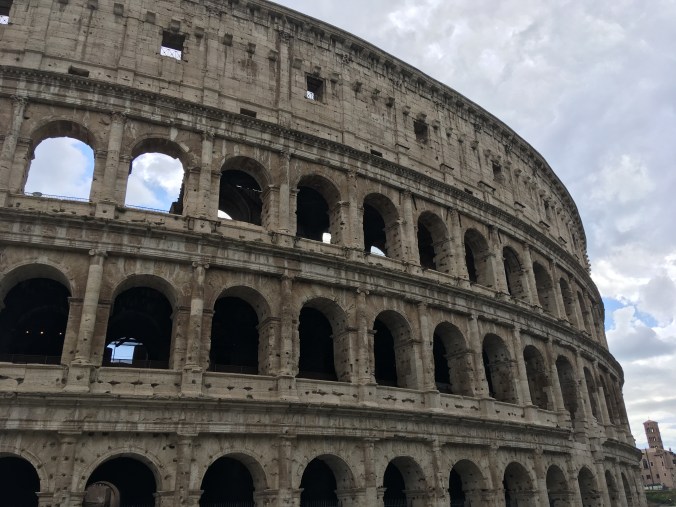
The Colosseum – look for the Doric, Ionic and Corinthian columns
And of course there’s the sheer size of the thing. It’s not that much smaller than a modern-day sports stadium, standing proud in its piazza and looking much shinier than what remains of the Forum and Palatine Hill nearby. From the outside you can see entrances into the stadium everywhere – several on every level. In fact it was so efficiently designed, and each Roman knew his way in and out so well that the entire stadium could be filled and them emptied again in a matter of minutes – a feat no modern day sports stadium has been able to achieve.
As I walked past the single entrance that is now used for members of the public, I noticed a notice, which said ‘Free entrance today’, or something like that, with a very small queue behind it. So I decided, even though I had not planned to visit the Colosseum on this trip, that in fact I would – it was 6pm and it would be open for another hour, which was plenty of time to have a good wander around before dinner.
It had been years since I was inside the Colosseum and it was much as I remembered it, apart from some workmen in bright yellow vests who were setting up some kind of rigging that looked like a lighting set for a concert of some sort. Tourists can walk all the way around the arena on two different levels, but the floor is off limits – mainly, I suppose, because most of it isn’t there – instead there’s a tiny bit of floor (which was covered in workmen and rigging) and the rest has been removed, so that you can see underneath to the maze of rooms and tunnels where gladiators, slaves, starving animals and all the other condemned once trod. You can see, as well, where the trap doors in the floor must have been, where they were stepped out to face their doom (which sounds very dramatic, but believe me, it was). Once again I was impressed by the level of engineering of the Romans as I set off around the ground level.
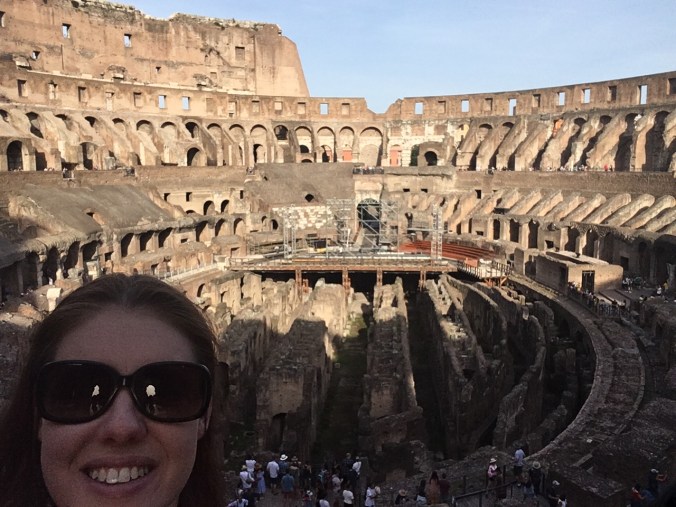
Colosseum Selfie – it had to be done.
The sun was getting low in the sky by now and half the arena was in shadow, but the other half was giving off a lovely brown-orange glow with a bright blue sky behind it. There’s no denying its slightly decrepit state, nor its gruesome history, but nevertheless it’s still an impressive picture. I tried to imagine what it must have been like in the days of the empire, with its marble columns and flooring glistening under the hot roman sun. Perhaps it would have looked like an enormous Jacuzzi. Some of the marble is still there – one section of steps has been preserved and fragments of columns still lie scattered about – but most of it now adorns the front façade of St Peter’s Cathedral and the ridiculous jelly mold lookalike that is the Victor Emmanuel monument. Here and there bits of original marble flooring can be seen under the dust and the trample of tourists. As I walked past one such bit of old floor, a girl in her twenties scuffed it with her foot and said (in an accent I shall not name) to her companions, “Do you think this would have been marble at some point?”, at which point, I made off hastily in the other direction.


Up on the second level, the view is just as much about what’s outside the Colosseum as what’s in it. Making my way around from arch to arch I could see out over the Via dei Fori Imperiali, heading off into the centre of Rome and busy with tourists and locals alike heading back and forth, and which was currently blighted by a long row of scaffolding, hiding the construction of a third underground line. A little bit further around I was looking out over the forum, a row of jagged columns sticking up into the sky in sharp silhouette before the setting sun. Around a bit more is the Arch of Constantine, built to impress but looking slightly diminished from my lofty position, and beyond that down the Via di San Gregorio which passes the ruins of the Palatine Hill on its way to the Circus Maximus, the ancient racing arena. Truly, in Rome, you can’t look anywhere without seeing history.

I finished my circuit of the top level and headed back outside. It was too late now to go through the forum, so instead I followed those tourists heading into the centre along the Via dei Fori Imperiali. Quite a lot of the forum is visible from the road, and excavations have come a long way since I was last in Rome. I took my time, stopping here and there to listen to buskers while I looked out over the ruins, admiring the different coloured marble reflecting the evening sunlight. Sadly, the four large maps showing the expansion of the Roman Empire (a gift to Mussolini from his old pal Hitler) were also behind scaffolding, but there were plenty of information boards and placards for me to read along the way, which may or may not have been there on my last trip – I couldn’t remember.
I took the familiar route past the enormous Victor Emanuel monument (which I personally feel well deserves its nickname of the Typewriter, and can never be forgiven for its sourcing of construction materials – but that’s another story), through the Piazza Venezia and down toward the Trevi Fountain. I heard it before I saw it, even over the buzz of the tourists, as I emerged into the floodlit and crowded square. There it was, unchanged and enchanting, just as I remembered it. I stood at the top of the steps leading down to it and leaned on the railing for a few minutes, watching something that resembled a production line of tourists tossing coins and taking photos. Suddenly I felt tired and hungry, and knowing that I had two more days to come back and enjoy it properly, I headed off to find my dinner.
I found a restaurant called Le Lanterne which was on my way home and took a table outside where I could watch people going by. I impressed myself by managing to order a pizza and a beer in Italian, and sat and ate them as the evening turn to night, and a wandering accordion player stared entreatingly at the passing tourists. I wandered home back past the noisy roadworks and the Colosseum, which was now floodlight and glowing against a midnight blue sky. Before I went to bed I opened the shuttered window in my apartment and looked down to road below. A familiar night time hush had settled over it, broken only by the odd whine of a Vespa or friends calling goodnight to each other. As I closed the shutters I wondered to myself, is there any better place to be on a warm summer’s evening than in Italy? I couldn’t think of one.

Pizza, beer and a Fiat 500 – what more could a tourist want?
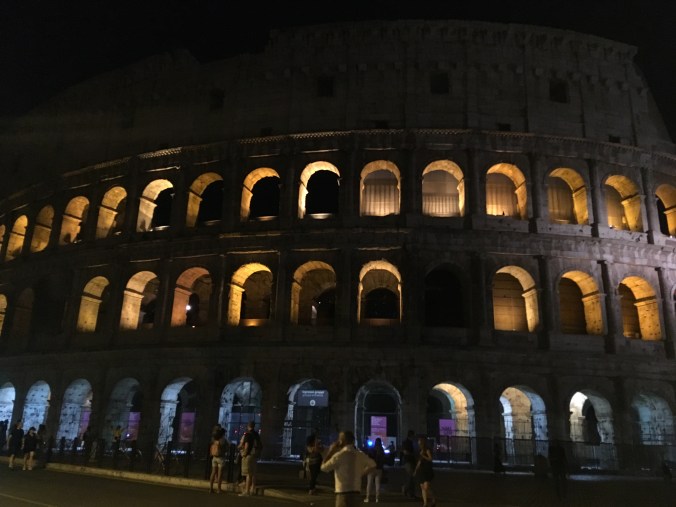
Floodlit Colosseum
 karleenstevens.blog