Rome really is a remarkable city. At a glance, it is busy, dusty, noisy and chaotic. Too many tourists crowd into too-small spaces, bustling and jostling for the best selfie spot. The sun glares down and bounces off the tall stone buildings, unfiltered by balconies or foliage to hit you right in the eyes. Traffic is relentless, cars and mopeds swerve and dodge this way and that, honking and screeching as they zip around startled pedestrians. Road works and metro line extensions add to the general pandemonium. But it is, at its heart, a real, working, Italian city. It doesn’t just exist for the tourists and shoppers. It’s a living, breathing metropolis of life. This is a fact that I never fully appreciated about Rome, until my most recent trip, which was the first time in 20 years that I went there just for a holiday. I woke on that first morning, to the bleeping of my alarm, and gradually the distant sounds of traffic and the workday morning filtered through to my consciousness, and warm sunshine slanting its way through the window beckoned me to get up. I made myself a coffee (the Italian way, with the caffetiere on the stove – for reasons no one can explain, this way always tastes the best! – pushed open the window shutters and let the city come clamouring in. There were the early commuters, sitting outside on the grey pavement, taking their time over their morning coffee, and there were the ones who strode in and stayed just long enough to gulp their espresso and then were on their way again. The steady whirring of the machines from the laundromat across the road. The metallic clatter of roller shutters going up, a sound universally associated with the beginning of the working day. The odd car or scooter zoomed by, people called or shouted to each other from one side of the road to the other. To the left and right, straight, tall buildings like the one I was in stretched as far as I could see, and as I stood there, an observer watching the city come to life, I fully appreciated, for the first time, that Rome was a proper city. It was fascinating, and somehow comfortable – like staring at a painting that makes you feel nostalgic without really knowing why. I could have stayed and watched for hours, but I had a city to explore, so I grabbed some biscuits (the kind that Italians have specifically for breakfast, so it’s allowed) and set off on my way.


I had big plans for the day! I wanted to explore the Forum this morning, but there was a quick stop I wanted to make on the way – at the small but intriguing Basilica di San Clemente. I arrived just before 9am, and I was the only visitor apart from a group of tourists who were sitting very obediently in the pews to the right of the entrance, while their guide chatted at them in Spanish. I set off around the church in the other direction, admiring the gold guilt ceiling decorated with the papal mitre and key symbol, lambs and other emblematic heraldry. It wasn’t long before the part I really came to see was opened up, so I headed on over to a tucked-away corner of the church and down a flight of cool, stone steps to a medieval church hidden underneath. I say hidden, although in it’s time it would have been at ground level and open to anyone, but at some point in its history it vanished under the many layers of Rome (and the new basilica on top of it) and was forgotten. I was just setting off to explore it when the group of Spanish tourists appeared on the steps behind me, chattering loudly, so I changed my plan and headed down yet another staircase, more narrow and rickety this time, to the very bottom layer of the Basilica, a 3rd century house complete with Mithraic temple.
But what on earth is a Mithraic temple? The ancient cult of Mithras was dedicated to the Persian god of the same name, often depicted slaying a bull. The temple is small but well preserved, with long stone benches cut out along each side and a small stone statue, about the size of a small doll, on display at one end. It reminded me a little of similar rooms in the temple of Abu Simbel in Egypt. It’s dark, underground setting gives it the feeling of a forbidden cult, but at the time it would have been at ground level, with plenty of light coming in, and as it was in the days before Christianity it was considered perfectly acceptable. The rest of the level contains the rooms of an old roman house, probably owned by a wealthy family, according to a priest-guide who was showing an American lady around and who I was trying to listen to without looking like I was trying to listen (she shot me a few disapproving looks, but what can you do). Considering its size, its proximity to the Colosseum and the fact that it has running water, in it’s time is was probably considered very comfortable!
I headed back up to the middle level which had a few more people in it now, but thankfully the Spanish group had gone. This middle layer, a church in use from the 9th – 11th centuries, feels a little bit like a cistern, with its low ceiling, columns and the sound of running water. It’s laid out like an enormous square courtyard with long stretches of ‘corridor’ separated by Romanesque style arches and columns. Astonishingly, there are several wall frescoes still intact, in various conditions – some are easily recognisable as images of Christ and the Apostles, others are now just faint outlines and patches of colour. It’s amazing that they are preserved at all, considering the humidity from the spring running underneath.
Satisfied with my sojourn in the three-layered temple, I stepped back out into the sunshine and headed towards the Forum, stopping on the way for a quick coffee and to grab a pannini for later. It was now about 10am on a Monday morning, and the Via Dei Fori Imperiali was a hive of activity. I retraced my steps from the evening before down past the Colosseum, until I got a glimpse of the newly revealed forum in the daylight. It really is quite vast, and amazing that so much is still being uncovered. There were in fact several, separate forums – one each for Juluis and Augustus Caeser, Vespasian, Nerva and Trajan – as each emperor expanded and built on the previous emperor’s effort, and together they make up one enormous public space. This time I bought a ticket and went in, guidebook in hand, to rediscover this remarkable space.


I had been in the forum once before, when I was training as a tour manager. I remember standing in a group with my fellow trainees, clipboards in hand, propping each other up as we listened to our guide droning on and on about ancient Rome. I took in enough to appreciate that it must have been very interesting, but not much more. Standing in the forum today, fully refreshed and not a clipboard in sight, it occurred to me that I must have been even more tired than I thought – because I couldn’t remember any of it!
Never mind, I thought, because I had the whole morning to explore. I wandered past a big, square building that was once the senate house, open spaces that were once market squares where men exchanged news, goods and money, now exposed to the glaring roman sun but would once have been enclosed with shady marble colonnades. Scattered bits of broken columns lay here and there, succumbed to the effects of time and upheaval, while others remained upright, remains of ancient temples still standing defiantly. I stopped to top up my water bottle and sat down on an old bit of column, pondering how much of the world’s history was made here. Decisions about war, money, language and religion – some that still influence the world today – were made in this space. It’s really quite mind-boggling.


By far my favourite spot was the temple of the Vestal Virgins. It’s a long, rectangular space, exposed now although it would have been a lovely, enclosed space shaded by trees and with lovely, clear pools and the sound of water. It must have been a blessed retreat, from the heat as well as the hubbub of the rest of the forum where the men went about their business. The role of the Vestal Virgins was to tend the eternal fire in the nearby Temple of Vesta, which had to be kept alight for the good of Rome. They lived a relatively privileged life – often coming from wealthy families, they came as young girls and were obliged to serve – and remain chaste – for 30 years. After that, they could marry if they chose to and could even own property. It was a considered a great honour in Roman society to have a daughter initiated into the Vestal Virgins. They lived in small rooms surrounding the courtyard, and I could just imagine that in the heat of the day the coolness of the courtyard with it’s trees and pools would have felt like an oasis in the centre of the world.
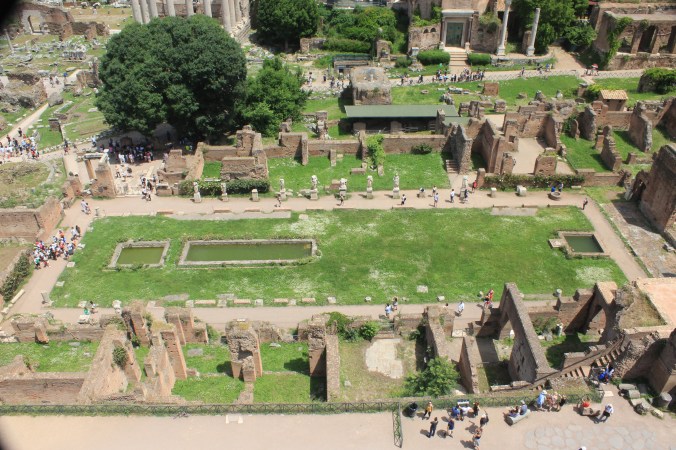
The courtyard of the Vestal Virgins, seen from above
Behind the Forum is the Palatine Hill, which according to legend is the place where Romulus, one of the twins raised by the she-wolf, first founded the city – and in fact there are traces of an early settlement on the site dating from around the 9th Century BC. It’s an intriguing muddle of styles – in the days of the empire it was the place where all the emperors and important Romans – Senators and the like – had their residences, starting with the first emperor Augustus. When the empire fell, its invaders took up residence here, and several churches were added in the middle ages. In the 15th century the wealthy Farnese family added their own Villa and formal gardens, which remain today, with their many balconies and courtyards overlooking the forum. It was in these gardens where I sought out a shady spot on the grass and sat and ate my panini while I watched the tourists go by. There were a few other people about, reading or taking naps in the shade. It was amazing to think that the space here was being used for the same things as they were centuries ago (we’re even still using tablets…).


I wandered around the hill for a little while, looking at the old palaces and villas, all of which are ruins now. But even as ruins they are lovely with their dark red walls jutting up straight and solid like legionnaires awaiting their next orders. Several floor and wall mosaics are still intact, their colours still showing beneath the sand and steady trudging of tourists. There’s an arena, its grass neatly trimmed and various bits of column and wall neatly arranged to give a vague impression of what it once would have been. Presumably this was a private arena for the residents of the hill, for their private amusement. The general public still had their entertainment, though, with the arena games at the Colosseum, and for racing, they would have gathered on the Circus Maximus, which is just a grass field now, but once hosted the chariot races. The grand buildings of the Palatine Hill had a royal box view over the arena so they could keep themselves and their guests entertained without ever leaving home!
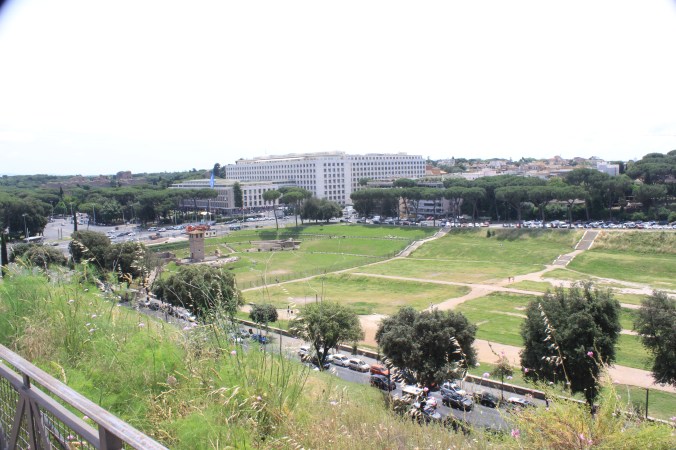
The Circus Maximus, site of the ancient Chariot Races
I finished my tour of the hill with a look at the iron age settlement, of which there isn’t much left except some building foundations and a few primitive tools scattered here and there. From my vantage point above it, if I looked up, I could see the blue-grey dome of St Peter’s in the distance, and I recalled something I overheard while I was wandering around the forum earlier: “Rome is like a lasagne; it has so many layers”. I had to agree that it was true.
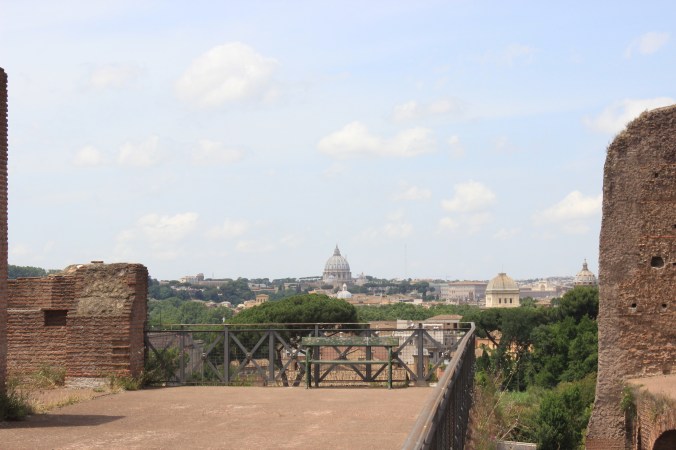
View over the iron age settlement to St Peter’s dome in the distance
I headed back down the hill – where I could see the Colosseum rising above the trees in the distance – and back through the Forum towards home, feeling that I was long overdue for a siesta. I thought I might reacquaint myself with the Spanish Steps later on, and perhaps have a drink and watch the buskers in the Piazza Navona. But first, a shower and a coffee, and perhaps a few minutes resting on the balcony, watching the Romans go by.
 karleenstevens.blog