Every time I travel to Italy, I ask myself why I don’t just move there. I love its sights and its smells, its noise and its bustle. I love the culture, the lifestyle, the food, and above all its people, the beating heart of a civilization old and yet new at the same time, grounded by its deep and rich history and yet finding its feet in a new world.
I pondered all this while I stood by my windowsill in a now familiar routine, sipping my morning coffee and looking out at a world I didn’t want to leave. Well, I still had 24 hours in Rome, and I intended to make the most of it. I headed out, once again past the Colosseum and through the old forums. I stopped and looked out at the newly excavated sights and pondered the Romans once again, but this time the ones long gone, who lived their lives in this space. Not the ones we’ve heard about, the emperors and statesmen and conquerors, but the regular ones, who did business in these buildings, exchanged money and goods, petitioned senators, caught up on news and gossip, visited temples and worships their gods. I wondered if regular peasants and travellers who came to their capital looked on it with as much awe and surprise as we do now.
I headed up the hill, not much farther for my first stop for the day, the Capitoline Museum. Sitting atop the Capitol Hill (also known as Campidoglio), it was the religious centre of the old forum but now faces the opposite direction (towards the Vatican) after a Renaissance makeover from Michelangelo. It was Pope Paul III who commissioned the artist and chose the statue of Emperor Marcus Aurelius for the centre, which was no doubt meant as a political statement at the time. However, I wasn’t here for the architecture – grand though it was – but for the museum. I hopped in line, bought my ticket and in I went.
The museum felt to me like a mixed statement of exquisite art and self-importance. I saw artworks by Titian, Veronese and Caravaggio, a beautiful statue of Venus, a marble carving of the head of Medusa, a charming statue of a girl protecting a dove and the original bronze statue of the she-wolf, dating from the 5th century BC. There was also an enormous marble fountain, at least two rooms full of busts of former Emperors (they all had the same grumpy expression), a statue of Helena, mother of Emperor Constantine, and an entire gallery for the statue of Marcus Aurelius on his horse (the one outside is a replica). I wasn’t quite sure what to make of it all, but most of it delighted me.


As the museum is made up of two opposing buildings, you have to get to one from the other through a separate corridor, which looks out over the forum. The sky was being particularly dramatic that day so I stopped and took some more photos on my way past. I found the exhibit I most wanted to see – and the highlight of the museum, for me – on the other side.


The Dying Gaul is a Roman copy – in marble – of an earlier Greek bronze sculpture. It depicts a naked man – a warrior – on the ground and defeated, with a bleeding wound above his heart. However, as I stepped closer I saw defiance and bravery in his expression, as if he died proudly, and I sensed respect and admiration in the hands of the artist. I couldn’t help feeling that this was at least in part a tribute to a worthy adversary, as well as a statement about the glory and power of Rome.


On my way out I stopped for a quick look in the nearby church of Santa Maria in Aracoeli (it’s pronounced ara-shelly) which has a glittering interior made up of chandeliers, mosaics and a gilded ceiling. It was much bigger than I expected it to be, considering that from the outside it looks as though it’s been tucked into a corner. It was a little overwhelming, but very pretty, and couldn’t help thinking that’s it’s probably even more beautiful at night when the chandeliers are lit. I wandered around, passing several chapels decorated with frescoes and other curiosities (including the tombs of St Helena, the aforementioned mother of emperor Constantine and St Juniper, and tucked into a quiet chapel, possibly its most famous relic: a statue of the Christ child carved from olive wood from the gardens of Gethsemane. Every Christmas eve it is brought out onto the high altar where it presides over the Christmas services, but the rest of the time it is housed in this small chapel to the left of the main altar. According to tradition, it’s responsible for several miraculous healings, and even today letters come from all over the world, presumably petitioning the child for healing interventions (apparently, even letters addressed simply with “Il Bambino, Roma” will find their way here). I found the statue and did indeed see several letters piled in a basket next to it, with stamps from all over the world.
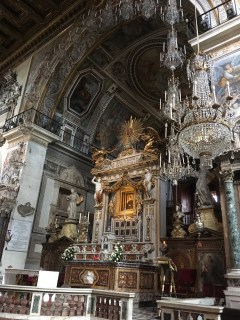
The Interior of Santa Maria in Aracoeli
I left the church through the front entrance and headed down its enormous flight of steps to the Piazza Venezia, and turned left to walk around the ruins of the Theatre of Marcellus, named for the nephew and adopted son of Emperor Augustus. From there I headed south to the river and across it to district of Trastevere, which translates literally to ‘across the Tiber river’. I had never been to this area before and was keen to explore it. I found it quiet, sleepy, as if it hadn’t realised it was daytime yet. The narrow streets with awnings jutting out and vines growing overhead made it cooler and quieter than the busy part of the city, and I wandered around for a little while, passing others doing the same. There was no bustle, no clamour of tourists – I liked it, despite most of the shops being closed. Perhaps siesta time started early here.
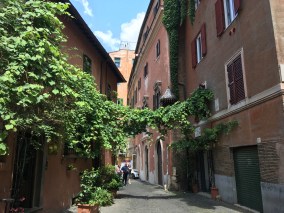
The Quiet Streets of Trastavere
I passed a row of restaurants, thinking that I might choose one to have lunch in, when a colourful display on the corner caught my eye and I discovered a Nepali shop, open and crammed with oriental nick knacks – prayer flags, incense holders, beads, bags, elephants of all shapes and sizes. The owner turned out to be from Bodnath, on the outskirts of Kathmandu, and I had to resist the urge to buy half his shop! After a nice chat I headed off to find lunch.
A lot of the restaurants weren’t open and I got the impression the place would be much more lively in the evening. I found one with a small patio at the back and let the waitress recommend her Gorgonzola gnocchi, which went very well with a cool white wine, I must say. After lunch I went looking for some of the churches in the area, which were among the first to be dedicated when Christianity was legalised in the 4th century. They also house some famous fine artworks, including a Bernini funeral monument and some 12th century mosaics – however they were all closed. I decided then that I’d had enough of Trastevere (although I made a note to return here for dinner on another trip) and walked back across the river over Tiber Island, one of the earliest parts of the city to be settled and according to legend, where the she-wolf suckled the twins Romulus and Remus after they were swept up onto the Island by the river. From there my walk took me past the temples of Hercules and Portunas, two small roman temples, both surrounded by columns, and both still in remarkably well-kept condition, mostly due to the fact that they were rededicated as Christian churches and therefore were kept well maintained. Unfortunately they are both closed to the general public, but they present a striking image, particularly from ground level (I had only ever seen them from a bus).
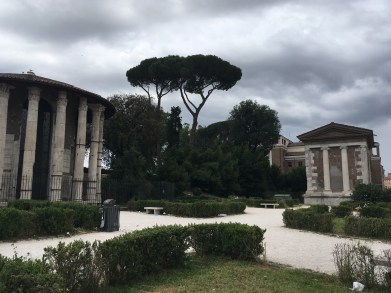
The Temples of Hercules and Portunas
Across the square from these is the church of Santa Maria in Cosmedin, which no one has ever heard of, despite knowing all about its famous artifact, the Mouth of Truth. The large marble mask, believed to be a drain covering from one of the nearby temples, is perched up against the wall in a covered portico outside the church where a long line of tourists was waiting for their chance to stick their hand in the open mouth (and take a photo, of course). According to legend, the mouth would bite off the hand of anyone who told a lie. I had a chuckle and, forgoing the chance to stick my hand in, continued my walk across the Circus Maximus and once again past the Colosseum to home.
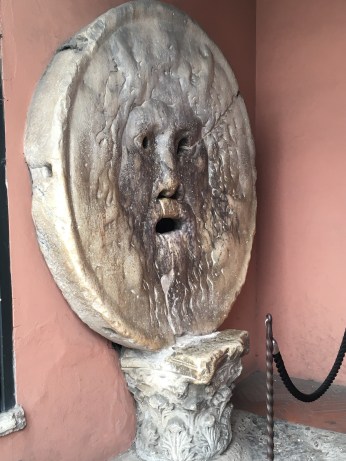
The Mouth of Truth
After a refreshing siesta it was time to head out for my last evening in Rome. Unfortunately, it was raining, so I borrowed an umbrella from the apartment and set off, this time away from the Colosseum and again to the metro station, and on to the Castel Sant’Angelo. It bucketed down with rain as I dashed from the station to the castle, and then conveniently stopped when I stepped inside. Ah well. I was excited for this visit, as it was yet another museum that I hadn’t seen before. It’s most famous now as a setting for several dramatic Dan Brown novel scenes, but I was more interested in its history. It’s been repurposed several times in its long life, from mausoleum to fortress, prison, palace, and fortress again, and I found the castle conveniently arranged with a one-way tourist route which led through the various layers. It led me first around the outer walls, where I could see the battlements and artillery which had been added during the wars of the reformation, during one of its incarnations as a fortress.


Next I was led down into the mausoleum, the oldest part of the structure. It was built for this purpose by the emperor Hadrian, with the intent that it would house the tombs of himself and his family, and in fact several emperors after himself were also buried there. It was dark and gloomy and didn’t strike me as a very cheerful resting place. Finally I came out on the top of the castle, where I discovered the most spectacular views over Rome – better even than the view from St Peter’s, I thought, mainly because I could actually see the dome and statues of the façade not very far away. From here I also had a close-up view of the giant statue of Archangel Michael from which the castle gets its name – the legend states that in the year 590 the angel appeared to Pope Gregory the Great at the top of the castle. In the vision, the Angel sheaths his sword, signalling an end to the plague. The statue of Hadrian was swapped out for the archangel and the first transformations of the castle began.


I wandered around the top of the tower, spotting out familiar landmarks here and there. From this height it was easy to make out unique five-pointed star design of the outer fort. I could also see the famous tunnel connecting the castle to St Peter’s, added in 1277 and used by many popes fleeing from plunderers and invaders.
Finally the route led back into the castle and through the papal apartments which I have to say resembled many a medieval palace I’d seen before. With its carved wooden panelling, elaborate ceilings and furniture clearly made by master craftsmen, nowhere was I more reminded that at many moments in the past the papacy was as much a political institution as a religious one. I found it a garish and ostentatious, and must admit I didn’t find it nearly as fascinating as the rest of the building.
My curiosity well satisfied, I finally headed out and across the Pont Sant’Angelo, an impressive structure of original Roman foundations and Bernini sculptures representing the passion of Christ. The sun had come out properly now, and the marble glinted against the deep blue sky. I sat outside enjoying a glass of prosecco before dinner, and once it was dark, headed back to the forum for one last bit of fun.
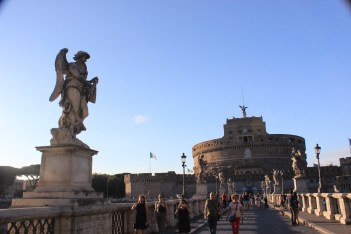
View of Castel Sant’Angelo from the Pont Sant’Angelo
It was a new attraction for that summer, a light and sound show in the newly excavated ruins of the Foro Cesare – Ceaser’s forum. It sounded tacky, but it had good reviews so I decided to give it a go – when in Rome, after all. A group of about 12 of us were each given a set of headphones set to our native language – how nifty – and led down into the forum.
I have to admit it was very cool. We were allowed to walk past the columns and ruins and underneath the road through ancient rooms and buildings that tourists normally can’t go. As the voice in my headphones described what I was looking at, various columns and rocks would light up to show which one it was talking about. Clever projections gave images and impressions of what life in the forum might have been like. It was really quite impressive, and at one point I was even convinced that there was a real water fountain right behind me. Judging by the grins on the faces of the others, they must have been enjoying it too. The commentary was a little bit sentimental at times, but I was definitely glad I did it. I hope they keep it going next summer.

Floodlit Columns of the Foro Cesare
I finished the day with a coffee and as was my habit now, leaned out of my windowsill and watched the night. What a surprise Rome had been – it had always been my least favourite of the three big cities I used to visit (Venice and Florence are the other two) but what it lacks in charm and prettiness it makes up for in vibrancy and a rich, multi-layered history. The tour guide in the Forum was right – Rome really is like a lasagna. I felt sad that I was leaving the following day – there was still so much I could explore! But I was excited to visit my friend and I felt sure that, as all roads do, one would one day lead me back to Rome.
 karleenstevens.blog