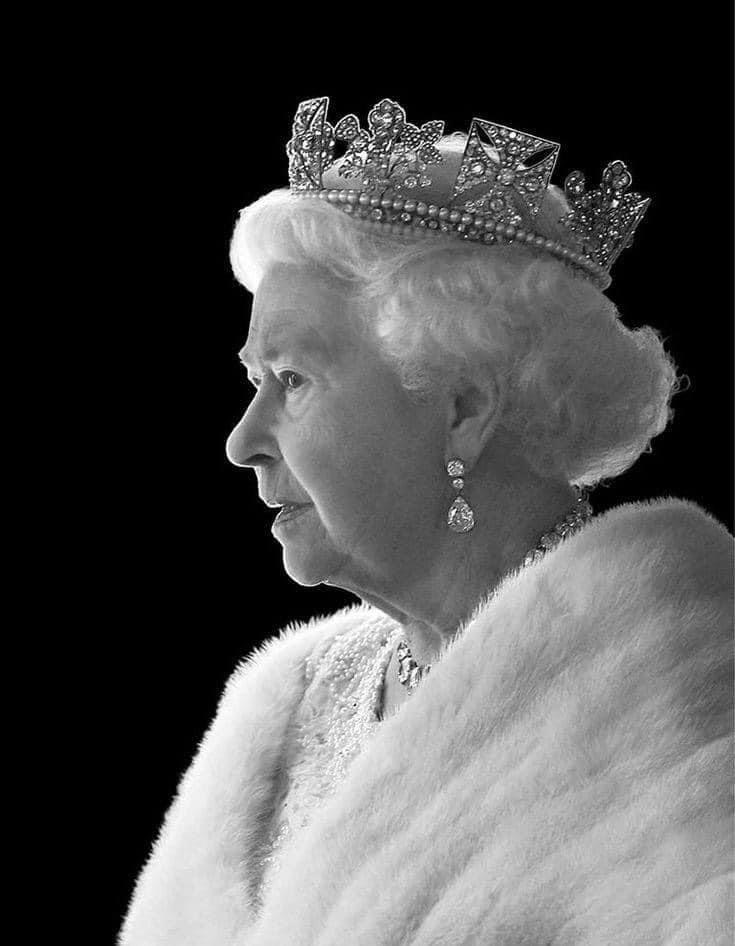
Joining The Queue – The Time I Went To London, One Last Time, To See The Queen

September 2022 was a strange time here in the UK. With the passing of Queen Elizabeth II, phrases like ‘end of an era’ and ‘long, devoted life’ were being bandied about by the press, neighbours, and on social media, but none of it really seemed to encompass the strange feeling of loss that had so suddenly settled over everything.

It was difficult to know how to feel. Is it okay to grieve for someone you never met? Is it right to grieve for something that had no direct impact on your life whatsoever? We were going about our lives without any physical interruptions, but pretending everything was normal somehow felt hollow and seemed to disregard the immense loss, physical or not, we had suddenly, collectively experienced.

Personally, I felt the loss keenly, though even now I would struggle to explain why. As an Australian, the monarchy has always held for me a kind of historical fascination. On a slightly more tangible level, The Queen was just always there, a kind old lady somewhere in the distance, a reassuring, indomitable presence. (Actually, I think Kevin Rudd summed it up pretty well when he was interviewed on the BBC, when he said ‘she was like our nanna’.) As long as she was there to tell us everything would all be alright (who could forget her moving message during the Covid pandemic?) we could be sure it would be.

So when we suddenly didn’t have her any more, what were we to do?

I’m not ashamed to admit that I was incredibly sad – in fact I was a little taken by surprise at how deeply I was affected. I found myself continually distracted and glued to the television. The BBC, which of course had been prepared for this eventuality for 70 years, rose to the occasion as royal commentators, former household staff members, honours recipients and anyone who had a funny story to tell were brought out of the woodwork to comment and share their experiences. My work sat on my desk, ignored, as I watched images of the queen’s coffin being driven through Scotland and as people filed past as she lay in state at Edinburgh cathedral. Then she was brought down to London, and we were informed that members of the public would be able to pay their respects at Westminster Hall. A route along the river was drawn for people to line up, portaloos were brought in, and the phenomenon of The Queue began.
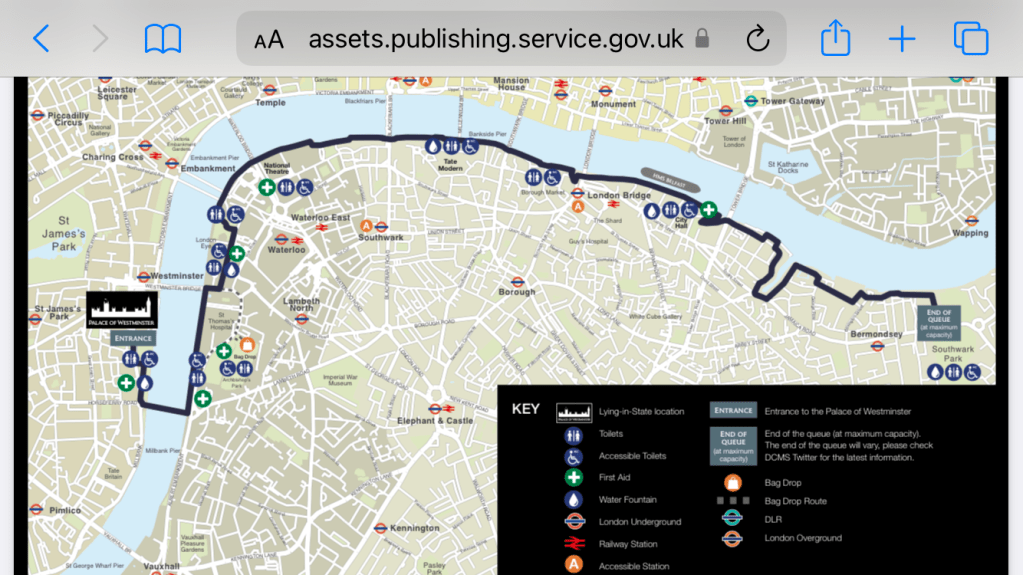
It was a simple enough concept, and not a new one, but to the surprise of many the thing developed a life of its own. People began queuing days before the Queen’s coffin even arrived, camping in the Victoria Tower Gardens, the park south of Westminster Palace. By the time the doors opened and people began filing past, it was over two miles long, starting with a zig-zagging snake through the Gardens, over Lambeth Bridge and along the South Bank almost to Tower Bridge.  It even had its own website, with a live tracker informing us where the end point was and the estimated waiting time. When it got to Southwark Park, about five miles away, they closed it off, so people were forced (or perhaps it just never occurred to them not to) to queue for The Queue. ‘Only in Britain could this happen’, people said, and I’m sure it’s true! News bulletins kept us updated on its progress and reporters chatted to randomly selected people to get a sense of what it was like, and from how far away people had come to join it. Most reported steady movement and a feeling of camaraderie amongst strangers who were all there for the same noble purpose. Despite warnings of potential wait times up to 24 hours or more, people weren’t put off. They flocked in by the thousands – more than 200,000, it was estimated. People were fascinated by it. They stuck cameras in Westminster Hall, and ran a live feed to televisions across the nation. It’s a phenomenon lately called ‘slow television’ and people were utterly absorbed by it – despite the fact that nothing ever changed except the guards on duty every quarter of an hour, and the faces of people filing past, most of which were wiping their eyes as they emerged and filed past the spot where the camera was. Maybe it was a morbid fascination, but it was a fascination nonetheless, and I couldn’t take my eyes off it. I felt very far away, and the sense of needing to do something became greater and greater. In the end, I could no longer sit and watch, and it was no use trying to get on with things; I needed to be part of it, which meant I would have to go in.

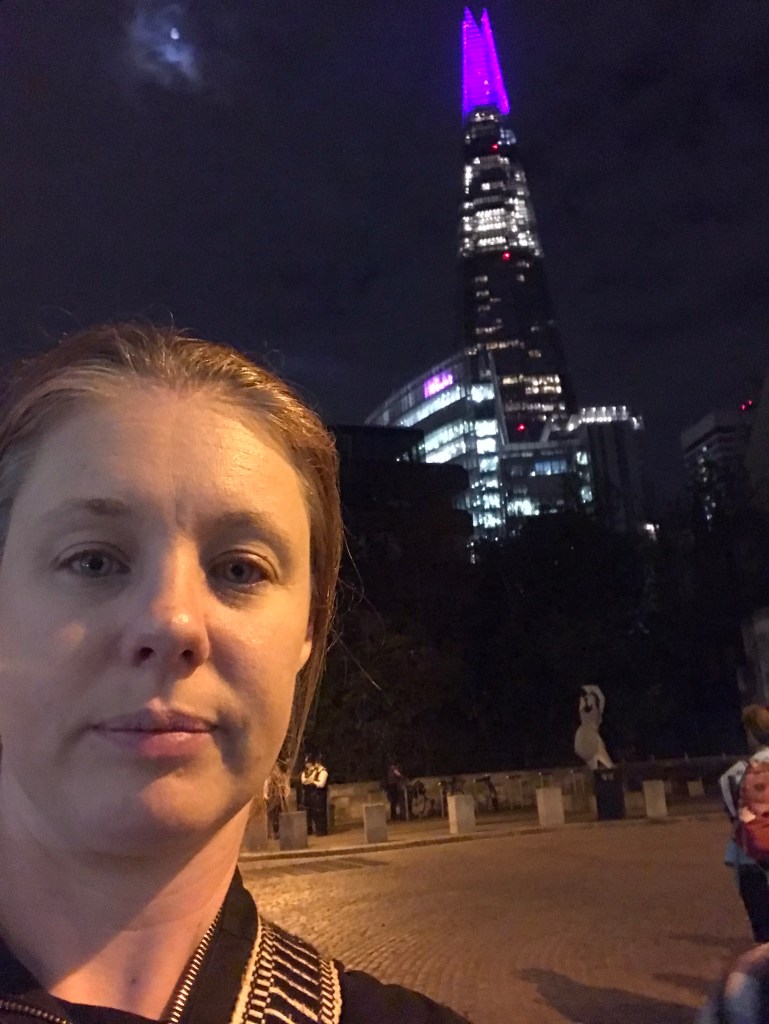
I decided to go on the Wednesday evening and join The Queue overnight. It might be shorter than during the day, I reasoned, and actually that fitted better with my schedule, as I could go home and have a sleep on the Thursday. I got the train at 11.30, after stopping by the local Tesco for snacks, and emerged at London Blackfriars Station at around 1 am. I could see The Queue the moment I emerged from the station, creeping along the South Bank, and turned right to follow it about a mile or so to the end, where I joined it just before London Bridge.
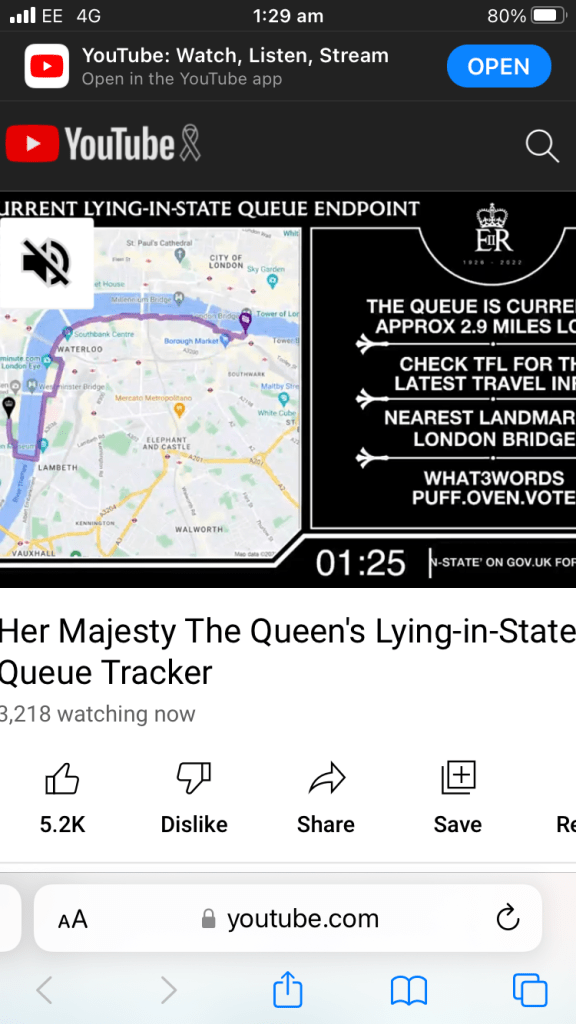
I hopped in behind a middle-aged couple, and not long behind me were two men who didn’t show much interest in chatting, so I directed my attention to the pair in front. In front of them was another couple, much younger, and the five of us spent a few minutes doing introductions. When you know you’re going to be standing with someone for a lot of hours, you might as well get to know them, so we did. The couple in front had come up from somewhere on the Dorset coast, the younger couple from somewhere in the midlands. We chatted for pretty much the entire night, and I didn’t realise until afterwards that we never exchanged names. Conversation, naturally, got to why we’d all come, and the stories were all very similar. Respect for the Queen, and a way to say thank you for a life of extraordinary service. And, like me, a desire to simply be a part of it in some small way.
When we got around to logistics, it became clear that the couple in front of me hadn’t really done their research at all. They’d booked a hotel room, checked in and slept for a couple of hours, then left their bags and come to join The Queue. They were hoping to get back in time to sleep and enjoy breakfast at the hotel before checking out. Secretly I thought that was a rather ambitious and probably impossible plan, but I kept that to myself for now.

The Queue moved at a steady pace. Only very rarely did it stop altogether, which meant you might be able to lean on the wall or sit on a bench, but it was only ever a few moments, and then we were on the move again. The night was quiet, a cool breeze and the lapping of the Thames were all there was to accompany the gentle hum and chatter that rumbled up and down The Queue as we strode past the Clink Prison Museum, Shakespeare’s Globe Theatre and the Oxo Tower, following our progress on map apps and checking the live tracker every so often to see if it was getting longer or shorter.
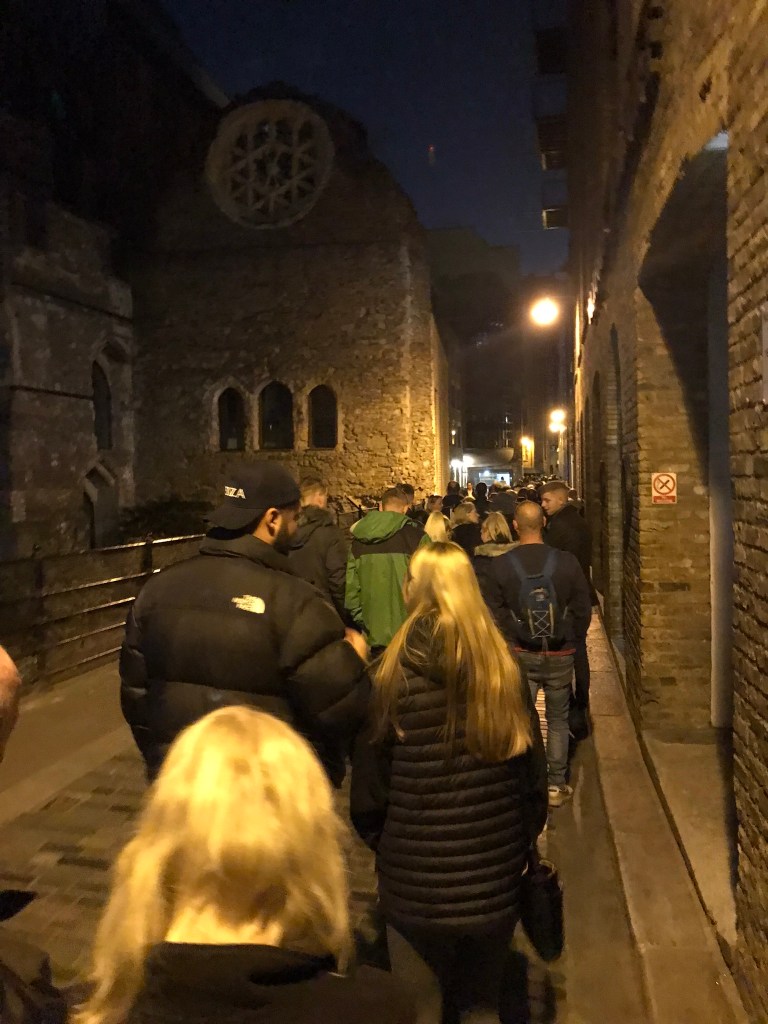
It was a dark night – the moon was up, but its light was greatly weakened by competition from the streetlights, bridges and illuminated shopfronts that lined the river. Here and there, buildings remained open after hours for people to use the bathrooms, and we popped in and out with complete faith that we’d be able to get back into the line again. Indeed, when I emerged from the Tate Modern at about 3am the section of queue in front of me was unrecognizable – I had to walk ahead a long way before I saw my new friends looking back and waving to catch my attention. There were no challengers – by that time, each participant knew their neighbours and there was an unspoken agreement that toileting was allowed and anyone who had to duck out should be allowed to duck back in. This was long before the much-touted wristband system was initiated, which turned out to be entirely unnecessary because The Queue was reliably self-regulating in that regard. One or two unrecognizable faces did try to surreptitiously squeeze their way in, but were unceremoniously squeezed back out by people who were justifiably protective of their positions.

As we progressed along the South Bank several of us noticed with despair that many of the usual food carts and vans were closed, and the one or two cafes that were open had off-puttingly long queues. Fortunately I was prepared, and made sure to keep nibbling away at my snacks. Quorn eggs, mini cheddars and a ham and cheese sandwich kept me going, but when I did spot a drinks van open I took the opportunity to grab a hot drink for myself and my new friend, the lady in front of me. Before I got there, she came running to catch up with me, to say she didn’t want one after all, as neither of them had brought their wallets. Thinking this was utter madness (who goes to stand in a queue in London at 1am without a wallet, or any means of acquiring provisions?) I got her a cup of tea anyway, because she was looking distinctly wobbly by that time. As we sipped our tea, I felt a bit of life coming back into my legs and was pleased to see a bit of colour returning to her face. They really haven’t thought this through, I thought, not for the first or last time that night. Both were wearing jackets, but no other warm layers, and she was only wearing ¾ length leggings and trainers. I, on the other hand, was wearing my warm, waterproof boots, thermal leggings and jeans, my thermal top, a jumper and a jacket, and as the night wore on over the early hours, when metabolism slows and body temperature drops, I added a scarf, beanie and an extra jumper. By about 4am my stroll had become more of a waddle, but at least I was just about warm enough. I had a very small bottle of whisky (one of those sample size ones) and whenever I felt my energy levels droop significantly I took a small sip, and that perked me up enough to keep going.
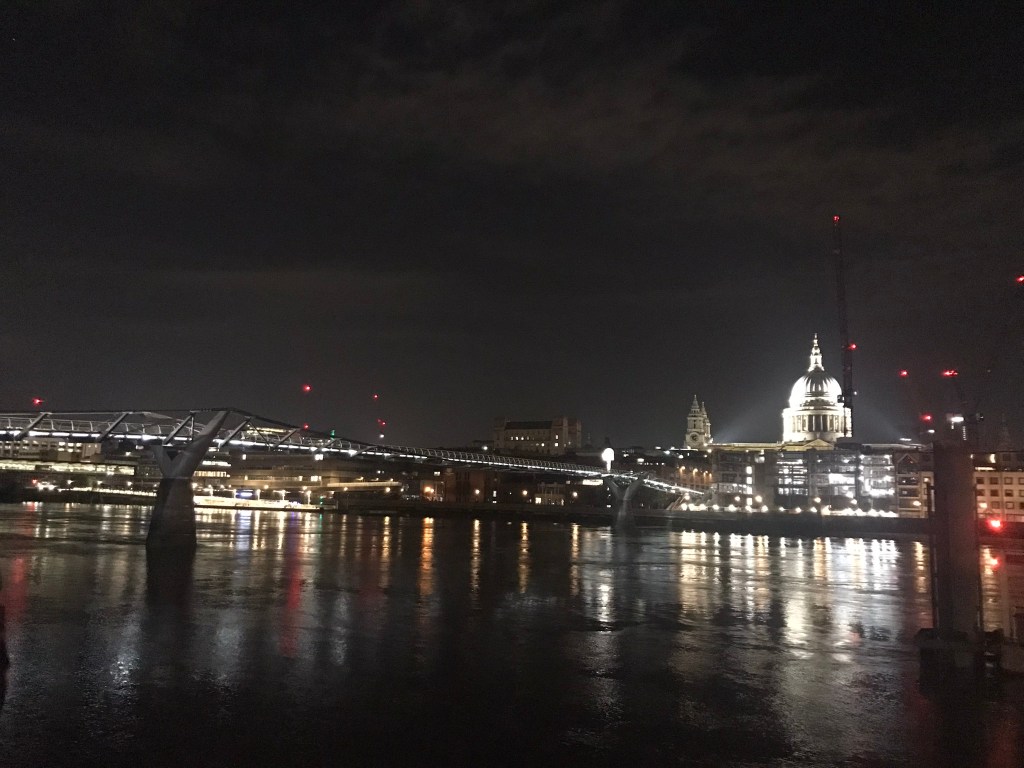
We moved through the night. Across the river, the reflections of St Paul’s Cathedral, the City of London School, Cleopatra’s Needle and other lights of London shimmied and danced in the black vastness of the river that was rippling slightly in the gentle but steady breeze. The moon moved across the sky, and still we trudged on. Conversation never flagged, but was never very intense either. We talked about the weather, how lucky we were that it wasn’t raining (did someone have some brownie points in Heaven, we wondered?) how organised the whole thing was, how the time seemed to be passing surprisingly quickly, who had a story about the royal family, what we all planned for the next day, what the last week had been like. Superficial, maybe, but sustaining, and pleasant, and all underlaid with a sense of shared purpose. Who in their right mind would stand outside in the dark and cold all night for a brief moment in front of a coffin? We would, of course, and in that moment it didn’t matter that the rest of the world thought we were mad.

After a few hours, when we were veering to the left to divert round the Eye, we heard a sound, oh so familiar to the night shift workers, the bakers and other early risers – the cry of a bird signalling that dawn was not far away. Soon after that we became aware of an almost imperceptible lightening of the sky to the east, downriver towards the docks, and as we turned left away from the river and were directed behind the Sea Life Museum onto Belvedere Road there was a faint tinge of grey, reassuring us that the dark, deep night was almost over.
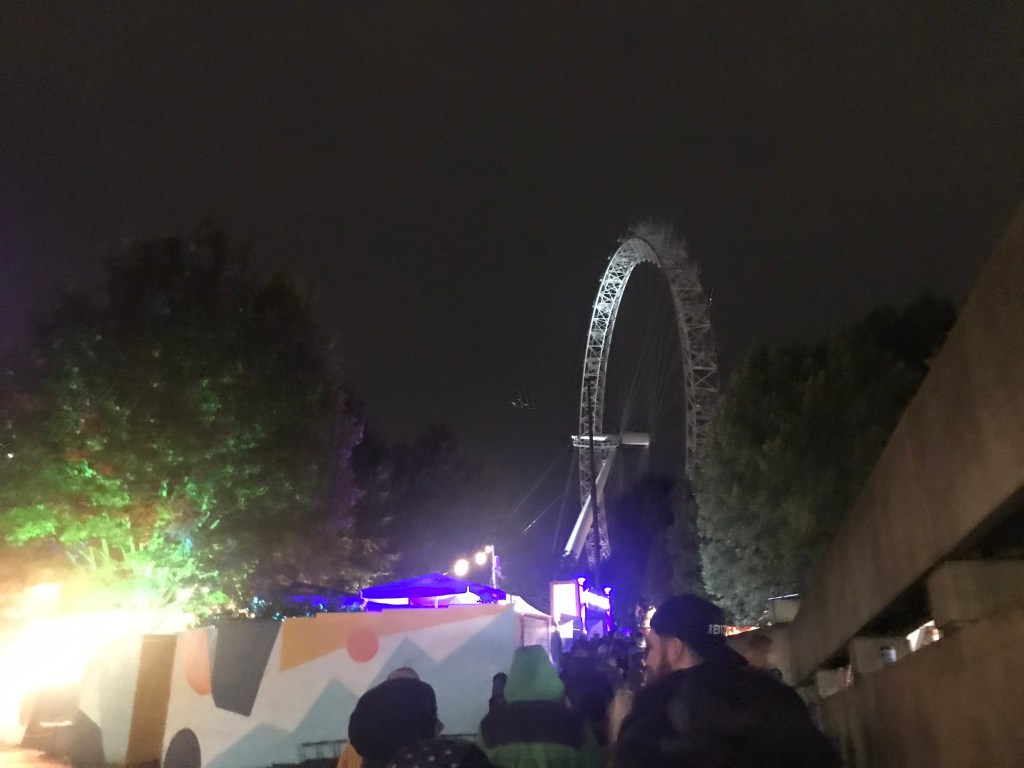
It was about at this point that we reached another milestone – we were finally issued with our official wristbands. By now they had become largely redundant as we all knew where our spot was, but it felt nice to log it as a sort of checkpoint. We were on the way, and soon we would be there.

We re-joined the river shortly after that, turning left at Westminster Bridge to walk along the riverbank again. Here we found ourselves passing the National Covid Memorial Wall, which I had not seen before – a collage of a thousand and more messages, images, faces and flowers. It lent a strange sort of perspective to our own pilgrimage, looking at all these lives that had been cut so tragically short.
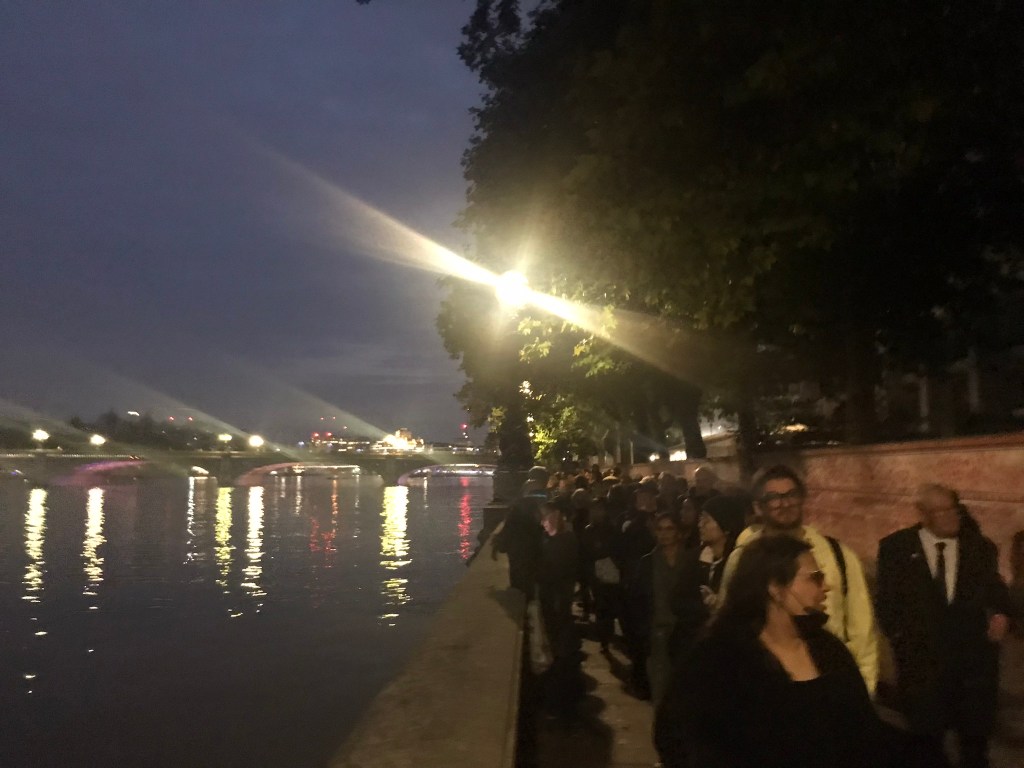
Things started slowing down a bit at this point, and I could see that my companions were beginning to feel the strain. They hadn’t had anything to eat all night (they refused all my offers to share my snacks), and the woman, in particular, was getting very prickly and went from complaining that they weren’t going to have time for their nap before breakfast, to worrying whether they would even be back for check-out time at all. Meanwhile, the sun rose over a subdued Westminster Palace, its flag flying disconsolately at half-mast and a few solitary boats chugging by without much enthusiasm. It was a dreary morning – dry but overcast and entirely colourless, reflecting the sombre mood of the thousands of souls trudging in unison along the banks of the equally grey surface of the river.
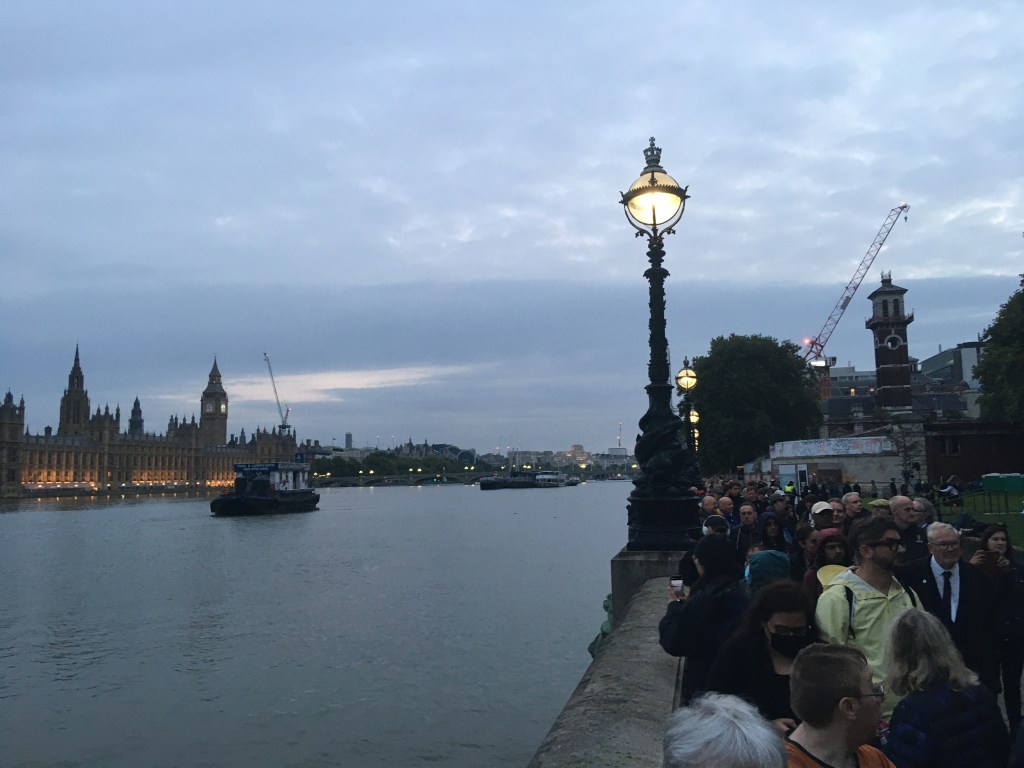
Across Lambeth Bridge we marched, and after convincing my friend in front (a few times) that she could do it and wouldn’t it be a shame to give up at this point, we reached the final test – the Great Snake of Victoria Tower Gardens. This was by far the toughest part of The Queue. We were tired – physically and mentally, by the long, cold march through the night. The sun was now fully up, the sky, in its great, grey shroud, was uninspiring and the sense of adventure, inspired by journeying through the dark into unknown and unprecedented circumstance, had long since worn off.  The end was so close, within sight, but we moved towards it so very, very slowly. The snake zigged and zagged, back and forth, forth and back endlessly through the park. We could feel our feet moving, yet the palace seemed to come no closer and the Buxton Memorial Fountain, which marked our entry to the park, seemed to shrink no further away.

The only redeeming feature of this part of The Queue, apart from the indecently cheerful volunteers handing out sweets and snacks on the turns, was the fact that its natural geography brought us right alongside our fellow queuers, not just the ones immediately before and after that we’d spent the night chatting with. Now we had compatriots also on our left and right, recognisable at each turn and along each straight to the next one. We pumped each other up, we cheered each other on. Signs of delirium began to show, mainly in the form of too-much-information style reports on the state of the portaloos, or cackles of excitement as an enthusiastic punter made it around another bend. My friend in front became very grumbly, and made frequents comments about giving up, but all around were shouts of encouragement, of ‘don’t give up now’, and ‘come on, we’re nearly there’, not just in our row but all the way up and down the park.
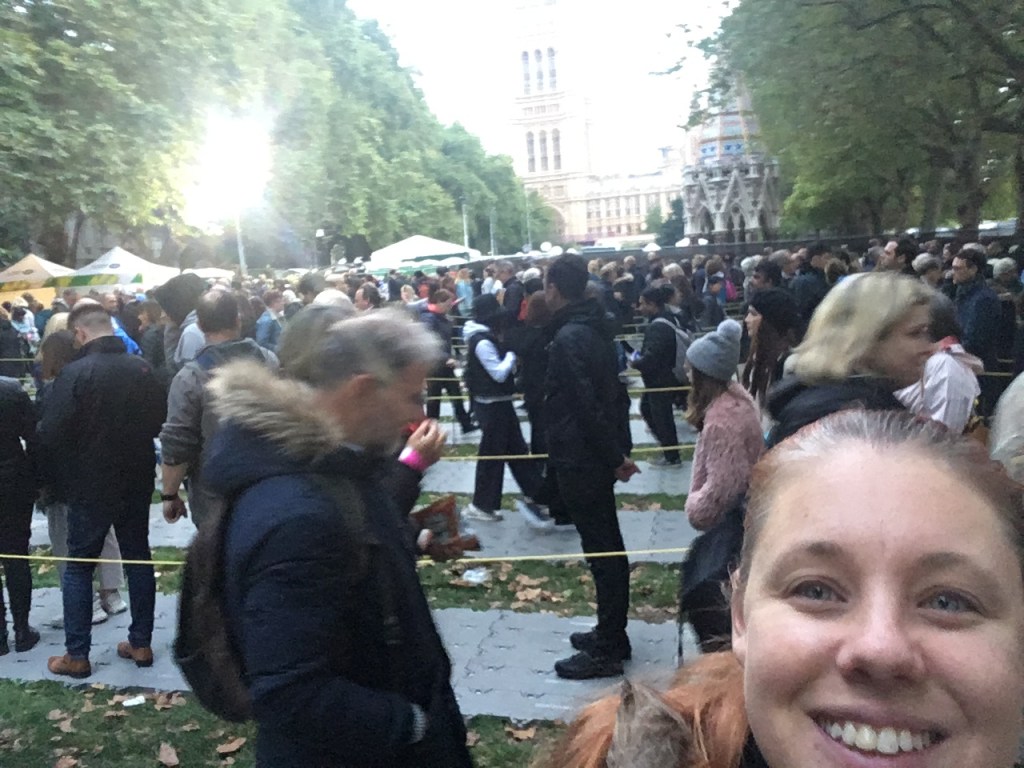
At last, at about half past eight, when the statue, finally, was discernibly distant, the walls of the palace appeared in front of us and we were directed towards the security screening. I took my last swig of whisky and threw the tiny bottle in the bin along with the rest of my rubbish. I had read up on the rules and knew that I was allowed only one bag, with one zip opening, no liquids of any kind and nothing that might be considered a weapon – it was tighter than airport screening. The couple in front of me, who had nothing but their phones, had obviously taken the advice of ‘don’t bring anything’ a little too literally – meanwhile the younger woman in front of them was having a very loud grumble about her £80 lip gloss being confiscated. My initial thought on this was why on earth would you pay £80 for a lip gloss, but I didn’t ponder it for very long because at this point we were ushered into Westminster Palace’s entrance area, still outside, where the atmosphere had taken on a different feel. There was anticipation now, almost nervousness. A hush had fallen over The Queuers, and each was filled with their own thoughts. This was it, the moment we’d been standing in the dark for nearly eight hours for. What would it be like? What should I do, when my turn comes and I’m standing in front of the coffin?

Then The Queue moved, I turned and found myself standing at the top of a flight of stairs and looking down onto one of the most peculiar and amazing sights I have ever seen. Four lines of people were making their way slowly down to the bottom of the stairs, where they forked to flow around either side of the central dais (called a catafalque, but don’t worry, I won’t test you on that). It was slow and procession like, as if we’d all been told to walk as if we were proceeding down a wedding aisle. In the centre, below where I was standing but raised high above the stream of mourners, was a coffin draped in the coat of arms of the United Kingdom, gold lions blazing against their scarlet background. On top of that was an enormous wreath of flowers and at either end, in all their magnificence, were the crown jewels: the orb, the sceptre and the St Edwards Crown. I’d seen them before, in the Tower of London, but only now, when they were free of their glass confines could I appreciate how superbly crafted and spectacular they were. Was it the morning light, slanting in through the great stained windows, that made them sparkle as brightly as summer sunlight on rippling water? Or was it the moisture in my eyes, that came unbidden as I looked over this scene, the culmination of my long wait through the night?

As I made my way down the steps, taking in as much as I could, from the sparkling jewels to the household guards – standing motionless but alert at every corner of the dais, and at strategic points around the hall – to the calm and silence that had descended on the crowd after the noise and bustle outside. So chatty we had been through the night – team mates, almost, bolstering each other’s spirits and relishing the sense of anticipation and occasion. Now we were individuals, each with our own thoughts, contemplations on our role in all this ceremony, and private reflections on the person we were all there to pay tribute to.
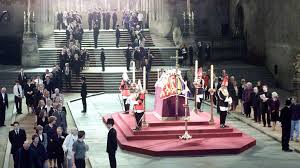
My own feelings, at this point, were a furious muddle of anticipation, excitement, nerves (what if the live camera zooms in on me? I must not cry on television!!), indecision as I considered what I would do or say when I finally found myself in front of the coffin, and awe at the sheer spectacle of the Hall. My emotional state, intensified by exhaustion, sleep deprivation and having spent the previous eight hours in a heightened sense of anticipation, was only barely under control. Most people were stopping when they reached the front – some just walked past, but most paused to bow, curtsy, or say a few silent words of thanks. The rules, which I had so thoroughly examined before I left, stated that we were not allowed to stop – but most people paused only for a moment before moving on, and the security team clearly did not have the heart to discourage this. I saw men, women and children, and many cultures and religions represented. It was a marvellous thing to be a part of.

When I finally did step forward and turn to face the coffin, I felt all my emotions come unbidden to the top. As I looked up at the emblazoned images on the flag and the glistening crown, I felt time stop, and the rest of the room fade away, as though it had gone fuzzy at the edges (or it could have been the moisture in my eyes again). The moment felt stretched, though I’m sure it was mere seconds. After all that time wondering what I would do, suddenly it was obvious – I bobbed a tiny curtsey, whispered ‘Thank you, ma’am’, and moved on, sniffing furiously and attempting to stay composed, at least until I was out of the building.

I emerged into bright sunshine, the grey pallor of the day having transformed into glorious blue. I looked around – others were emerging, like me, wiping their eyes and taking deep, heaving breaths. We were emotionally wrung out, exhausted and overwhelmed, but also satisfied. I found my Queue companions, bid them farewell, and stepped out onto the streets of London, anonymous once more. I was tired, yes, but at that moment my overwhelming feeling was one of satisfaction, gratification, and of a mission accomplished. I had done my part, and I could go home, back to the relative obscurity of my village, knowing I had now, at least, done something.
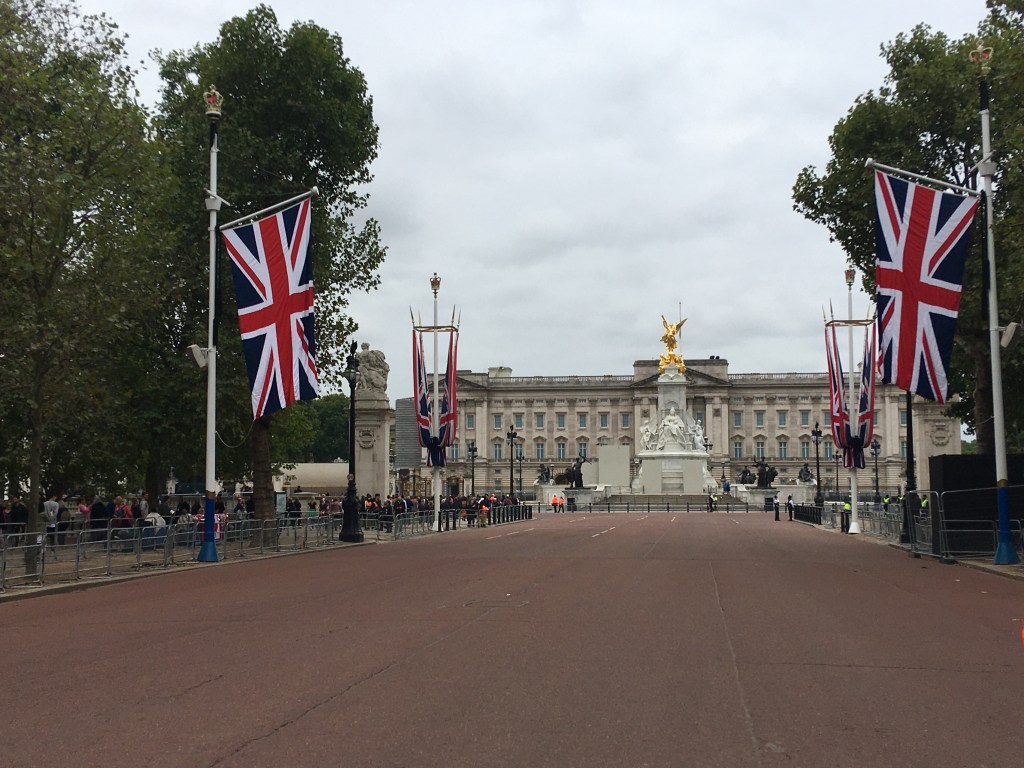
I finished the morning by walking back down Whitehall, across Horse Guards and to Green Park (collecting a very large coffee on the way), where I strolled among the flowers and cards that were being collected there, many of which featured Paddington Bear (I heard later that the stuffed toys were being donated to children’s hospitals). I read several of the messages, and the overwhelming sentiment was one of thanks. Schools, businesses, hospitals, clinics, religious groups, individuals and families and various international communities all expressed their gratitude alongside their condolences. I placed my own, and a few others that had been entrusted to me for the same purpose, and made my way home, sharing a conspiratorial nod with a few people who, like me, were still wearing their wristbands.

Was it tiring? Yes. Emotional? Yes. A lot of effort for a few moments to shed a tear for a woman I never met? Yes. I won’t deny any of that. But was it worth it? Absolutely. It was a unique, historical moment to be a part of and the feeling of camaraderie, the novelty of taking eight hours to walk two or three miles through the night with people I’ll never see again, and the overwhelming spectacle of the jewel-bedecked coffin on its catafalque, is a memory I will always cherish, and, now that I’ve written it down, I’ll be able to remember and share. Some of you will think I’m mad, and some may disapprove altogether, but I for one, will always be glad that I went to London, one last time, to see The Queen. 

The Three Peaks – the Most Challenging Challenge…


As many of my readers know, in 2015 I spent some time in Nepal following the April 25 earthquakes. I spent some time volunteering, and in particular I spent one day working with an organisation called the Nepal Youth Foundation. I was shown around one of their Nutritional Rehabilitation centres, which is a place where malnourished children are brought to stay while the child is rehabilitated back to health. There were two things that made a particular impression on me while I was there: firstly, the fact that it’s not just the child that is brought in but the caregiver as well, so they can learn about nutrition and hygiene, and then take that knowledge back to their communities and ensure that the cycle is not repeated. The second was the passion and determination of the organisation’s president, Som, who I was fortunate enough to meet while I was there. This was a man who clearly cared very deeply about the foundation and the children it sought to protect – the incorruptible sort. (For the story of how he helped to end the practice of indentured servitude in Nepal, check out my previous blog post here)

Since then I have followed the work of the NYF and supported them when I could, until early last year, when my social media feed showed me a post from their UK branch looking for people to take on the British Three Peaks challenge. I looked at it and thought, ‘maybe I could do that’ – and before I could talk myself out of it, I signed up.

And so it was that I found myself, on a fresh but bright Friday morning in June, at Manchester Piccadilly station, meeting six other women from around the country who had also signed up, and our guide Sam.

Looking at the others, I immediately felt out of place. I felt nervous where they all looked relaxed and confident. I knew that I hadn’t done enough training, yet they all looked fit and raring to go. I had about 5 different bags of various bits and pieces getting tangled up and in everyone’s way, yet most of them seemed to have only two or even one. I felt woefully underprepared. Still, I had the whole weekend to get the hang of it, I reassured myself, and it might not be as bad as I expected. Once we were all there – and our bus driver finally arrived – we were on our way.

It was a long drive from Manchester up to Fort William, and the long drive gave us a chance to get to know each other – although it turned out some of them already did. Gerry, our NYF rep who had organised the trip, had obviously talked some of her friends into it, and another two were former work colleagues. Of the seven of us, only myself and one other girl didn’t know anyone. Although that didn’t bother me as much as the realisation that they all seemed to be either personal trainers, gym junkies or seasoned hikers. I felt a sinking feeling in the pit of my stomach – I knew, somehow, that I was going to be the slowest in the group, and it was going to be just like it had been in Nepal – me trailing along at the back while everyone else cruised along up ahead, me out of breath and hauling myself up while everyone else stood there waiting, me never getting a rest because they were always waiting for me to catch up. I tried not to think about it, and instead to enjoy the view as we followed the windy Scottish roads around Loch Lomond and up into the highlands. At least I’d picked the right side of the bus for that.

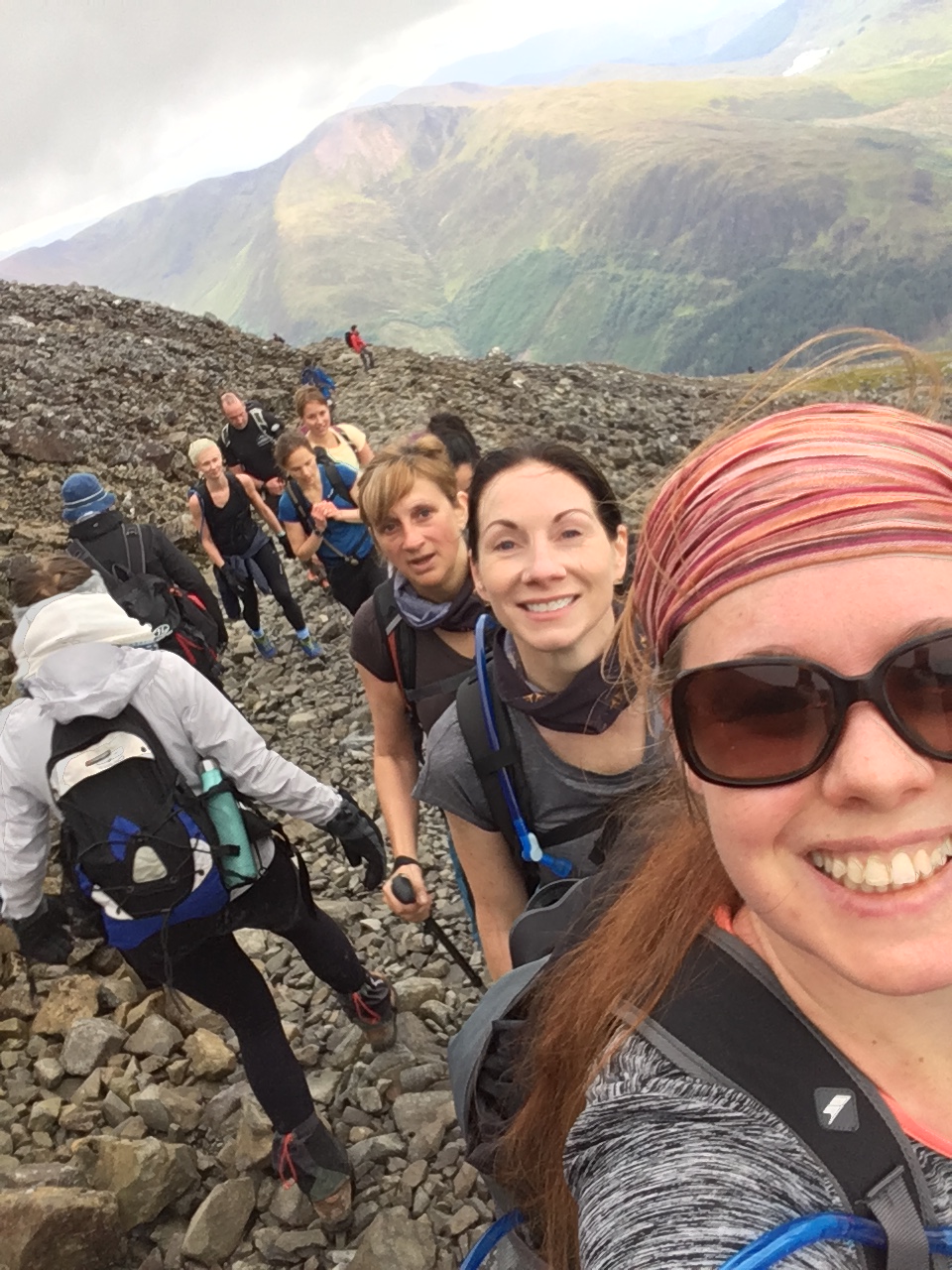
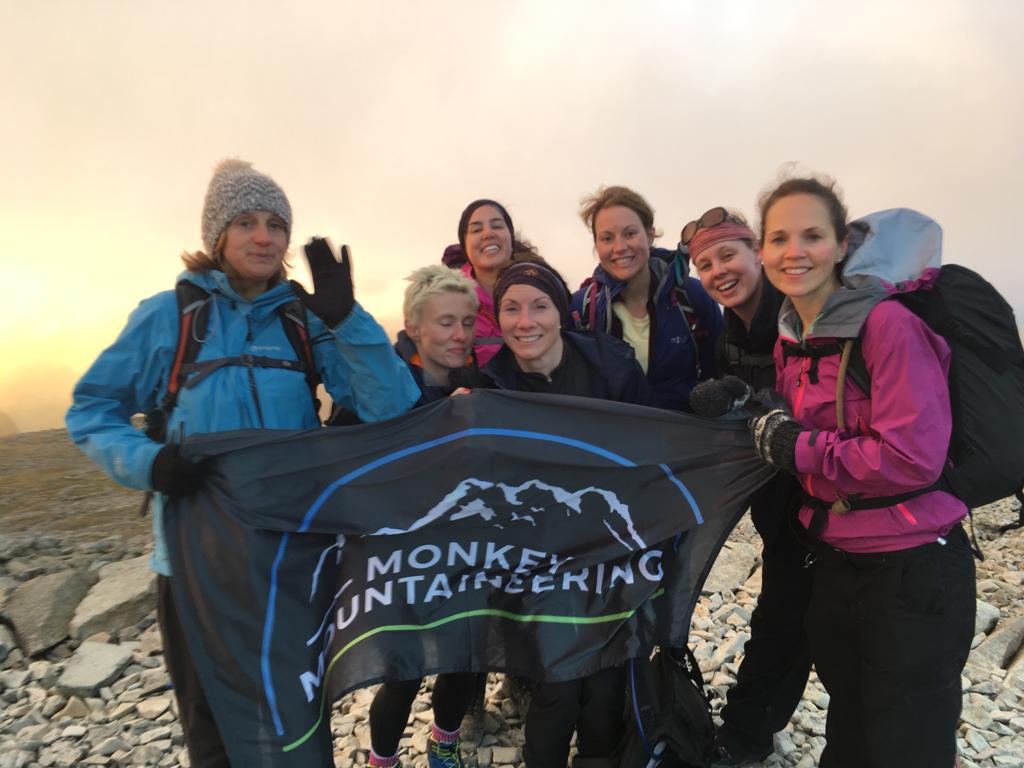
We spent the night in Fort William, and I shared a room with Kellie, a girl about my own age from Michigan, who was living in London with her Scottish husband. We managed to sleep a bit, before we were picked up at 7am the next morning to arrive at the foot of Ben Nevis about ten minutes later. It was chilly, but we kept our jackets in our backpacks – “be bold, start cold’, were Sam’s words of advice as we set off. A thin mist clung to the side of the mountain. A gate marked the start of the path and I could see it leading upwards and into the fog. A quick group photo, and we were off.

Ben Nevis Bottom

At the base of Ben Nevis

Sam’s instructions were to start at a slower pace for about half an hour while we warmed up, then we could open the pace up a bit. Talk while you’re walking, he said, as it would prevent us from going too fast. At about half-way, we would encounter seven long zig-zags, then there would be a brief plateau before a steeper ascent to the top. I took a deep breath and told myself just to think one phase at a time. Half an hour to warm up – surely I could do that.

I started at the back with a girl called Alicia, who was the other girl who didn’t know anyone. She had been to Nepal twice, once to volunteer and once to go trekking, and like me had been looking for a way to help. We chatted about music for a while, but within a few minutes I was already panting slightly and feeling that I should save my breathe. The girls at the front were drawing away and I realised with a sinking feeling that I wasn’t even going to make it past the warm-up without being exposed as the slow one. Sure enough, after half an hour or so Sam stopped us and brought me up to the front, giving instructions that the others weren’t to go past me. It was pretty embarrassing, and I could feel them all behind me, hovering as if they were itching to go faster. Not long afterwards, I heard Sam call from somewhere in the middle that we could stride out a bit more now, and my heart sank – I was already going as fast as I could.

Fortunately, not too long after that the path levelled and I was able to catch my breath a bit. I had a pair of borrowed walking poles and it gave me a chance to get used to them a bit and find a rhythm – I was the only one using them, although some of the others had a pair strapped to their backpacks. I had packed them because I thought they would help coming back down the mountains, but I would never have guessed that they would also be useful going up, as a kind of substitute for a handrail to haul myself up. Unfortunately, it meant that I couldn’t snack and walk at the same time, but I had a Camelbak water bladder that at least meant I could sip water as I went.

We carried on and warmed up despite the chill in the air and a few raindrops here and there which felt refreshing on my arms. We passed a waterfall and looked back over a stunning view – the mist had lifted to reveal a landscape of lochs and valleys stretching off into the slanting morning light. I took a couple of snaps on my phone, wishing I had time to get my big camera out, and then we were off again.


Eventually we reached the first of the zig-zags. They were rocky and slippery, slate and granite mostly, I think. Some people were coming down the other way, and I wondered what time they must have had to set off to be already on their way down. But it wasn’t long before my legs really started to hurt, it was getting harder to breathe properly and I had a blister forming on my right thumb.  I could feel myself slowing down even more. As we rounded a short stone column which marked the start of the second Zag, I heard some of the girls approaching behind me, and one of them launched into quite a long story about her love life misadventures. How she’d married and had a child too young, got divorced, dated another man who had been arrested, another who had been kicked out of an apartment for who knows what questionable activities. I found it very diverting, and let my brain tune into the story while my body kept plodding on upwards. There were more people coming down the other way now and lots of them were offering encouraging comments like ‘keep going, you’re almost there now!’ That, plus the odd comment that floated up towards me of ‘keep going Karleen’, and ‘you’re doing great Karleen’ kept my spirits up. Eventually Sam appeared at the front to see how I was going, and I asked him which Zag we were on – it seemed as though we’d been going back and forth on this slaty slope for ages.  ‘Oh, we’ve finished those!” he said. “We’re on the plateau now, just the last steep bit to go.”

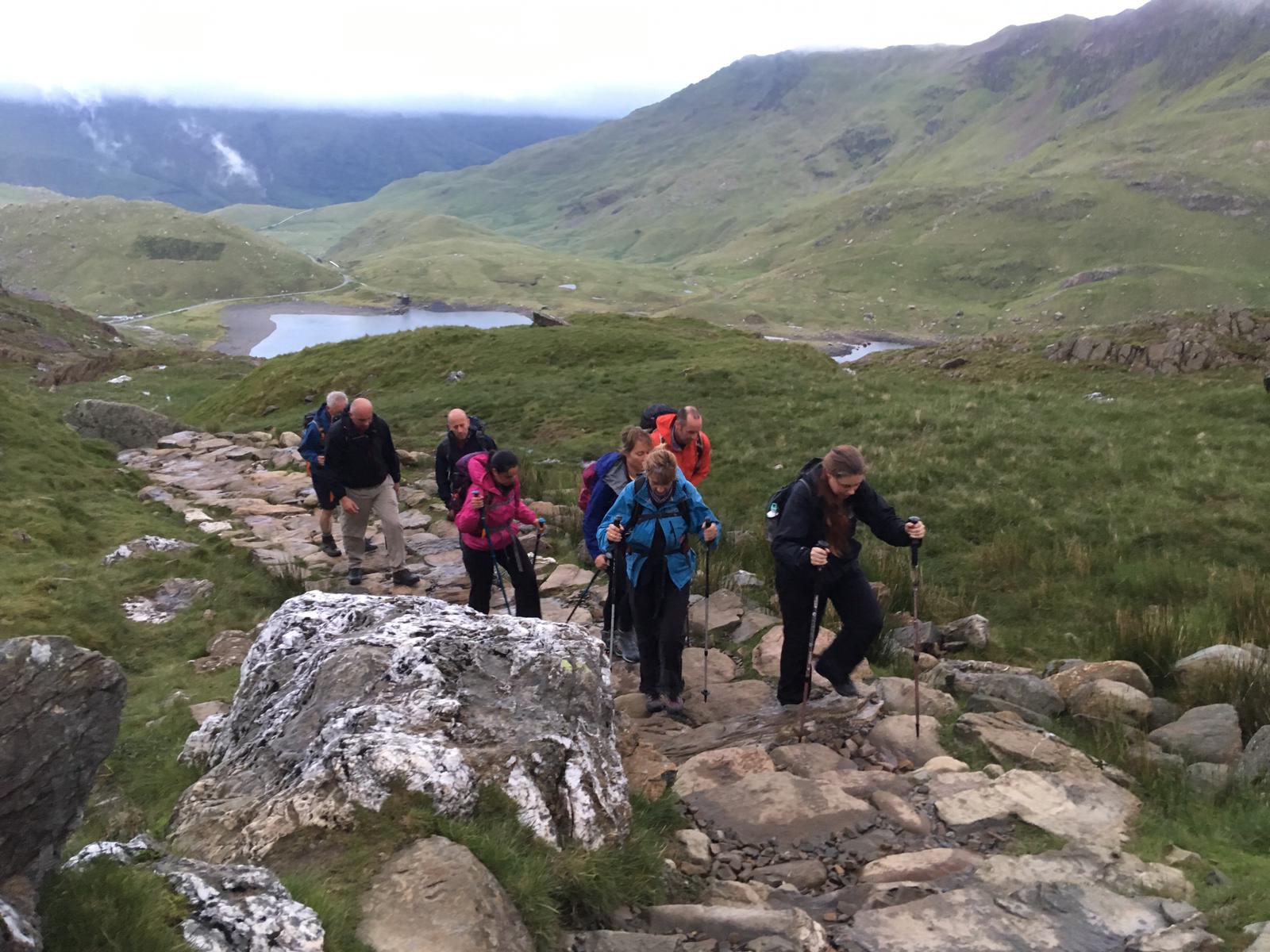
Ben Nevis going up

The First ‘Zig’

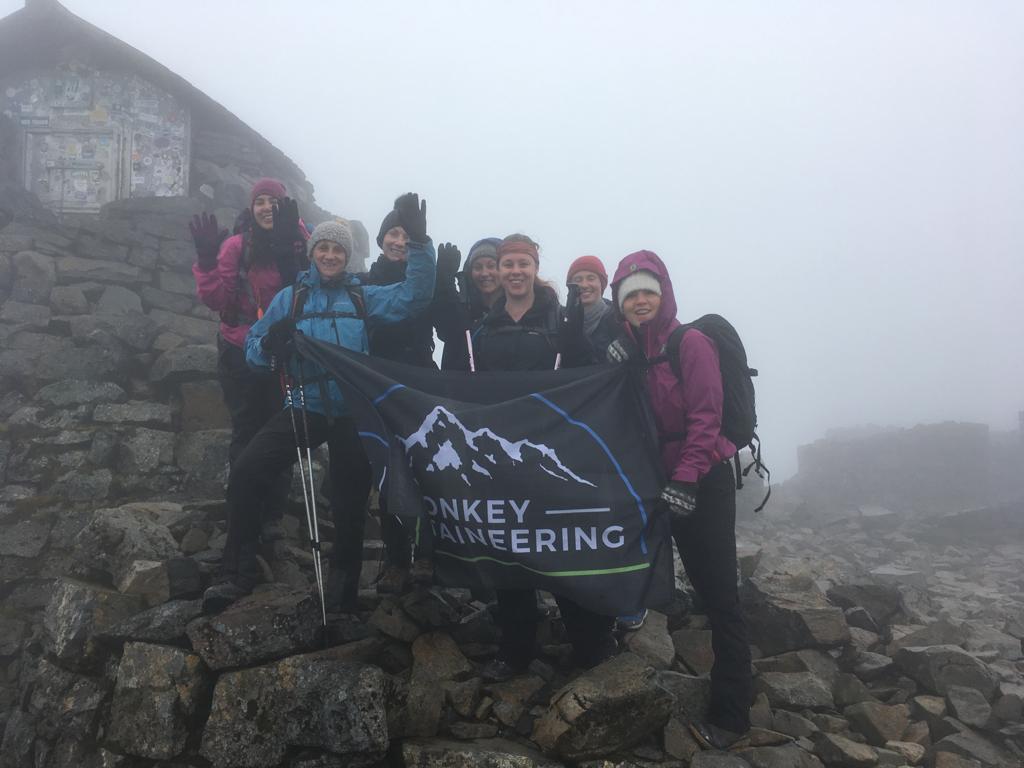
We stopped at this point to put more layers on, as it had become properly cold now and visibility was almost nothing – I could see back down the path we’d just come up but nothing much up ahead and the peak was completely obscured. We must be at least a thousand metres up by now, I thought to myself as I pulled on my jumper, jacket and gloves. I felt much better almost immediately. We scrambled up the last bit to the top, which was very satisfying despite not being able to see anything. Another group photo, and we were on our way down again.

Ben Nevis Peak

The Misty Peak of Ben Nevis

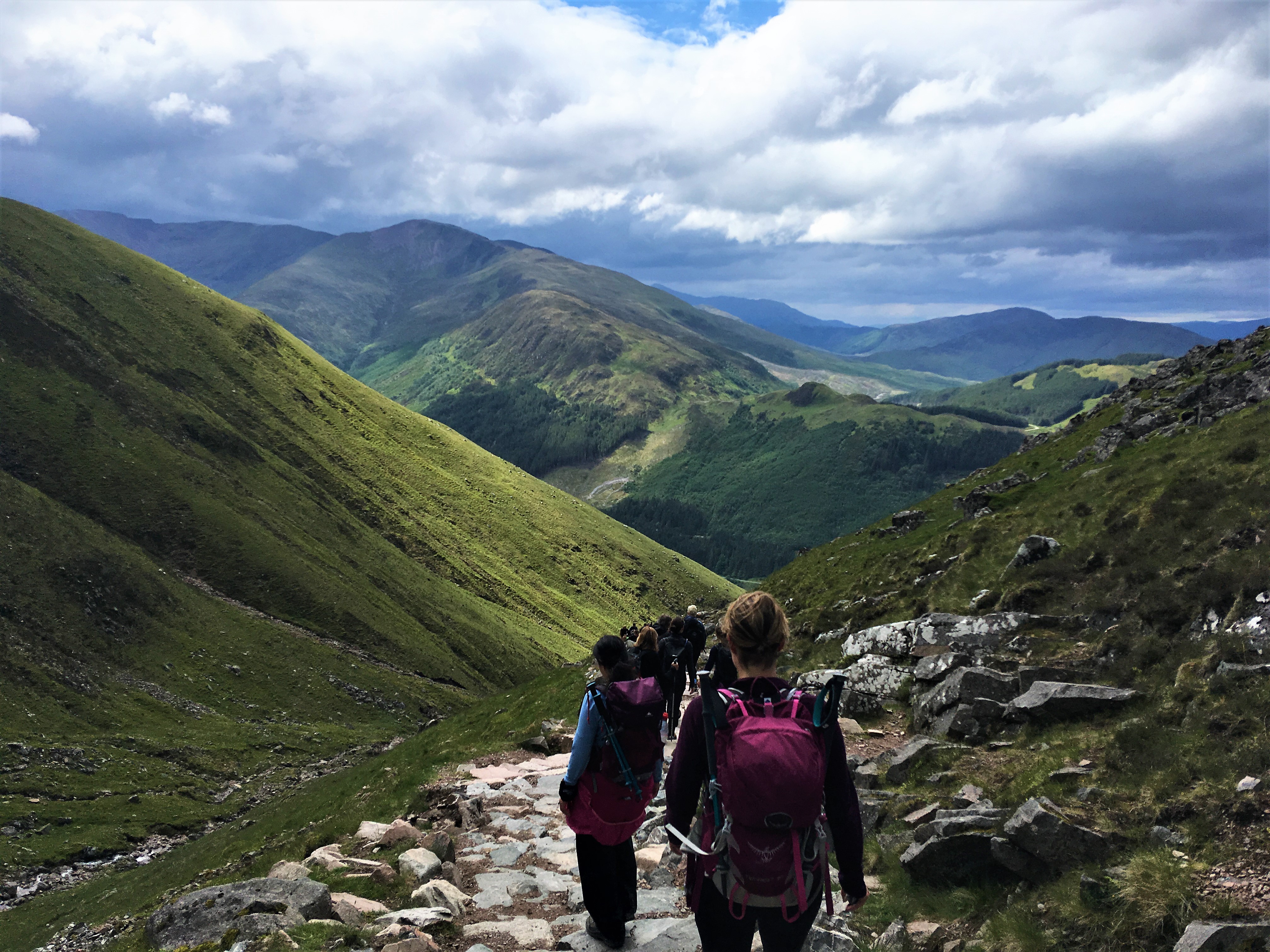
The descent was much easier, although the rocks were still slippery, so I paid careful attention as I picked my way down the zig-zags again. My mood lifted, and the view reappeared as we came down below the cloud cover, revealing a vista of lakes and mountains in full sunlight. I felt pleased to be there, and now it was my turn to encourage disheartened climbers trudging up the other way. “You’re almost there, keep going!” I called to anyone who looked like they needed it.

For a while I led the way, and for a time I lost sight of the group behind me. I enjoyed the quiet, and when I reached the waterfall again I couldn’t resist getting my camera out before the group caught up and it was time to move on again. The climb became harder after that and I fell behind as the path got steeper and narrower. Sam stayed with me, and as we diverted off the path we’d come up to take a shorter one down to the bus I felt my knees straining, and was again grateful for the poles. I reached the bottom about ten minutes or so after the others, and I had time to use the bathroom, change my clothes, which were soaked through with sweat, and we were off again. I also managed to find a cup of tea, and I sipped it gratefully as we headed south again.

Ben Nevis Views

The Lochs and Valleys of Ben Nevis

It took most of the afternoon to reach the Lake District, and we chatted at times, dozed at others, and snacked on protein bars and sandwiches. The girls at the back were well organized, and I watched, amazed, as one of them pulled out a bowl and a knife and made them all a salad of avocado, chickpeas and tuna, putting my Tesco pasta salad to shame. I tried to rest, but it was hard to get comfortable with all my bags around me – where did all my stuff come from? – and my legs were aching – I longed to put them up and close my eyes, but it was impossible and eventually I gave up and fell back on the time honoured technique of hoping for the best.

We stopped to refuel and stock up on supplies, and I came back to find my seat was sopping wet. Someone had put my backpack up on the seat to move past, and the Camelbak was leaking. I wanted to get all my stuff out and sort it out, but I already felt that I was inconveniencing everyone enough by being slow and having too many bags, so I dropped the Camelbak into another plastic bag and shoved it under the seat. Fortunately my camera was dry, but my jumper wasn’t, and after ten minutes of driving, neither was my bottom.

Just when I thought I couldn’t be any more uncomfortable, we arrived at the edge of the Lake District and the road became noticeably windy. Our driver, in a hurry to get us there in the shortest time possible, was hurtling around bends at an alarming speed, and I began to feel distinctly queasy. I really didn’t want to be causing any more awkwardness, but on balance I that was better than asking them to stop so I could be sick on the side of the road, so I hauled all my bags up to the front of the bus, where there was a free seat behind the driver. It was better, and it was a double seat so I had a bit more room – not to mention it was nice and dry. I wanted to sort out my stuff, but felt too ill to do anything more than close my eyes and take deep breaths until we were almost there.

At around 7.30 we arrived at the Scafell car park, and the cool air was lovely and refreshing. As we went through all the steps of getting ready – using the portaloos, checking shoelaces, hitching bags onto backs, I couldn’t help feeling that I wasn’t ready – my legs weren’t recovered from the first mountain – but I had to lead the way, there was no choice about it.

“Karleen up front!” Sam called, confirming what I already knew. One of the girls – Katie I think –  looked me in the eye and said, “Come on, Karleen – you’ve got this.”

“I’ll do my best guys,” I said. Then I gritted my teeth and we set off again.

The path to the top of Scafell Pike peak went up, and up, and up. It didn’t take long before my determined starting pace had reduced to a forced walk, but to the girls behind me it must have felt like a crawl and I could sense their frustration. Every so often one would creep past me, and Sam would call out and they’d drop back again. But they were never far behind, and if I stopped, even for a second, they would walk into me, and every time I tried to pull my shirt down, hitch my trousers up or grab a snack from my pocket I heard a squawk from behind me as my poles swung back and caught them on the leg or the hips.

Scafell going up

Scafell Pike – Up and Up and Up

And still the path went up, and up, and up. We crossed a stream, and Sam came forward to lead us over before dropping back again. He got us playing word games, which distracted us for a while, but still the path went up and up.

The weather was fine, and the setting sun was turning the sky a glorious orange as we climbed. My knees were holding up – the tape was working – and the poles helped, and I couldn’t help thinking that in another situation this would be a wonderful experience – if only I had time to admire the view, stop for a snack, close my eyes and breath in the scents and sounds of the mountain. But we were on the clock, we had a target to make, and the only things I was aware of was the burning in my legs and the constant presence of someone close behind me, ready with a ‘come on Karleen’, or a ‘keep going Karleen!’ every time I hesitated or took too long to breathe in between steps.

For a while, Gerry and Sam walked behind me and I could hear them talking. It seemed that they had known each other for a long time, and they were comparing stories about gyms, workouts and exercise regimes, which unlike the lurid love life stories weren’t in the least distracting, and only reminded me of how unprepared I had been for this challenge and how much I was hurting. Eventually I couldn’t stand it any longer and had to beg them to please, pleeeease talk about something else!

They looked taken aback, but they were quiet for a while and eventually Gerry came up to join me for a bit. I asked her about the NYF, and told her about my day at the centre, and as I felt myself getting fired up on the subject I got a little energy boost and was distracted for a while.

As we were getting nearer the top, we had to stop for Sam to tend a blister for Katie. The view was spectacular, and I took the opportunity to take a few more photos before grabbing a quick rest. One final climb up, and we were at the top, two hours after we’d left – on target, which was a great relief to me, at least.

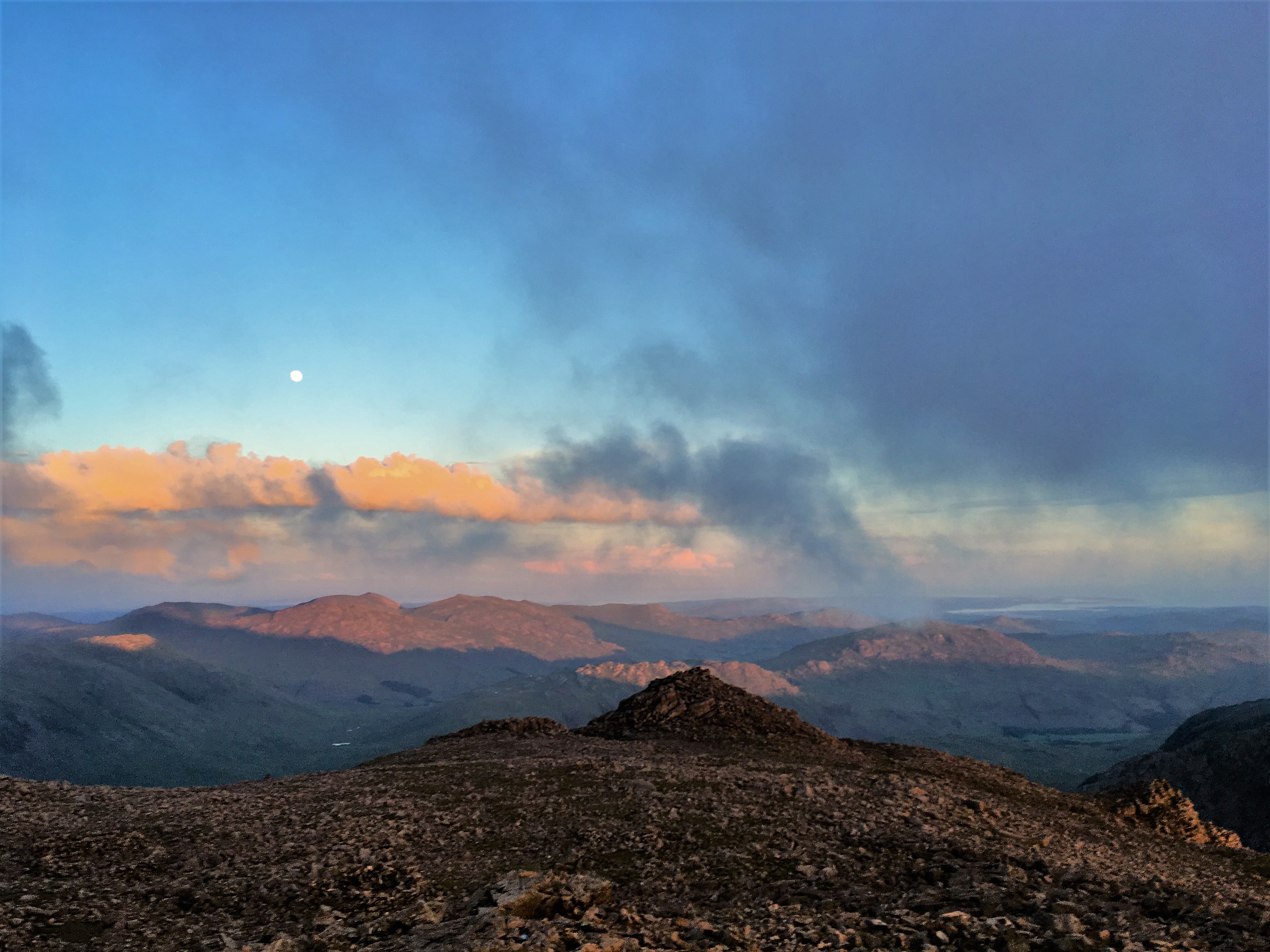
Scafell Sunset

Sunset Over Scafell Pike, Lake District

The view was spectacular, and we reached the top just as the sun was setting, sending sparkling orange rays over the mountains and reflecting off the still lake. It reminded me of Hogwarts. We stopped to admire the view for just long enough to appreciate how lucky we were – every one of us knew that if the weather had been bad, the climb would have been not just hard, but absolutely miserable.

Scafell Peak

Two Down – Scafell Peak

Sam was hoping to be down again in another two hours, and I was determined to make it. I set a much faster pace going down, determined to prove I could do it and that I wouldn’t hold everyone up if I didn’t have to. I chatted to Gerry a bit more, who besides being able to tell me stories of the NYF was being very encouraging and refused to listen to my laments about how slow I’d been going up. “Don’t worry, you’re smashing going down,” she kept saying. “We’re all fit, but you’re doing really well and you’re much fitter than you think you are, and you haven’t complained, you’ve just kept going.” I thanked her for saying so – it meant a lot, especially when I couldn’t help feeling that they probably all wished I hadn’t come.

At one point, Sam noticed that my backpack was dripping, and it turned out my Camelbak was leaking through the plastic bag. He got it out and emptied it and we carried on going down, at a good pace, and I was pleased with myself. The poles helped enormously, and my balance held, and finally I didn’t feel like I was too slow. The sun had set, and the evening grew darker, but a full moon appeared in the clear sky and lit our way for a bit longer. I was concentrating hard on where I was stepping, but there was space in my mind for me to appreciate how lucky we had been with the weather, and how much it was saving our energy for the final peak, when it wouldn’t matter so much if we were soaked and dirty at the end. We reached the stream we had crossed going up, and Sam came forward to lead us across it. It was getting darker now, and the path was narrower, so for the last stretch we got our head torches out. Most of the other climbers also had theirs on, and looking back it seemed like a Christmas procession coming down the mountain behind us. Some people were still heading up it, some even jogging, and it occurred to me that they must be even madder than we were.

Scafell Full Moon

Full Moon Over Scafell Pike

When we got close to the end Sam must have given the others some kind of signal, and they all zoomed off ahead of me towards the bus and the loos. I sped up a bit too, but still couldn’t go as fast as they could, and so as usual I was the last to finish and had the least time to sort my things out. I had time to use the toilet, but not to change, so I got back on the bus in damp underwear and feeling distinctly uncomfortable. Still, Sam reported that we’d got down in an hour and forty minutes, which was bordering on fast, and everyone was pretty impressed. I still felt like the others would be managing so much faster without me, but at least we were still on track to complete the challenge, and I almost managed to convince myself that it was better for us to pace ourselves anyway than to push so hard that someone does an injury (I even almost believed it).

I sat back up the front again and I was grateful I had, because the road was even windier heading out of the district and the driver seemed to be in a desperate hurry to get to our service stop, where he would be handing us over to another driver and heading home. He hurtled along like a rally driver, careening round bends, speeding up and slowing down, tailgaiting and swearing at slower drivers. I tried to eat – I needed to eat – but the queasiness was setting in again and my stomach seemed to have closed itself. I drank some water and slowly and painfully got through a protein bar. I tried to rest, but even when the road straightened out I couldn’t get comfortable with my underwear still damp, and wasn’t about to try and change when there were two men in the front with a large rear view mirror giving them full view into the back. I changed my socks, and was pleased to find I had no blisters, and only a couple of hot spots. I propped my feet up on my bag for a while, then closed my eyes in the hope that exhaustion would help me sleep.

We drove through the night, but it was not a happy journey.  The bus grew quieter, heads nodded and blankets came out. Some of the girls were whispering quietly to each other, others were looking at their phones. Some got a bit of sleep – I could see their heads nodding – but I was not so lucky. I turned one way and then the other, tried leaning on my bag, using it as a pillow, but I just couldn’t get comfortable, and the windy road didn’t help. After a little while Sam climbed into the back and lay down for a nap, which meant I couldn’t stretch my legs out, and as the hours ticked by I began to feel cold. Wretched thoughts filled my mind and I had no strength to push them out again. I was cold, tired, uncomfortable, seasick and I had wet underwear.  I was underprepared for this whole thing, when everyone else was fit and capable, and I stuck out like a sore thumb. I had too much stuff, and couldn’t get organised, I had a leaky water container, the wrong kind of snacks, and had no idea what I was doing. I felt like a great heffalump. Or perhaps a woozle, or anything else unpleasant that was annoying everyone else. Why had I suddenly become that person?

We stopped in the small hours to change drivers and have a quick toilet stop. Our new driver was slightly more sedate, but I gave up on sleeping as the sky began to lighten and the mountains of Wales came into view. I had just started thinking that we must be getting close and I’d better try to eat something, when Sam called “right everyone, let’s go!”

There were exclamations of surprise from the back – what had happened to our 15-minute warning? No one had shoes on, no one had eaten breakfast, no one was even properly dressed. Thank goodness I had plastered my feet already, and I shoved my shoes on and ran to the toilet as quickly as I could. Once again, there would be no time to change. I tried to eat a protein bar as the others were tucking in shirts and checking bags, but it was no good – fatigue had set in, and I couldn’t stomach anything, and there was no way I would be able to go up this mountain without the poles, which meant no free hands to eat. I would have to tackle Mt Snowdon, the last and most difficult of the peaks, with damp underwear, no sleep and an empty stomach. I was not looking forward to it. My only consoling thought, not that it was worth much, was that at least, for once, I wasn’t the only one who didn’t feel as though they’d had enough time.

We set off before the sun was up at around 4.30am. It was cold, and we started in t-shirts with our jackets on this time. The first half an hour or so was not too bad – there some flat bits, some rocks to climb over and a ladder to scale. Sam came up front with me and chatted for a while, which was nice. But it wasn’t long before the familiar burn in my legs was back, the queasiness returned, and my chest heaved. I was running on empty, I’d taken in no fuel, and my energy was zero. I pushed myself on.

“Not puffing already are you?” asked Sam jovially.

I cursed him in my mind for announcing my weak condition to everyone behind me. “No, no – just psyching myself up!” I replied. It was a lie. I was out of steam, and there was a whole mountain to go.

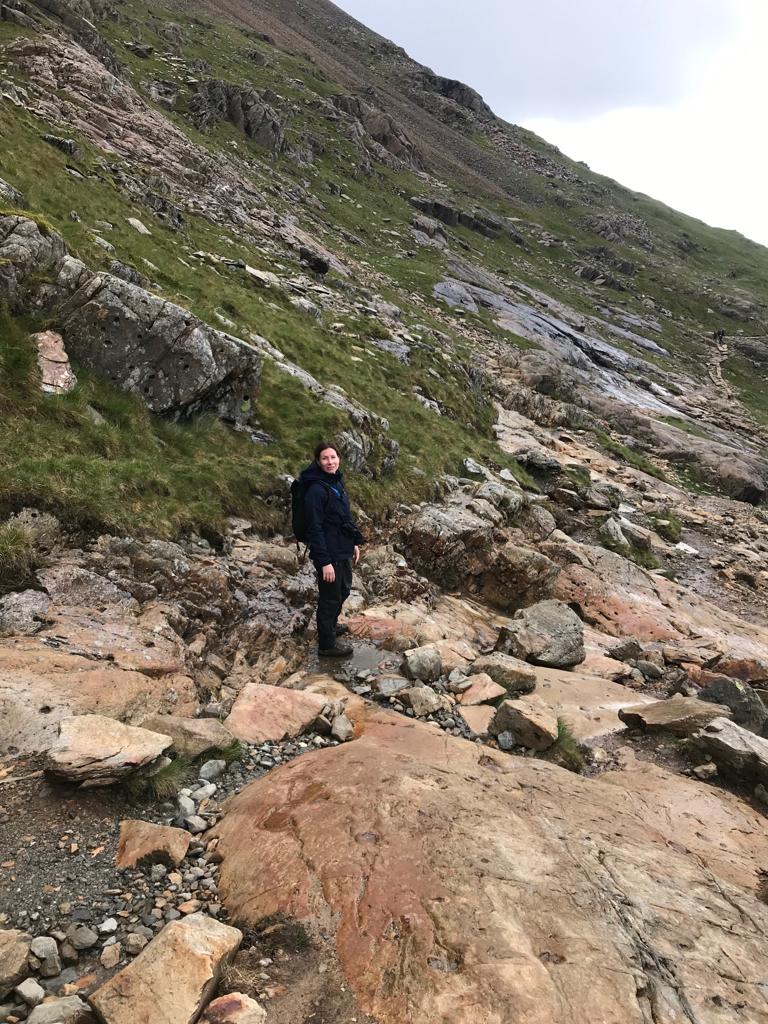
There were two routes up the mountain, Sam told us, and he’d picked the harder but quicker one, in the interests of completing the challenge on time. I made a mental note to myself that if I ever climbed this mountain again I’d be taking the other way, and I clearly wasn’t the only one who thought so – I could hear mutters of discontent from behind me, including from one or two who had used the other path before and were finding it wasn’t what they had expected. The view, at least, was pretty, and though the peak was obscured in thick fog the valleys and lakes below us came into view as the sun rose behind us. I had no energy for taking photos, but I did at least have the strength to appreciate that in any other circumstances I would have been thrilled to enjoy such a moment of nature’s splendour.

Going Up Snowdon

Struggling up Mt Snowdon

It was tough. With every step my mind was repeating over and over ‘It’s hard. I can’t. It’s hard. I can’t’. My shoulders began to ache with the effort of pulling myself up, a blister was forming on my left palm and my trousers had started to chafe, but it was nothing to the pain in my legs, the squeezing of my empty stomach, and the burning in my chest. I hauled myself up, step by step, gritting my teeth, hauling one foot up one step at a time and then dragging the other one up to meet it, swapping feet every few steps. With each hesitation a voice came from behind me – “Come on Karleen, keep going, don’t stop, one foot in front of the other, that’s it, keep going”, as if I didn’t already know that’s what I was supposed to be doing. And still there was that voice, repeating over and over, “It’s hard, I can’t. It’s hard, I can’t.” And yet, I did.

We stopped for a drink, and someone said, “Are you ok Karleen? You look a bit white.”

“No no, I’m fine.”

“Are you sure? Did you eat anything before we left?”

“No, there wasn’t time. But I’m ok, I’m fine.”

“I don’t think you are; do you want some flapjack? There’s some left.”

“No, no.”

“No, I think you should eat some.”

Someone – it might have been Katie again – put a piece of flapjack in my hand and I nibbled it slowly, and to my great relief, I felt some energy creeping back into my muscles, and my stomach unclenched a bit. I thanked whoever it was, and on we went, with me in front as usual, and all I could see ahead of me was rock, and dirt, and more mountain.

It began to rain, and we stopped to pull on hats, gloves and waterproof trousers which did, at least, hold my other trousers up and ease the chafing. On and on we went, and the voice came back louder than before: ‘It hurts. I can’t. It hurts. I can’t’. The rain grew heavier, and my borrowed jacket and trousers did their job and kept me dry, but I began to worry about my camera, as I didn’t have a waterproof covering on my bag. I hoped it was wrapped in my jumper, but I didn’t dare ask to stop if I could check. Eventually we crested a small peak and met up with the tram track that takes visitors to the top. Oh, how I would have loved to get on a train and go down! But we were near the top – though we couldn’t see it – and Sam urged us on.

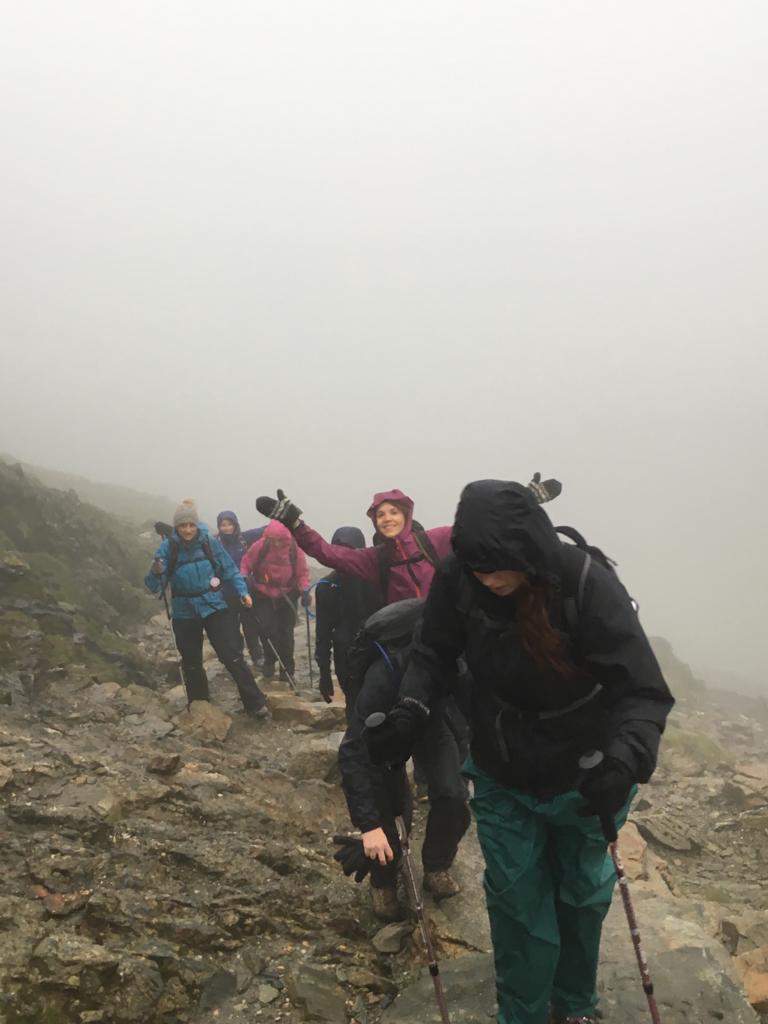
Struggling Up Snowdon

Sideways Hail on Mt Snowdon

We were exposed now, on the other side of the mountain, and the weather grew fouler. We could see a few meters in front and that was it. Rain came at us sideways, and then hail, battering our arms and poking us in the eyes. Ahead was only dense fog, and every time I asked Sam where the peak was, he refused to say.

“Is that it?” I would ask.

“No.”

“Is it that one?”

“No.”

“That one?”

“No. don’t ask, just keep going, don’t think about it.”

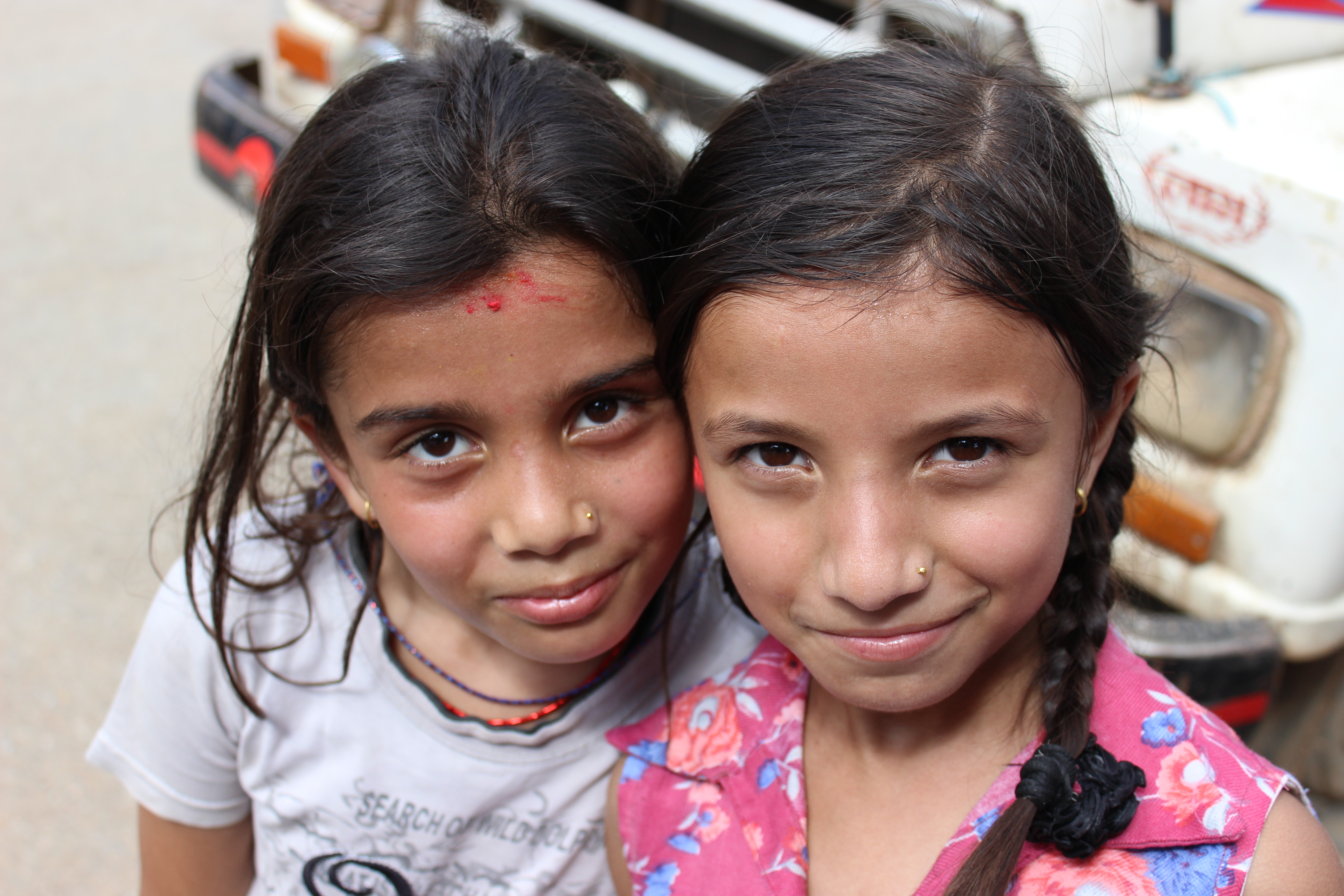
But I needed to know, I needed to see how far it was, and to see the distance getting smaller, not stare into a cloudy abyss with no knowing when it would end. The last stretch was awful. Each step was a strain, each breath an effort. I wanted to stop, I wanted to turn around, I wanted to shelter behind a rock and wait for the sun to come out, but I kept reminding myself that people had donated money for me to do this, and how would it be if I had to go home and tell them I didn’t do it? I thought of everyone who’d donated, everyone who’d loaned me clothes and equipment, and I thought of the children in Nepal who’d be able to eat and go to school because of that money. I thought of two girls I’d met in Tansen who might be able to follow their dreams, and I thought of the girls behind me who’d been pushing me and supporting me all the way.  Finally, finally, there was a peak up ahead and it had people on it.

“Is that it?” I asked Sam.

“Yes, it is.”

Hurrah! I pushed on, and we were at the tram stop, with one set of steps to go. I pushed on again, one last time, and we were at the top.

Mt Snowdon Peak

Success at Last – Mt Snowdon Peak

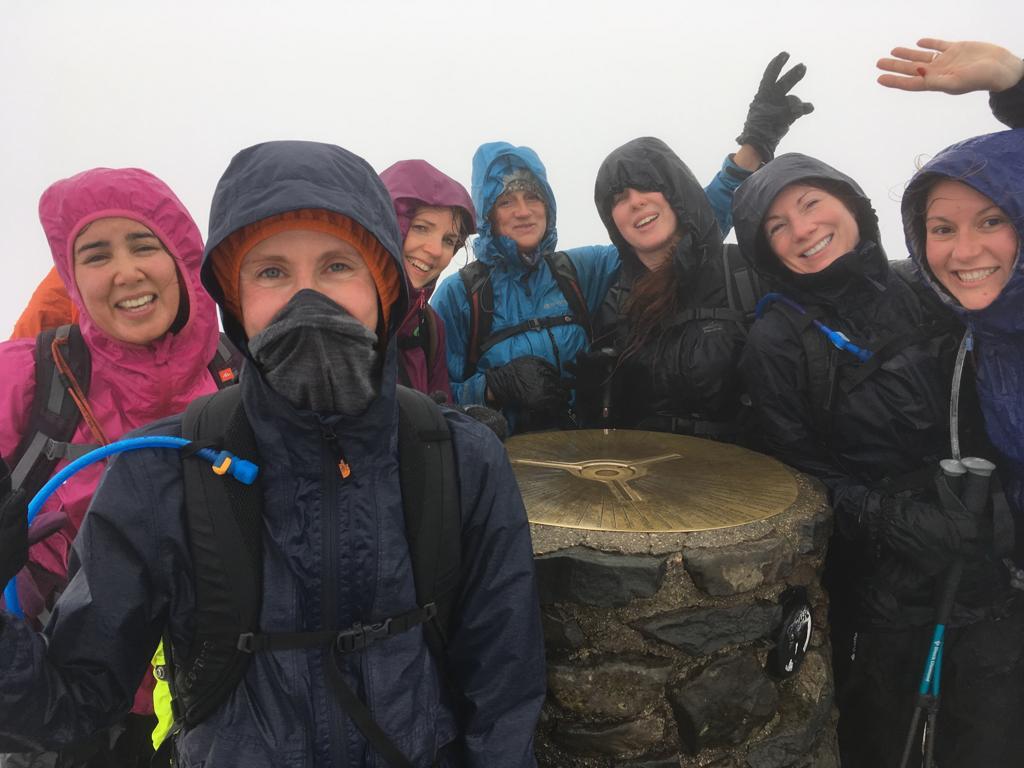
The relief in the group was palpable. We’d done it! There was a plinth, one of those one that have arrows and distances pointing in every direction. I collapsed onto it, never so grateful for the cool feeling of metal on my face. We took another photo, with the wind swirling around and our hair going wild, and then it was time to head back down, past the tram stop, along the track, turn at the plinth to go down to the right. Nobody could remember which one it was, so we stopped to wait for Sam, then down we went, through the mist, over wet rocks and across streams. It was hard, but so much easier than the way up, and I told myself that once I was down, that was it, I could relax, there would be no more mountains. Sam had hinted that he had something to celebrate when we got down, and I had an idea what it was, and I thought of that. the voice in my head was still there, but it had changed its tune, and now it just said ‘It hurts. It hurts’.

The others pulled ahead of me and Sam let them go. I didn’t want to arrive ages after everyone else again, but I couldn’t go any faster. Sam stayed with me, and I tried to get him chatting, as a distraction, but perhaps he thought talking would wear me out faster. I slipped on a rock and my knee slammed against the stone wall, but the path was narrow and I stayed upright. My calves began to protest and finally I could feel blisters on my toes. I ignored them, I told myself it didn’t matter, I could rest after this.

We caught up to Kellie and Alicia for a bit, but then the path became steep and treacherous and they pulled ahead again. They were chatting as they went, and for a little while I felt sad and lonely that I hadn’t had someone to chat with – not that I would have been able to. It was like the mountains in Nepal all over again.

“Do you think the other would be there by now?” I asked Sam.

He frowned. “Maybe. I’m not really happy that they went ahead, where’s the team effort?”

“I don’t mind”, I said, which was mostly true. “They must have been bursting to go at their own pace the whole weekend, and they’ve been good about not showing it, but I know they’ve been frustrated.”

“That doesn’t matter,” he replied in his broad Yorkshire accent. “Don’t worry about it. You shouldn’t feel guilty, it’s about you and what you can do and prove to yourself. You can only at your pace, and you’ve done really well, you should be proud of yourself.”

“Thanks.”

I was, it was true, but I’d be more proud when it was all over and I’d stopped hurting. Lots of people were passing us now on their way up, and I offered words of encouragement, like I had on Ben Nevis. We were so nearly there! I started to feel hungry again – surely it must be nearly lunch time? I couldn’t check my watch without impaling someone behind me, so I asked Sam – it was only 9am.

The path flattened out, and I heard Sam behind me say: “Do you see that gap in the wall where the others are going through? If you can get to that in two minutes you’ll complete the challenge in time.”

I looked up and saw Kellie and Alicia clambering through a small gap in a dry-stone wall. It was about 100, maybe 150 metres away.

“Ok, I can do that.”

And I did.

I stepped through the wall, raising my poles above my head as I did so, but there was no applause, no hugs, no pats on the back. I felt Sam raise his eyebrows. No one else even noticed. But it didn’t matter, I’d done it, and that’s what counted. We made it back to the bus, where the others were busy sorting stuff out, grabbing snacks, brushing hair. Some had even had time for a shower. Sam went immediately to the back of the bus, and I discovered my hunch was right – out of his bag he pulled a bottle of prosecco and some plastic cups. He handed it to me and I opened it like a pro, pleased to finally be good at something. We shared the bottle around and it was wonderful, despite the fact that it was warm and it was only 9.20am. I didn’t care. I felt we had earned it. Belatedly I remembered the nip of whisky I had packed into the bottom of my backpack, and wished I’d remembered it for the last struggle up Snowdon. Oh well.

I grabbed my bag and went inside to change, savouring the luxury of dry underwear, clean socks and tracksuits. I didn’t really want to put my boots back on but it was too cold to go barefoot, so I pulled them on, leaving the laces undone, and treated myself to a very large cup of tea from the canteen. Ah, it was wonderful! I would have loved to sit there for a while, enjoying the tea, looking back at the mountain and savouring our victory over the three peaks. We were only two hours away from Manchester, and I had no plans for the rest of the day, so I didn’t feel the need to rush. However the others were all keen to get back, to catch trains, to get return to their families for Sunday lunch, so we bundled back onto the bus one last time, and very soon we were back where we started, at the train station in Manchester. It was still only a bit after midday, but I was desperate to sleep, so I rang my hotel and thankfully they said I could check in early. It took me a long time to walk the one mile to the hotel, with my legs seizing up and my too-many-bags. But I made it, took another 20 minutes or so to get up the two flights of stairs, sent my parents a message to say I’d made it, and crashed into bed.
It took me several days to recover from the challenge (not to mention it took 15 minutes to get down the stairs in the morning) and it took a full three months for my big toenails to fall off, but it was worth it. I proved that I could do it – despite being unfit and unprepared – and I didn’t prevent the others from completing it in time either. But most importantly of all, I raised £1,000 for the Nepal Youth Foundation, which is a fantastic amount in a country where our currency goes a long way.

IMG_8093

The Two Girls from Tansen

I’ve been asked many times since then if I would ever do it again, and the answer is, probably not. If I were to climb those peaks again I’d like to do them one at a time, without being on the clock, and be able to stop more often, enjoy the views, and take more photos. But I’m glad I did it though, and I’m even more glad I was able to help a worthy cause along the way. If you’re one of the people who donated, I thank you from the bottom of my heart.


Volare, Cantare: Twenty Years On

19/09/2019:

Today is a significant day. It is exactly twenty years, (ignoring time differences) that I first left Australia to go overseas – specifically, to Italy. It was a school trip, and I travelled with seven of my classmates, all of us girls aged 16 or 17, and our two Italian teachers, Mr Civetta and Ms Russo. I had a shiny new passport – my first one – a handful of traveller’s cheques and my dad’s Olympus camera with about ten spare rolls of film. I’d only ever flown once or twice before, domestic flights, so stepping on to a Boeing 747 with its four enormous engines and the extra level sticking up at the front, I felt a great sense of newness and adventure.  There was no school uniform in my bag, only  my own clothes, a notebook, my Italian dictionary and a printed out copy of our itinerary, which I had memorised. I was filled with excitement and anticipation.

For the eight of us, even the plane journey was exciting. It was before airlines had screens for every seat, instead there was one giant screen on the front wall of each section, and little ones on the side. Everyone had their own headphones, the really old kind that had three prongs and only sometimes worked. Because everyone had to watch the same thing, we saw a lot of family friendly movies, and I remember a lot of episodes of Mr Bean. Even getting your food on a tray is a novelty when you’re 16 and on your first international flight – and we even had metal knives and forks then.
At one point, when it was dark and we must have been somewhere over the sub-continent, Mr Civetta sweet talked one of the crew – I have no idea how – and they let us go up into the cockpit in pairs. To get there, we had to go through the sticking up section at the front where the first class passengers were reclining in endless space – I even remember seeing  a boy younger than us with enormous headphones and playing a game on some kind of laptop or console – which back then was something I’d only ever seen in movies. However, that was nothing to the sight waiting for us from the cockpit, and for a second I felt as though we were floating between worlds. Far below us, a smooth blanket of cloud blocked the earth from view and above us a ceiling of clouds hid the stars, but ahead the sky was dark and clear. Far in the distance, I saw a bolt of lightning streak from the clouds above to the ones below – it was one of the most beautiful sights I’d ever seen. We sat and watched for a couple of minutes as the various buttons and dials blinked and glowed in the in the darkened cockpit, before tip-toeing back to our seats.
When we arrived in Italy the wonders continued. We wandered through the non-existent customs at Mestre airport and onto a water taxi, which took us around the lagoon and into Venice. I remember staring in awe as we approached this miraculous city from the harbour, all of us standing up in the boat with the wind in our hair and water spraying our faces. We found our way to the Piazza San Marco, where it immediately started pouring with rain, so we ran through the streets of Venice trying to find our hotel, dragging our cases behind us (in my case literally – I had an old one of my dad’s that didn’t have wheels. Mr Civetta ended up taking off his belt and tying it round the handle so I could pull it along). The hotel – when we finally found it – was called ‘Albergo San Zulian’, and it was small and quaint – the kind with florally wallpapers and baroque light fittings everywhere. It was a bit eclectic too – mine was a room for four and one of the single beds had a bedhead which had clearly belonged to a bigger one at some point, but it had been chopped off about two-thirds of the way along so it would fit against the wall. (As a side note, I have since been back to that hotel and was very disappointed to find it had been renovated and now had a modern reception area with glass windows all around it. I also discovered that it really is just around the corner from the Piazza San Marco – I have no idea how it took us so long to find that first time. But then, this was in the days before Google maps.)

Well, it was wonderful. Each morning a buxom Italian woman would bring breakfast up to our room on a big tray. We tried croissants with Nutella for the first time. Thanks to jet lag, or perhaps it was the lovely exhaust-free air of Venice, I slept like a log. On the first ay, we set the alarm to just before seven so we could listen to the bells of St Mark’s ringing in the morning. On the second morning we set the alarms to just after seven to see if the bells would wake us up, and we slept straight through. Our friends in the other room left their windows open to listen to the city at night, and one of them was bitten by a mosquito on the eyelid. It was a precious and remarkable time.

We had televisions in our room – another novelty – but the only channel we understood was the music channel and it seemed that every time we turned it on there would be Christina Aguilera singing ‘Genie in a Bottle’. There was another, very catchy Italian song that was obviously in the charts at the time, and it was called ’50 Special’, by a band called Luna Pop – it was all about driving out on your Vespa on a sunny Sunday with a pretty girl on the back, which held a certain appeal for us teenage girls. As far as I know they never had another hit (unlike Christina Aguilera) but to this day if I hear either of those songs, it takes me back to those two weeks and having the television on in our hotel rooms.

We did a lot of exploring of the city as well, though I won’t go into too much detail here. We marvelled at the undulating and extravagant tiled floor of the Basilica, we tip-toed across the Bridge of Sighs, sparing a thought for the poor souls who’s final journey it marked. We fed the pigeons in the square (you were allowed to then) and returned in the evening to listen to the musicians battle for supremacy, with one starting up the moment the other had finished, but neither ever interrupting. We took a boat tour out to the island of Murano and gawked at the glass makers, we took day trips out to Verona and Padua and ate a proper margherita pizza for the first time. On the first night, most of us managed almost half a pizza, by the end of our trip our plates would be clean.

Even the sounds were new and different. There was no motor traffic, no horns honking, no tyres screeching, no engine hums. Instead, we heard the lapping of water at the edge of the canals, the boat horns honking from the distant harbour, bicycles whizzing over the cobblestones and the sonorous bellows of “Attenzione!” every few minutes as merchants and delivery boys navigated the narrow streets with their carts and wheelbarrows.

From Venice we travelled to Florence, where it was all about shopping and night life. I think all of us took home something made of leather, and most of us went into a night club for the first time. It was nothing for our parents to worry about, at least – I think there were about three other people in there and we were more excited by the light-up floor than we were about mingling. We kept to ourselves and laughed at Mr Civetta doing silly dance moves. We climbed to the top of the dome of the Basilica, which I know now was designed by Brunellesci, who modelled it on the Pantheon in Rome – although even if I had known then I wouldn’t have appreciated it. I was more intrigued by the rickety staircases and narrow passages that we had to squeeze through to get to the top, and I kept imagining the monks in Renaissance times clambering up here with their long habits and flickery torches, and wondering if they ever tripped over.

We saw all the essential sites and took trips out to Siena and Pisa, but what I loved most about Florence was wandering around at night, through cobbled streets and wide squares, where locals and tourists sat outside restaurants eating and drinking into the late hours, young people gathered on steps and around fountains and statues chatting as only Italians can, and the open squares where buskers plied their trades and hawkers tried to sell silly trinkets, mostly the kind that flash and go a long way up into the air. I discovered that Vespas and scooters make a very distinctive sound as they zoom over cobblestones.  I’m pleased to say that these things haven’t changed.

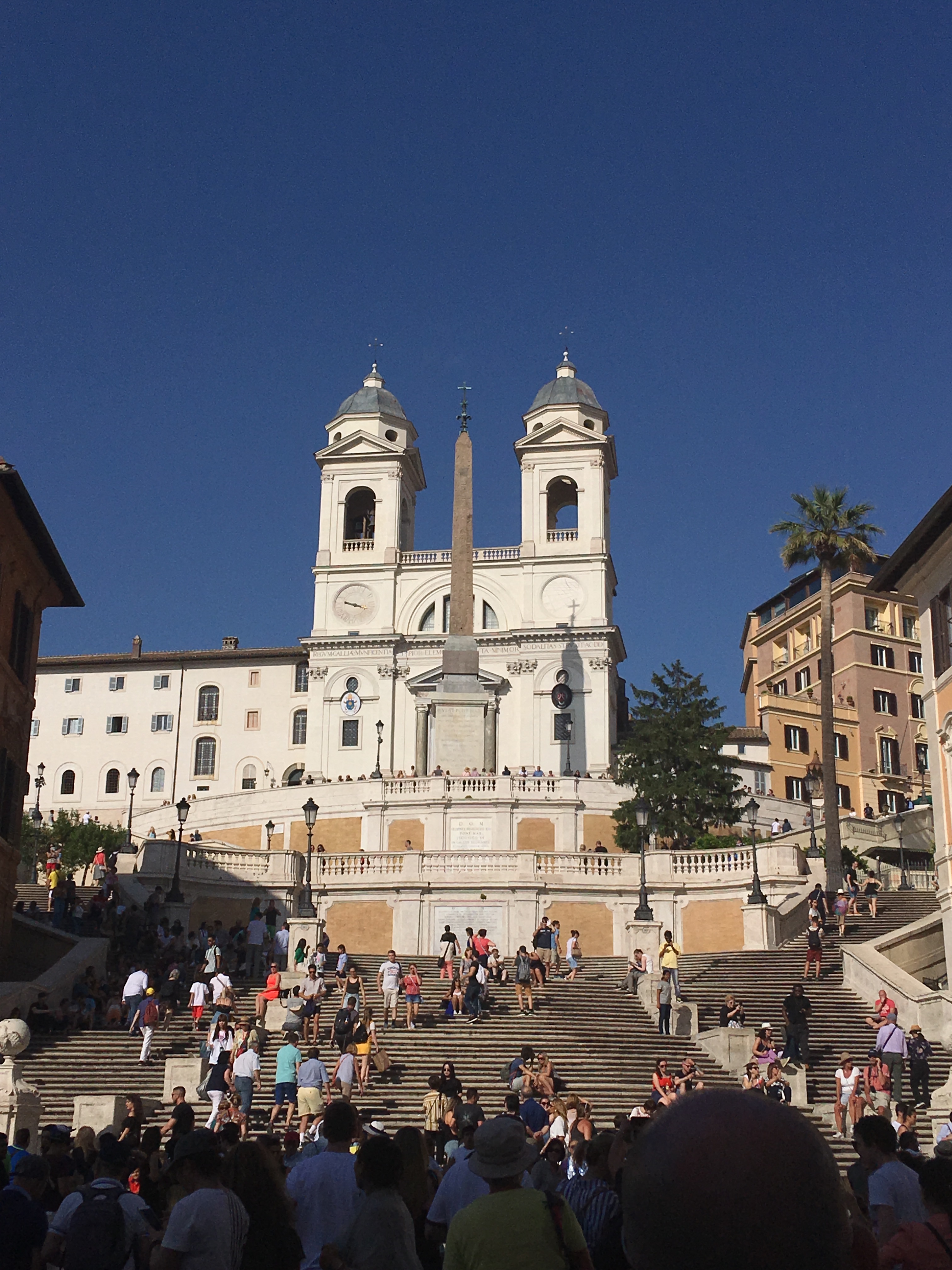
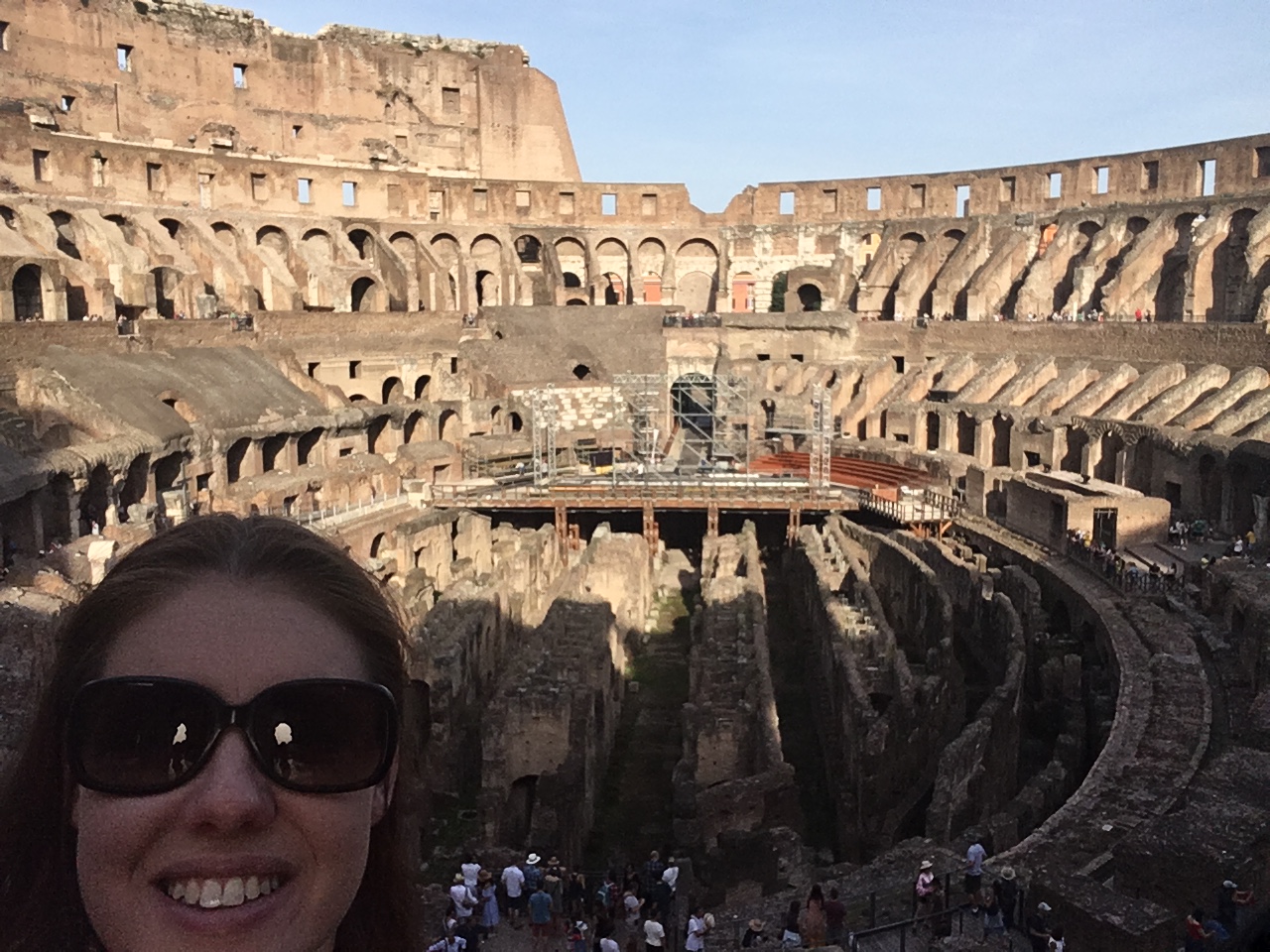
Rome was similarly exciting and different. We toured the Colosseum, threw coins into the Trevi Fountain – to ensure our return to Rome – and climbed the Spanish Steps. On the day we were to tour the Vatican museums, we arrived to find the doors closed and only one security officer – probably a member of the Swiss Guard – in sight. He directed us around to St Peter’s Square, where we found an enormous crowd, apparently waiting for something. At the top of the square we could see, just, a small podium with a green awning over it. On the front of the Basilica hung six giant banners, each with an image of a person. Mr Civetta went to find out what was going on and discovered the pope was going to be saying a mass in the square for the Beatification of the six figures – soon to be saints. Souvenir booklets were handed out to everyone in the crowd and we sat while Pope John Paul II said mass in St Peter’s Square. We didn’t understand any of it, but that didn’t prevent us from appreciating it was a pretty special moment. I still have my booklet somewhere.

While we were staying in Rome Mr Civetta took us on a three-hour train ride south to the town of Benevento, his birthplace. That was probably the most surreal day of the whole trip, as we were made welcome by his family and given lunch, we visited a school and joined a class where Mr Civetta gave a lesson on Australian history, went to a place called Leper’s Bridge – apparently called that because Lepers at one time had lived in a colony under the bridge and locals had given them food by lowering a bucket down from the bridge. I’ll never forget walking down one street past a school and suddenly there was a scrum of boys leaning out every window shouting and pointing at us. We were such a novelty that we appeared a week later in their local newspaper.

It may not surprise you to hear that I was very sad to finish the trip and go home. While the others were expressing sentiments like ‘it’s been fun but it’ll be good to get home’, my thoughts were more along the lines of ‘I don’t want to go home – I want to go back to Venice’. It had all been amazing – the new sights and sounds, the pizzas and the many, many gelatis. Exuberant Italian men, whose behaviour frequently reduced us to fits of giggles – one of them actually chased my friend Sarah halfway through a Florentine market, begging her to take her sunglasses off and show him her eyes, but she was the one who’d been bitten on the eyelid so she refused, to his great indignation. I had never laughed so much, or felt so free of judgement, as I did on that two-week trip. I dreaded the thought of returning home, to rules and rigidity, of being told what to wear and when to speak, to assignments and revision and being judged by my peers. I wanted to keep travelling – I wanted to be free.

Twenty years on, I have not lost my desire to travel. I still love to explore new places and yearn for that sense of adventure. I have seen a lot of the world, and there is a lot still left to see. But it is always Italy – and especially Venice – that tempts me back. I think my sense of adventure was already there, when I first stepped onto that Boeing 747 with the sticky-up bit at the front, and first had a gelato in a plastic cup. But if the spark was there, it was that trip that kindled it, that set the match and nurtured the flame.

I’m still in touch with one or two of the girls I travelled with on that trip, and thanks to the wonders of Facebook I even know what some of them are doing. Some of them, I know, have returned to Europe and to Italy since then. Most of them have settled down and have families now. As for me, I don’t think I will ever stop travelling. The world still has so many secrets to share, and I feel the need to dig them up and then share them in turn. But I’ll always go back to Italy, which feels just as much like home for me as, well, home – as it has for twenty years now. So, grazie, Italia. Alla prossima volta.

Image result for coins in the trevi fountain


All Roads Lead Back

Every time I travel to Italy, I ask myself why I don’t just move there. I love its sights and its smells, its noise and its bustle. I love the culture, the lifestyle, the food, and above all its people, the beating heart of a civilization old and yet new at the same time, grounded by its deep and rich history and yet finding its feet in a new world.

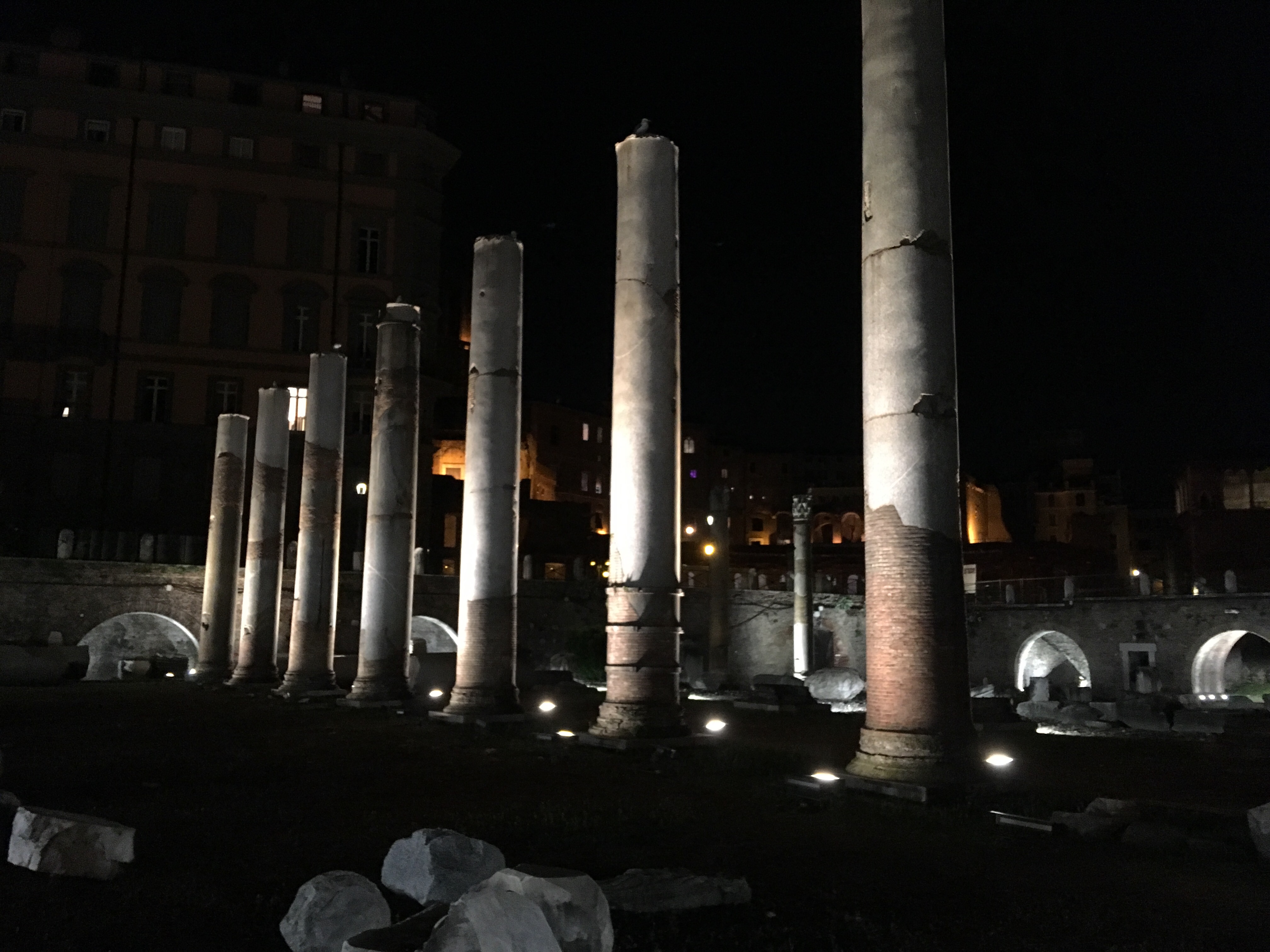
I pondered all this while I stood by my windowsill in a now familiar routine, sipping my morning coffee and looking out at a world I didn’t want to leave. Well, I still had 24 hours in Rome, and I intended to make the most of it. I headed out, once again past the Colosseum and through the old forums. I stopped and looked out at the newly excavated sights and pondered the Romans once again, but this time the ones long gone, who lived their lives in this space. Not the ones we’ve heard about, the emperors and statesmen and conquerors, but the regular ones, who did business in these buildings, exchanged money and goods, petitioned senators, caught up on news and gossip, visited temples and worships their gods. I wondered if regular peasants and travellers who came to their capital looked on it with as much awe and surprise as we do now.

I headed up the hill, not much farther for my first stop for the day, the Capitoline Museum. Sitting atop the Capitol Hill (also known as Campidoglio), it was the religious centre of the old forum but now faces the opposite direction (towards the Vatican) after a Renaissance makeover from Michelangelo. It was Pope Paul III who commissioned the artist and chose the statue of Emperor Marcus Aurelius for the centre, which was no doubt meant as a political statement at the time. However, I wasn’t here for the architecture – grand though it was – but for the museum. I hopped in line, bought my ticket and in I went.

The museum felt to me like a mixed statement of exquisite art and self-importance. I saw artworks by Titian, Veronese and Caravaggio, a beautiful statue of Venus, a marble carving of the head of Medusa, a charming statue of a girl protecting a dove and the original bronze statue of the she-wolf, dating from the 5th century BC. There was also an enormous marble fountain, at least two rooms full of busts of former Emperors (they all had the same grumpy expression), a statue of Helena, mother of Emperor Constantine, and an entire gallery for the statue of Marcus Aurelius on his horse (the one outside is a replica). I wasn’t quite sure what to make of it all, but most of it delighted me.

As the museum is made up of two opposing buildings, you have to get to one from the other through a separate corridor, which looks out over the forum. The sky was being particularly dramatic that day so I stopped and took some more photos on my way past. I found the exhibit I most wanted to see – and the highlight of the museum, for me – on the other side.

The Dying Gaul is a Roman copy – in marble – of an earlier Greek bronze sculpture. It depicts a naked man – a warrior – on the ground and defeated, with a bleeding wound above his heart. However, as I stepped closer I saw defiance and bravery in his expression, as if he died proudly, and I sensed respect and admiration in the hands of the artist. I couldn’t help feeling that this was at least in part a tribute to a worthy adversary, as well as a statement about the glory and power of Rome.

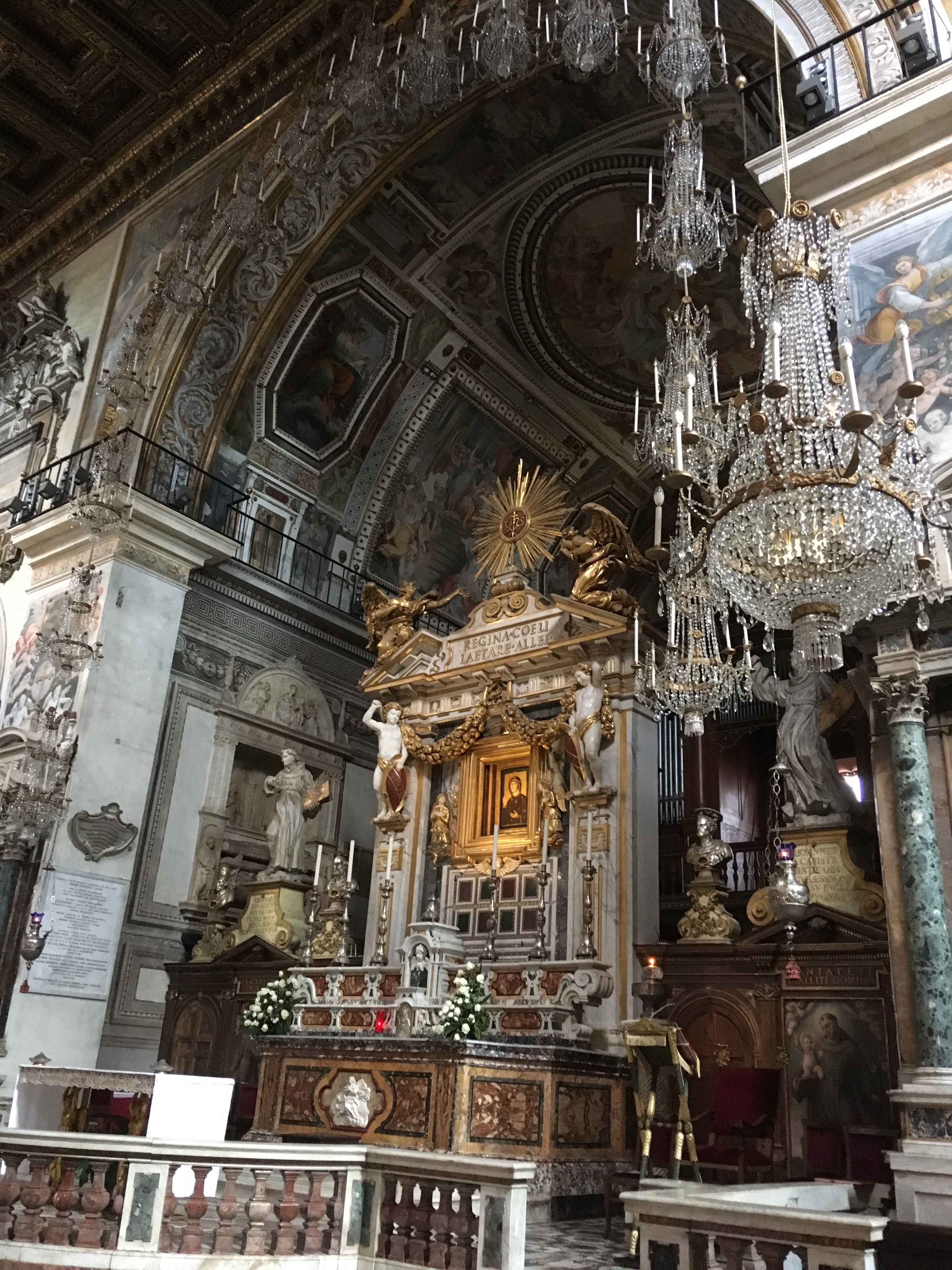
On my way out I stopped for a quick look in the nearby church of Santa Maria in Aracoeli (it’s pronounced ara-shelly) which has a glittering interior made up of chandeliers, mosaics and a gilded ceiling. It was much bigger than I expected it to be, considering that from the outside it looks as though it’s been tucked into a corner. It was a little overwhelming, but very pretty, and couldn’t help thinking that’s it’s probably even more beautiful at night when the chandeliers are lit. I wandered around, passing several chapels decorated with frescoes and other curiosities (including the tombs of St Helena, the aforementioned mother of emperor Constantine and St Juniper, and tucked into a quiet chapel, possibly its most famous relic: a statue of the Christ child carved from olive wood from the gardens of Gethsemane. Every Christmas eve it is brought out onto the high altar where it presides over the Christmas services, but the rest of the time it is housed in this small chapel to the left of the main altar. According to tradition, it’s responsible for several miraculous healings, and even today letters come from all over the world, presumably petitioning the child for healing interventions (apparently, even letters addressed simply with “Il Bambino, Roma” will find their way here). I found the statue and did indeed see several letters piled in a basket next to it, with stamps from all over the world.

20180605_103609744_iOS (2)

The Interior of Santa Maria in Aracoeli

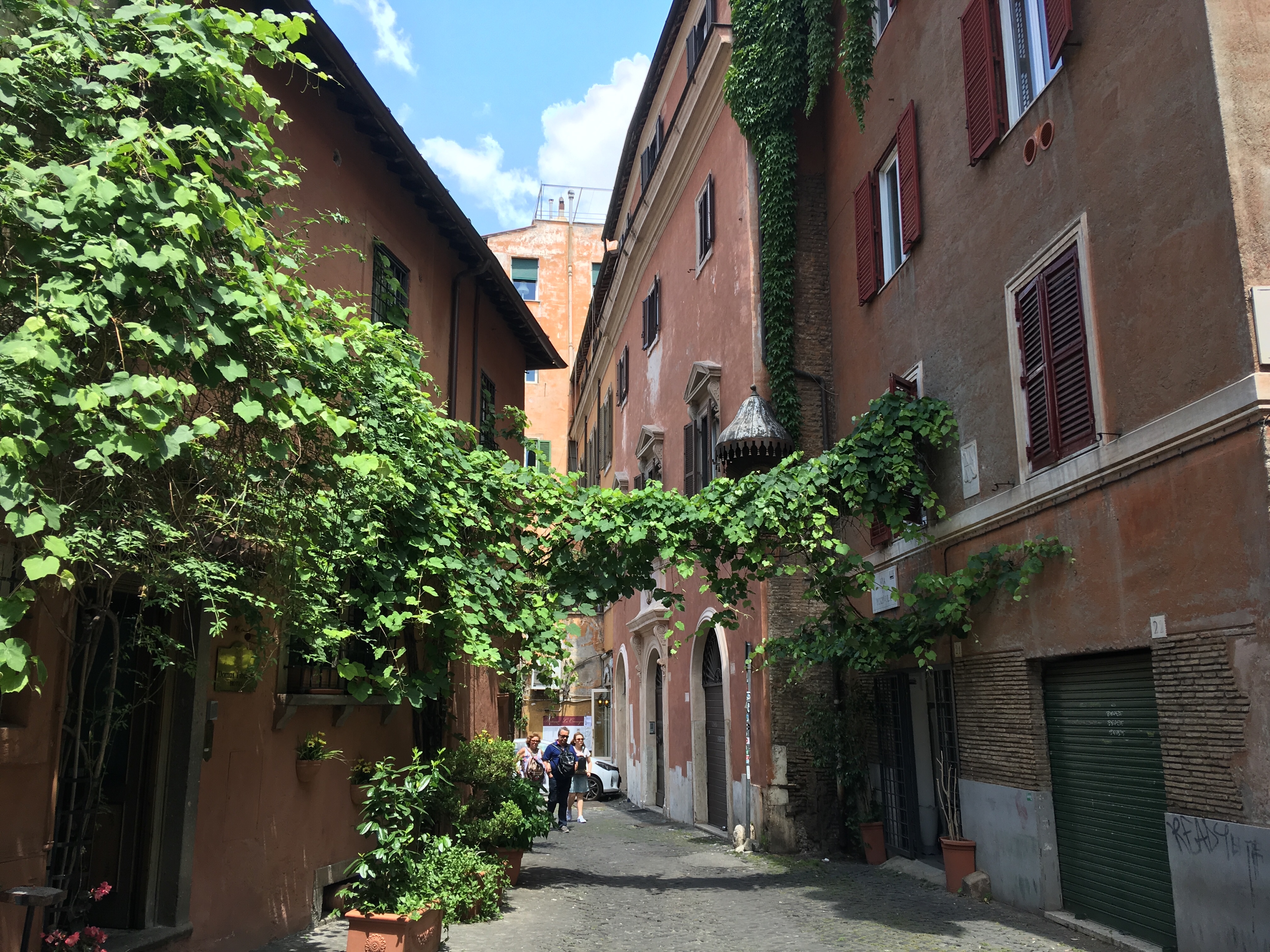
I left the church through the front entrance and headed down its enormous flight of steps to the Piazza Venezia, and turned left to walk around the ruins of the Theatre of Marcellus, named for the nephew and adopted son of Emperor Augustus. From there I headed south to the river and across it to district of Trastevere, which translates literally to ‘across the Tiber river’. I had never been to this area before and was keen to explore it. I found it quiet, sleepy, as if it hadn’t realised it was daytime yet. The narrow streets with awnings jutting out and vines growing overhead made it cooler and quieter than the busy part of the city, and I wandered around for a little while, passing others doing the same. There was no bustle, no clamour of tourists – I liked it, despite most of the shops being closed. Perhaps siesta time started early here.

20180605_110722258_iOS (2)

The Quiet Streets of Trastavere

I passed a row of restaurants, thinking that I might choose one to have lunch in, when a colourful display on the corner caught my eye and I discovered a Nepali shop, open and crammed with oriental nick knacks – prayer flags, incense holders, beads, bags, elephants of all shapes and sizes. The owner turned out to be from Bodnath, on the outskirts of Kathmandu, and I had to resist the urge to buy half his shop! After a nice chat I headed off to find lunch.

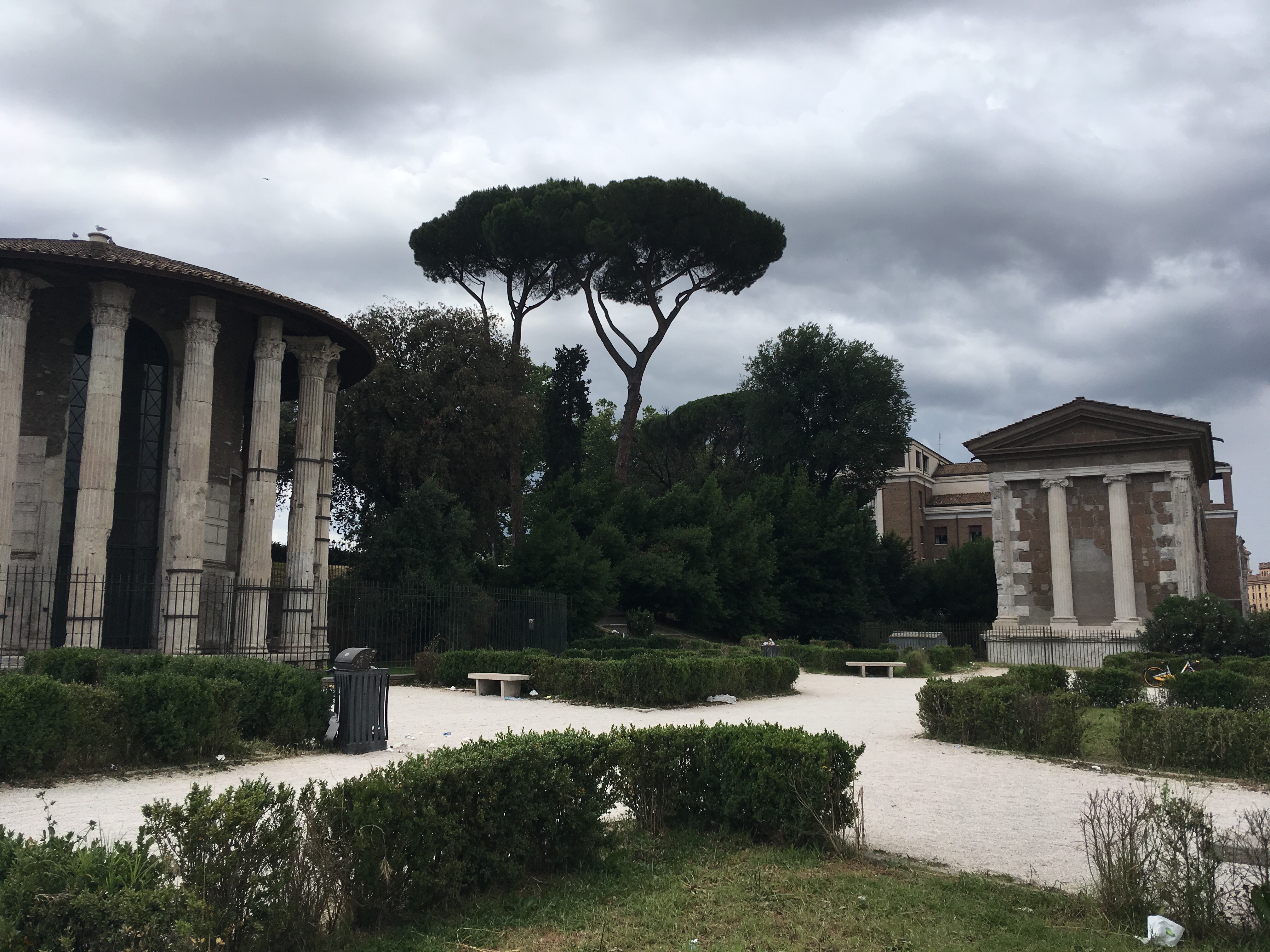
A lot of the restaurants weren’t open and I got the impression the place would be much more lively in the evening. I found one with a small patio at the back and let the waitress recommend her Gorgonzola gnocchi, which went very well with a cool white wine, I must say. After lunch I went looking for some of the churches in the area, which were among the first to be dedicated when Christianity was legalised in the 4th century. They also house some famous fine artworks, including a Bernini funeral monument and some 12th century mosaics – however they were all closed. I decided then that I’d had enough of Trastevere (although I made a note to return here for dinner on another trip) and walked back across the river over Tiber Island, one of the earliest parts of the city to be settled and according to legend, where the she-wolf suckled the twins Romulus and Remus after they were swept up onto the Island by the river. From there my walk took me past the temples of Hercules and Portunas, two small roman temples, both surrounded by columns, and both still in remarkably well-kept condition, mostly due to the fact that they were rededicated as Christian churches and therefore were kept well maintained. Unfortunately they are both closed to the general public, but they present a striking image, particularly from ground level (I had only ever seen them from a bus).

20180605_131556292_iOS (2)

The Temples of Hercules and Portunas

Across the square from these is the church of Santa Maria in Cosmedin, which no one has ever heard of, despite knowing all about its famous artifact, the Mouth of Truth. The large marble mask, believed to be a drain covering from one of the nearby temples, is perched up against the wall in a covered portico outside the church where a long line of tourists was waiting for their chance to stick their hand in the open mouth (and take a photo, of course). According to legend, the mouth would bite off the hand of anyone who told a lie. I had a chuckle and, forgoing the chance to stick my hand in, continued my walk across the Circus Maximus and once again past the Colosseum to home.

20180605_132100312_iOS (2)

The Mouth of Truth

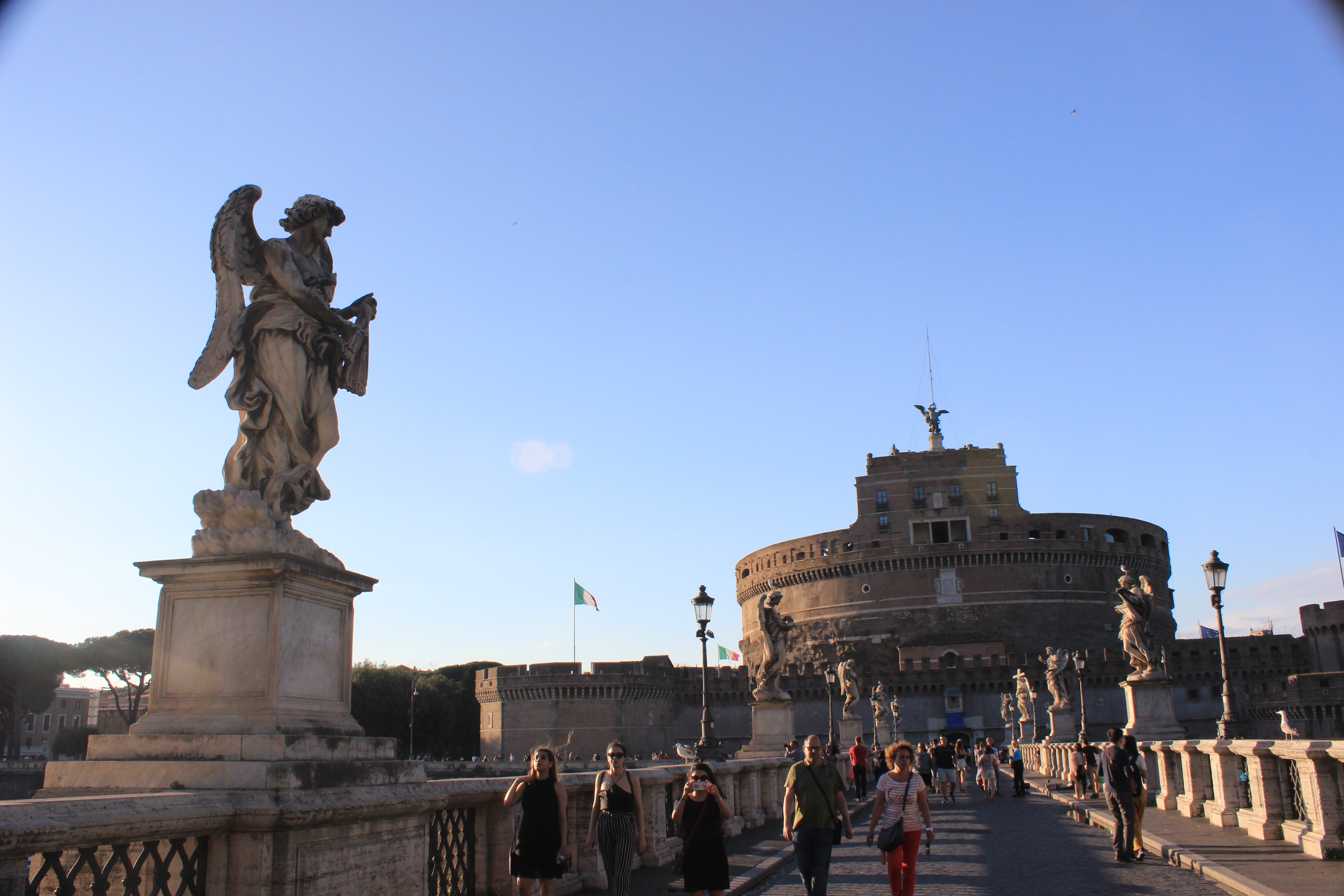
After a refreshing siesta it was time to head out for my last evening in Rome. Unfortunately, it was raining, so I borrowed an umbrella from the apartment and set off, this time away from the Colosseum and again to the metro station, and on to the Castel Sant’Angelo. It bucketed down with rain as I dashed from the station to the castle, and then conveniently stopped when I stepped inside. Ah well. I was excited for this visit, as it was yet another museum that I hadn’t seen before. It’s most famous now as a setting for several dramatic Dan Brown novel scenes, but I was more interested in its history. It’s been repurposed several times in its long life, from mausoleum to fortress, prison, palace, and fortress again, and I found the castle conveniently arranged with a one-way tourist route which led through the various layers. It led me first around the outer walls, where I could see the battlements and artillery which had been added during the wars of the reformation, during one of its incarnations as a fortress.

Next I was led down into the mausoleum, the oldest part of the structure. It was built for this purpose by the emperor Hadrian, with the intent that it would house the tombs of himself and his family, and in fact several emperors after himself were also buried there. It was dark and gloomy and didn’t strike me as a very cheerful resting place. Finally I came out on the top of the castle, where I discovered the most spectacular views over Rome – better even than the view from St Peter’s, I thought, mainly because I could actually see the dome and statues of the façade not very far away. From here I also had a close-up view of the giant statue of Archangel Michael from which the castle gets its name – the legend states that in the year 590 the angel appeared to Pope Gregory the Great at the top of the castle. In the vision, the Angel sheaths his sword, signalling an end to the plague. The statue of Hadrian was swapped out for the archangel and the first transformations of the castle began.

I wandered around the top of the tower, spotting out familiar landmarks here and there. From this height it was easy to make out unique five-pointed star design of the outer fort. I could also see the famous tunnel connecting the castle to St Peter’s, added in 1277 and used by many popes fleeing from plunderers and invaders.

Finally the route led back into the castle and through the papal apartments which I have to say resembled many a medieval palace I’d seen before. With its carved wooden panelling, elaborate ceilings and furniture clearly made by master craftsmen, nowhere was I more reminded that at many moments in the past the papacy was as much a political institution as a religious one. I found it a garish and ostentatious, and must admit I didn’t find it nearly as fascinating as the rest of the building.

My curiosity well satisfied, I finally headed out and across the Pont Sant’Angelo, an impressive structure of original Roman foundations and Bernini sculptures representing the passion of Christ. The sun had come out properly now, and the marble glinted against the deep blue sky. I sat outside enjoying a glass of prosecco before dinner, and once it was dark, headed back to the forum for one last bit of fun.

IMG_5633

View of Castel Sant’Angelo from the Pont Sant’Angelo

It was a new attraction for that summer, a light and sound show in the newly excavated ruins of the Foro Cesare – Ceaser’s forum. It sounded tacky, but it had good reviews so I decided to give it a go – when in Rome, after all. A group of about 12 of us were each given a set of headphones set to our native language – how nifty – and led down into the forum.

I have to admit it was very cool. We were allowed to walk past the columns and ruins and underneath the road through ancient rooms and buildings that tourists normally can’t go. As the voice in my headphones described what I was looking at, various columns and rocks would light up to show which one it was talking about. Clever projections gave images and impressions of what life in the forum might have been like. It was really quite impressive, and at one point I was even convinced that there was a real water fountain right behind me.  Judging by the grins on the faces of the others, they must have been enjoying it too. The commentary was a little bit sentimental at times, but I was definitely glad I did it. I hope they keep it going next summer.

20180605_200006348_iOS (2)

Floodlit Columns of the Foro Cesare

I finished the day with a coffee and as was my habit now, leaned out of my windowsill and watched the night. What a surprise Rome had been – it had always been my least favourite of the three big cities I used to visit (Venice and Florence are the other two) but what it lacks in charm and prettiness it makes up for in vibrancy and a rich, multi-layered history. The tour guide in the Forum was right – Rome really is like a lasagna. I felt sad that I was leaving the following day – there was still so much I could explore! But I was excited to visit my friend and I felt sure that, as all roads do, one would one day lead me back to Rome.


Pizza, Piazzas and Proposals

My second afternoon in Rome. Once I felt I’d had enough siesta time I left my apartment and took the metro to the Piazza di Spagna, where I popped up and found myself looking up at the Spanish Steps. It was almost 5pm by now, but the city and its visitors were showing no signs of slowing down, and the steps were as populated as I’ve ever seen them. It’s always been a curious notion to me that considering that this particular landmark is in fact a flight of stone steps (the clue is in the name), its most popular use is not to get one from one point to another, but for sitting on. Considering that some of the Italians’ favourite past times include sitting, chatting and people watching, the Spanish Steps make an ideal place to gather. They don’t really lead anywhere, except to higher places to sit and chat and people watch (unless you count the church at the top, which has a lovely façade, but its interior is a mystery, as it’s not open to the public).

20180604_154012895_iOS (2)

The Spanish Steps

As pointless architectural features go, however, they really are quite a masterpiece. Like a beautiful and grand terraced garden, it rises in levels with strategically placed plant features so you can choose your way to the top. Once there, you can buy some artwork from intrepid buskers or just enjoy the view down the Via dei Condotti. It was still lovely and warm when I arrived, so I bought some gelati and found a sunny spot about halfway up, where I sat for a while watching the crowds and licking gelato off my hands, which was melting as fast as I could eat it. I climbed up the steps, for no reason other than to say I did it, climbed back down again, passed the children splashing in the fountain at the bottom, and headed off to find the Pantheon.

IMG_1315

Spanish Steps Selfie

I got slightly lost at this point, but that was no problem because in the process I passed several delightful little shop windows, small restaurants where people were sitting outside enjoying an aperitif (it was much too early for dinner) and eventually turned down a narrow lane where I could see the distinctive dome and columns of the Pantheon at the other end.

20180604_155801920_iOS (2)

The Pantheon – My Favourite Building in Rome

The Pantheon always was, and still is, my favourite building in Rome. It’s an architectural marvel, still standing after 2000 years, with its neck-breakingly high entrance columns and its immense domed roof, entirely made of concrete and perfectly measured so that if you copied and inverted it you would have a perfect sphere, which would touch the floor exactly. Nobody really knows how they managed such a feat of engineering in the first and second centuries, but it became the model for all subsequent domed churches, a style made popular again in the renaissance by Brunellesci in Florence and Michelangelo in the Vatican.

The name ‘Pantheon’ means temple of all Gods, and its extraordinary state of preservation is mainly due to the fact that it was converted, shortly after the fall of the empire, into a Christian church. It’s also suspected that its foundations go deep into the ground, possibly as deep as it is high, but it’s hard to be sure of that kind of thing without actually digging it up. Either way, it’s in remarkable condition. What I also love about it is its vast and completely open interior – a large circular room where light (and the weather) filters in from the hole in the roof. The lovely tiled floor (complete with draining holes) and the marble walls give it a lovely cool and ‘shushed’ sort of feeling which cuts you off from the outside world at the same time as it connects you to a different one. Lining the walls are the tombs of some very important Italians, including Victor Emmanuel II (he of the very ugly monument in the Piazza Venezia) and the artist Raphael. My heart swelled as I walked around and gazed up at the sky through the hole in the ceiling – it’s a place where I can’t help feeling part of something bigger – even if I can’t define exactly what that is.

IMG_5335

Behind the Pantheon and facing a small courtyard is the less famous church of Santa Maria sopra Minerva, which – as the name suggests – sits on the site of a former temple to the goddess Minerva. I had never seen it before, so I decided to have a quick look before happy hour. Its façade was obscured by canvas and scaffolding but in front of it stood an ancient obelisk, appropriated from a nearby temple of Isis and supported by a Bernini carving of an elephant. The sculpture is small but sweet, and I stood admiring it for a few minutes before wandering inside. The interior was quite stunning, with its deep blue painted ceiling and gothic style pointed arches – quite unusual for a roman church. Many small chapels line the walls and hidden among them are a number of treasures, including a Michelangelo fresco of the Risen Christ, Lippi frescoes of the life of Thomas Aquinas and the tomb of St Catherine of Siena. It was quiet, and I wandered through it enjoying the peace and calm and marvelling that I had never discovered it before.


Back outside, I did a very extravagant thing and sat down for a drink in the square outside the Pantheon. For the price of an average meal I sat outside in the warm evening sipping my spritz and watching people come and go, some sitting and chatting, others passing through. I saw buskers set up and entertain with a song or two before moving on, men walking by with briefcases, young people in groups lolling past with backpacks slung over one shoulder, tourists taking photos, a horse and carriage stopping to let people down. And in the background, dominating this vibrant and ever-changing scene, stood the indomitable façade of the Pantheon, with its Greek columns and pediment and great dome rising behind them, still making tourists gawp as much as it must have done 2,000 years ago.  It was worth the splurge.

IMG_1364

Spritz

Following my old walking tour route, I headed next to the Piazza Navona where I did another thing I would normally advise people not to do, which was to stop for dinner there. As it’s a tourist hot-spot and its appeal is the atmosphere, the food tends to be inferior to what you might find in a ‘real’ Italian restaurant where the locals go. However, as I was on my own and atmosphere was what I was after, I found a nice-looking table near where some buskers were setting up and sat back to enjoy the view.

Piazza Navona is quite a lovely square – although it’s really an oblong, and its shape and the crowds mean that you can’t see very far in any direction, so you can wander around it and be constantly making new and delightful discoveries. At either end are two small fountains – ideal for sitting and licking a gelato whilst people-watching – but it’s the enormous central fountain which immediately draws the eye – Bernini’s fountain of four rivers, with its four massive marble figures representing the major rivers of the four continents of the world (at the time) surrounding an Egyptian obelisk which reaches into the sky. Opposite is the rococo façade of the church of St Agnes in Agony, which, if you’re lucky enough to be passing when it’s open, has a typical rococo over-the-top interior.

20180604_185731422_iOS (2)

The Fountain of Four Rivers in Piazza Navona

As I sat enjoying my Pizza Diavola with a glass of red, I watched a group of acrobats, a flame thrower and a very talented young violinist all plying their trade in the hope of earning a few coins from the tourists. I threw a couple of euro to the violinist on my way back to the Pantheon, where I was impressed once again by a young duo with guitars who were playing an interesting acoustic version of a Nirvana song. I watched for a moment before retracing my steps back to the Trevi Fountain.

It was still warm, and I was in the mood for soaking up a bit more atmosphere, so I popped into a small corner shop on the way and picked up a nice cold bottle of Moretti. I had just reached the fountain when I realised I had no means of opening it, so I popped into another shop and picked up a tacky souvenir bottle opener (I still have it). As usual I heard the fountain before I saw it, and amazingly I could hear the roar of its three springs churning and tumbling over the hubbub of the crowd. There it was, exactly as it had been the night before, cool, shining marble exquisitely carved into elegant sweeping lines, possibly the most famous work of art from the baroque period (although not by Bernini, as it is often presumed). I found a spot next to two ladies who were sharing a bottle of wine, and settled down for some more people watching.

I was astounded (although I shouldn’t have been really) at the number of people still congregating around the fountain – including children – despite it being shortly after 10pm. It was a warm evening, and the steps were crowded with people sitting along them, legs swinging over the edge while others picked their way along in between. Still more people stood around the basin of the fountain, throwing their coins in and taking selfies (I did too – when in Rome, you know!) including one very glamourous woman who must have been in her 50s posing and pouting while her daughter took shot after shot until she got one she was happy with!

At one point the crowds in front of me parted briefly and suddenly a circle of phones were all pointing at a young couple in front of the fountain. As the crowd watched, the young man went down on one knee and produced a ring, said something no one could hear, and the girl nodded, and the crowd (including me, I’ll admit) cheered enthusiastically. It would have been a lovely and sweet moment, except for the fact that the second the girl had the ring on her finger she was engulfed in a circle of girlfriends who pushed the boyfriend aside while they exclaimed shrilly. He stood sheepishly as the the new bride-to-be had to pose for a group photo as her friends pulled implausibly surprised faces and pointed at the ring. The poor fiancé couldn’t get near her – but at least he now has evidence of the whole thing on several videos.

After this it quieted down for a while and I heard the girls next to me discussing the features of the fountain and wondering what it all meant. They must have noticed me watching them, because the one nearest to me turned and asked me if I knew anything about it. Well, the old tour manager in me just couldn’t resist: “Well, actually, the writing on the top says the names of the two popes who commissioned and paid for it, Clemet XII and Benedict XIV, and the year, 1735. The figure in the middle is Neptune, representing the ocean, and the two figures on either side are health and abundance, which the fountain bestows. Neptune’s chariot it being pulled by two tritons, one calm and one turbulent, representing the moods of the sea…” I could have gone on, but the two women were staring at me open mouthed and as I was in the mood for chatting I didn’t want to put them off. Once they realised I’d finished, they smiled and of course asked me how I knew it all. That led to a very pleasant conversation about our respective travels (they were on holiday from California) and other things, and I passed a very pleasant part of the evening sitting there on the warm steps of the fountain, sipping my beer and watching the crowd come and go with the pleasant hum of running water in the background (incidentally, in the 45 minutes or so that I was sitting there, I saw two more marriage proposals, and heard a hearty cheer from the other side of the crowd which suggested a fourth).

It was nearly 11 when I decided I would head home, on the grounds that I had a lot of ground to cover tomorrow – although the crowds showed no signs of thinning and I did feel a little bit like I was leaving the party early! I headed back the way I had walked the previous evening, past the restaurant where I had eaten, which still had a few late-night diners taking advantage of the warm night. Back down the Via Dei Fori Imperiali, where I stopped for the last time that evening to watch a busker, this time a fairly large woman (or it could just have been a very large dress) singing something from an opera with a pop music accompaniment blaring from a speaker behind her. She was actually quite good, and I tossed her my last euro coin as I went past. The last part of my walk took me back past the floodlit Colosseum and back to my hotel, where I made myself a coffee – of course – and sipped it in my pyjamas, looking out from my windowsill at a much quieter road. The noises were different now – there was the odd vespa zooming past, the clatter or a garbage bin lid, soft voices floating up as lovers walked home hand in hand. It was a peaceful end to a full day, and the best part was I still had another whole day in Rome to go. What would it bring? Well, actually, I had a pretty good idea (it involves a castle, an island, and an imaginary water fountain – and coffee of course). But you’ll have to wait till the next post to find out.

20180603_194423584_iOS (2)

Floodlit Colosseum

Lasagne, Anyone?

Rome really is a remarkable city. At a glance, it is busy, dusty, noisy and chaotic. Too many tourists crowd into too-small spaces, bustling and jostling for the best selfie spot. The sun glares down and bounces off the tall stone buildings, unfiltered by balconies or foliage to hit you right in the eyes. Traffic is relentless, cars and mopeds swerve and dodge this way and that, honking and screeching as they zip around startled pedestrians. Road works and metro line extensions add to the general pandemonium. But it is, at its heart, a real, working, Italian city. It doesn’t just exist for the tourists and shoppers. It’s a living, breathing metropolis of life. This is a fact that I never fully appreciated about Rome, until my most recent trip, which was the first time in 20 years that I went there just for a holiday. I woke on that first morning, to the bleeping of my alarm, and gradually the distant sounds of traffic and the workday morning filtered through to my consciousness, and warm sunshine slanting its way through the window beckoned me to get up. I made myself a coffee (the Italian way, with the caffetiere on the stove – for reasons no one can explain, this way always tastes the best! – pushed open the window shutters and let the city come clamouring in. There were the early commuters, sitting outside on the grey pavement, taking their time over their morning coffee, and there were the ones who strode in and stayed just long enough to gulp their espresso and then were on their way again.  The steady whirring of the machines from the laundromat across the road. The metallic clatter of roller shutters going up, a sound universally associated with the beginning of the working day. The odd car or scooter zoomed by, people called or shouted to each other from one side of the road to the other. To the left and right, straight, tall buildings like the one I was in stretched as far as I could see, and as I stood there, an observer watching the city come to life, I fully appreciated, for the first time, that Rome was a proper city. It was fascinating, and somehow comfortable – like staring at a painting that makes you feel nostalgic without really knowing why. I could have stayed and watched for hours, but I had a city to explore, so I grabbed some biscuits (the kind that Italians have specifically for breakfast, so it’s allowed) and set off on my way.

I had big plans for the day! I wanted to explore the Forum this morning, but there was a quick stop I wanted to make on the way – at the small but intriguing Basilica di San Clemente. I arrived just before 9am, and I was the only visitor apart from a group of tourists who were sitting very obediently in the pews to the right of the entrance, while their guide chatted at them in Spanish. I set off around the church in the other direction, admiring the gold guilt ceiling decorated with the papal mitre and key symbol, lambs and other emblematic heraldry. It wasn’t long before the part I really came to see was opened up, so I headed on over to a tucked-away corner of the church and down a flight of cool, stone steps to a medieval church hidden underneath. I say hidden, although in it’s time it would have been at ground level and open to anyone, but at some point in its history it vanished under the many layers of Rome (and the new basilica on top of it) and was forgotten.  I was just setting off to explore it when the group of Spanish tourists appeared on the steps behind me, chattering loudly, so I changed my plan and headed down yet another staircase, more narrow and rickety this time, to the very bottom layer of the Basilica, a 3rd century house complete with Mithraic temple.

But what on earth is a Mithraic temple? The ancient cult of Mithras was dedicated to the Persian god of the same name, often depicted slaying a bull. The temple is small but well preserved, with long stone benches cut out along each side and a small stone statue, about the size of a small doll, on display at one end. It reminded me a little of similar rooms in the temple of Abu Simbel in Egypt. It’s dark, underground setting gives it the feeling of a forbidden cult, but at the time it would have been at ground level, with plenty of light coming in, and as it was in the days before Christianity it was considered perfectly acceptable. The rest of the level contains the rooms of an old roman house, probably owned by a wealthy family, according to a priest-guide who was showing an American lady around and who I was trying to listen to without looking like I was trying to listen (she shot me a few disapproving looks, but what can you do). Considering its size, its proximity to the Colosseum and the fact that it has running water, in it’s time is was probably considered very comfortable!

I headed back up to the middle level which had a few more people in it now, but thankfully the Spanish group had gone. This middle layer, a church in use from the 9th – 11th centuries, feels a little bit like a cistern, with its low ceiling, columns and the sound of running water. It’s laid out like an enormous square courtyard with long stretches of ‘corridor’ separated by Romanesque style arches and columns. Astonishingly, there are several wall frescoes still intact, in various conditions – some are easily recognisable as images of Christ and the Apostles, others are now just faint outlines and patches of colour. It’s amazing that they are preserved at all, considering the humidity from the spring running underneath.

Satisfied with my sojourn in the three-layered temple, I stepped back out into the sunshine and headed towards the Forum, stopping on the way for a quick coffee and to grab a pannini for later. It was now about 10am on a Monday morning, and the Via Dei Fori Imperiali was a hive of activity. I retraced my steps from the evening before down past the Colosseum, until I got a glimpse of the newly revealed forum in the daylight. It really is quite vast, and amazing that so much is still being uncovered. There were in fact several, separate forums – one each for Juluis and Augustus Caeser, Vespasian, Nerva and Trajan – as each emperor expanded and built on the previous emperor’s effort, and together they make up one enormous public space. This time I bought a ticket and went in, guidebook in hand, to rediscover this remarkable space.

I had been in the forum once before, when I was training as a tour manager. I remember standing in a group with my fellow trainees, clipboards in hand, propping each other up as we listened to our guide droning on and on about ancient Rome. I took in enough to appreciate that it must have been very interesting, but not much more. Standing in the forum today, fully refreshed and not a clipboard in sight, it occurred to me that I must have been even more tired than I thought – because I couldn’t remember any of it!

Never mind, I thought, because I had the whole morning to explore. I wandered past a big, square building that was once the senate house, open spaces that were once market squares where men exchanged news, goods and money, now exposed to the glaring roman sun but would once have been enclosed with shady marble colonnades. Scattered bits of broken columns lay here and there, succumbed to the effects of time and upheaval, while others remained upright, remains of ancient temples still standing defiantly. I stopped to top up my water bottle and sat down on an old bit of column, pondering how much of the world’s history was made here. Decisions about war, money, language and religion – some that still influence the world today – were made in this space. It’s really quite mind-boggling.

By far my favourite spot was the temple of the Vestal Virgins. It’s  a long, rectangular space, exposed now although it would have been a lovely, enclosed space shaded by trees and with lovely, clear pools and the sound of water. It must have been a blessed retreat, from the heat as well as the hubbub of the rest of the forum where the men went about their business. The role of the Vestal Virgins was to tend the eternal fire in the nearby Temple of Vesta, which had to be kept alight for the good of Rome. They lived a relatively privileged life – often coming from wealthy families, they came as young girls and were obliged to serve – and remain chaste – for 30 years. After that, they could marry if they chose to and could even own property. It was a considered a great honour in Roman society to have a daughter initiated into the Vestal Virgins. They lived in small rooms surrounding the courtyard, and I could just imagine that in the heat of the day the coolness of the courtyard with it’s trees and pools would have felt like an oasis in the centre of the world.

IMG_5217

The courtyard of the Vestal Virgins, seen from above

Behind the Forum is the Palatine Hill, which according to legend is the place where Romulus, one of the twins raised by the she-wolf, first founded the city – and in fact there are traces of an early settlement on the site dating from around the 9th Century BC. It’s an intriguing muddle of styles – in the days of the empire it was the place where all the emperors and important Romans – Senators and the like – had their residences, starting with the first emperor Augustus. When the empire fell, its invaders took up residence here, and several churches were added in the middle ages. In the 15th century the wealthy Farnese family added their own Villa and formal gardens, which remain today, with their many balconies and courtyards overlooking the forum. It was in these gardens where I sought out a shady spot on the grass and sat and ate my panini while I watched the tourists go by. There were a few other people about, reading or taking naps in the shade. It was amazing to think that the space here was being used for the same things as they were centuries ago (we’re even still using tablets…).

I wandered around the hill for a little while, looking at the old palaces and villas, all of which are ruins now. But even as ruins they are lovely with their dark red walls jutting up straight and solid like legionnaires awaiting their next orders. Several floor and wall mosaics are still intact, their colours still showing beneath the sand and steady trudging of tourists. There’s an arena, its grass neatly trimmed and various bits of column and wall neatly arranged to give a vague impression of what it once would have been. Presumably this was a private arena for the residents of the hill, for their private amusement. The general public still had their entertainment, though, with the arena games at the Colosseum, and for racing, they would have gathered on the Circus Maximus, which is just a grass field now, but once hosted the chariot races. The grand buildings of the Palatine Hill had a royal box view over the arena so they could keep themselves and their guests entertained without ever leaving home!

IMG_5305

The Circus Maximus, site of the ancient Chariot Races

I finished my tour of the hill with a look at the iron age settlement, of which there isn’t much left except some building foundations and a few primitive tools scattered here and there. From my vantage point above it, if I looked up, I could see the blue-grey dome of St Peter’s in the distance, and I recalled something I overheard while I was wandering around the forum earlier: “Rome is like a lasagne; it has so many layers”. I had to agree that it was true.

IMG_5309

View over the iron age settlement to St Peter’s dome in the distance

I headed back down the hill – where I could see the Colosseum rising above the trees in the distance – and back through the Forum towards home, feeling that I was long overdue for a siesta. I thought I might reacquaint myself with the Spanish Steps later on, and perhaps have a drink and watch the buskers in the Piazza Navona. But first, a shower and a coffee, and perhaps a few minutes resting on the balcony, watching the Romans go by.

Oh, do be silly!

Have you seen Mary Poppins? The original I mean. The ‘practically perfect’ nanny flies in with her umbrella ostensibly to look after the Banks children, Jane and Michael, but really it’s about teaching them – and their father – that life ought to have a little fun in it. Nurturing one’s inner child, if you will – embracing the whimsical and silly for no other reason than that it makes you happy.

I think this is a lesson that’s hard to learn. After all, we can’t ignore our responsibilities, can we? We have to earn a living, we have to take care of our families, we have to do the things we’ve promised to do. But what if, maybe, we ranked having fun as highly on our lists? I’m pretty sure every child who’s ever watched Mary Poppins and then ridden a carousel has either wished or imagined that their horse would break free and take them galloping over the countryside… why aren’t grown-ups allowed to wish for that kind of thing as well? Fair enough, we know that we can’t click our fingers and the house will tidy itself – but who says we shouldn’t go and feed the birds, fly a kite or dance with a chimney sweep broom if we want to?

IMG_0239 (2)

Doing something silly…

But this is the trouble with grown-ups, I’ve decided; we’ve all stopped believing in magic.  Perhaps it starts when we stop believing in Santa. Or perhaps when we go to school and books become ‘work’, things to be studied and analysed instead of escaped into – and in the process we learn to take more and more of the world in but to let less and less of ourselves out. The inner child remains locked in the cupboard under the stairs when it is bursting to break free, to go outside and draw on the pavement, discover a door to a secret garden or explore the hidden stairways and turrets of an ancient castle.

IMG_4889 (2)

Time for an adventure?

IMG_5482

Or time to explore?

But why shouldn’t we do those things? Personally, I am a big fan of the ‘spoonful of sugar’ method. Just as you would reward a child for completing an unpleasant task, why not ourselves? For example, if you’ve got some nasty filing to do, or an unpleasant phone call to make, or a cupboard that needs sorting out that you’ve been avoiding for a long time, you make a promise to yourself that when it’s done you’ll reward yourself with a cup of your favourite tea and an episode of your favourite program. Or perhaps if you’ve got a long and unpleasant shift ahead of you, you promise yourself that you’ll stop for a treat on the way home. If it’s time to file your tax return, reward yourself afterwards with a trip to the movies or a visit to a museum – whatever works for you. Some of my favourites are visiting stately homes, cosy pub lunches, walking or driving around pretty countrysides, shopping in charity shops, a good fantasy novel, playing board games and decorating Christmas trees. I could go on, but you get the idea. The most important thing to remember, as the parent to your inner child, is that you must follow through with the reward once the job is done, lest your inner child becomes bitter and stops trusting you.

12570833_10153696095151311_29130965_n

Making a snowman on the beach… why not?

IMG_5695

My sandcastle, complete with drawbridge and battlements

Don’t let yourself think: “No, that would be silly” – that’s the point! Because here’s what I think – that just as every child longs to find a magical land in their wardrobe, drive though a phantom tollbooth or be whisked away by a giant on a motorcycle, why shouldn’t grown-ups be allowed to climb trees, build sand castles, make daisy chains or throw snowballs if they want to? When did we become scared of having fun?

IMG_20151122_164346

This isn’t the human you’re looking for…being silly  with a Stormtrooper

I went to see the new Mary Poppins film the other day, and I thought it was wonderful. In a way, it was a bit like having a bucket of nostalgia dumped all over me. Michael Banks, all grown up now and in possession of the family home, is about to lose it because he’s had some trouble repaying a loan to the bank where he now works. He’s a widower with three children and it’s all falling to pieces. In flies Mary Poppins, with a bit of magic and her spoonful of sugar to see if she can put it all to rights. Meanwhile, Jack the lamp lighter adds a bit of warmth to this cold and foggy scene by singing and dancing his way around London. It’s the kind of thing that makes you want to be a child again just so you can believe that it all might be true. After all, who hasn’t ever wished, on the days when life gets tough, that some more enlightened being might fly in, wave a magic umbrella and fix all our problems for us?

By the time I came out of the cinema it had started snowing. Perhaps it was because there was a lamplighter in the film, or because it was set in winter, or maybe the magic hadn’t quite worn off yet, but as I walked towards my car I looked up and saw a lamp post, glowing orange in the dark and illuminating a small circle of snowflakes that floated down past it – and for that moment I could have been in Mary Poppins’ London, or in a forest in Narnia, or even the main street of Hogsmeade. My inner child jumped for joy.

Before I finish, I would like to clarify that I know those places aren’t real. But my inner child is happy believing that they could be, and as long as my inner child is happy, my grown-up is much happier too.  And so, if you’ll excuse me, as I’ve finally written that blog I’ve been meaning to write for ages, I’m off to reward myself with a cup of tea and a chocolate biscuit. And since the magic of spring is in the air, I might go and pick myself some flowers.

d51b16cb12e5c38a95503860d6dafe25--winter-night-lamp post

Do you believe in magic?

The Eternal City

I arrived in Rome on a sunny Sunday afternoon in June, and by plane, train and bus eventually arrived at my accommodation in Esquilino, one of the seven hills of Rome.  The accommodation, which I was expecting to be a hotel, in fact turned out to be a small two-bedroom apartment, run by a very friendly Italian named Carlo. He showed me my room and told me proudly that it had been his own room during his college years, and I could easily believe it, as the apartment had a distinctly homey feel about it. My room was bare apart from a desk along one wall and a bed along another, which was incorporated into a wardrobey cupboard-like structure which was probably home-made. A small glass-paned door opened out onto a small balcony – or at least it would have if the balcony had not been covered with boxes and outdoor furniture and everything you would expect to find in a downstairs storeroom or garage. I peered through the various boxes and mop handles and I could see three more walls of an enclosed courtyard dotted with shutters and hanging plants and lines of washing running from one window to another.

The rest of the apartment had the same homey feel – there was a small kitchen stocked with biscuits and coffee, with one of those very clever dish racks that hides in the cupboard above the sink so all the drips go back in again. In the living area there was a couch along one wall with a cover thrown haphazardly over it, in the corner was a small desk with a computer on it and the table in the middle sported a bright orange table cloth and a bowl which had everything in it from fruit to keys to the television remote. Taking up an entire wall was an enormous cabinet of many doors and panels, full of books and videos – including vhs’s – umbrellas and crockery, old mobile phones, bric a brac, stuffed toys and goodness knows what else. But my favourite feature of all was the large window that looked onto the street outside. It had two panes that opened inwards, two shutters that opened outwards and a large windowsill which was the perfect height for leaning on. I stood at the window, after Carlo had left, gazing down onto the Roman street below. It was Sunday evening so there wasn’t much going on – most of the businesses were closed and shuttered but I could still hear people shouting to each other across the street and the energetic vroom of the Vespas zooming by. It occurred to me as I stood there, looking out at real Roman life from my apartment that already felt like home, that I would quite like to stay there forever.

On the other hand, I had a city to explore, and at 5.30pm on any day Rome starts to come to life again, so I grabbed my camera and off I went. Carlo had pointed out to me that as it was the first Sunday of the month, most of the museums would be free to enter, and therefore would have long queues and large crowds and were probably best avoided. So I figured I would spend the evening wandering around, have dinner somewhere, perhaps go and have a look at the Trevi Fountain or some of my other favourite places.

I was staying quite close to the Colosseum and I knew my way into the centre from there so I headed off in that direction. It appeared as I emerged from between two buildings onto the main road, and I stopped and stared at it for a few minutes, comprehending that finally, I was really, truly in Rome again, and here was the Colosseum, real, solid, and looking as though someone dropped it into the wrong box of building blocks. I’ve seen it so many and times and yet still I find it awe-inspiring and impressive. Not as a symbol of the power and might of the Roman Empire, as I’m sure it was originally intended to be, but as a feat of engineering – it’s a marvel to me that they even got it up, let alone that it’s still standing. And despite its size and its purpose to intimidate, it’s still a work of art. The arches are all in perfect alignment and perfectly curved, the marble (at least the marble that’s still there) is polished and shiny, and the whole structure has a lovely symmetry. Even in the columns surrounding each level you can see careful decision making, with the plain but steady Doric columns supporting the bottom level, the prettier Ionic scrolls on the second layer and then the intricate Corinthian columns gracing the top two levels. There is no questions that master stonemasons were at work here.

IMG_1533

The Colosseum – look for the Doric, Ionic and Corinthian columns

And of course there’s the sheer size of the thing. It’s not that much smaller than a modern-day sports stadium, standing proud in its piazza and looking much shinier than what remains of the Forum and Palatine Hill nearby. From the outside you can see entrances into the stadium everywhere – several on every level. In fact it was so efficiently designed, and each Roman knew his way in and out so well that the entire stadium could be filled and them emptied again in a matter of minutes – a feat no modern day sports stadium has been able to achieve.

As I walked past the single entrance that is now used for members of the public, I noticed a notice, which said ‘Free entrance today’, or something like that, with a very small queue behind it. So I decided, even though I had not planned to visit the Colosseum on this trip, that in fact I would – it was 6pm and it would be open for another hour, which was plenty of time to have a good wander around before dinner.

It had been years since I was inside the Colosseum and it was much as I remembered it, apart from some workmen in bright yellow vests who were setting up some kind of rigging that looked like a lighting set for a concert of some sort. Tourists can walk all the way around the arena on two different levels, but the floor is off limits – mainly, I suppose, because most of it isn’t there – instead there’s a tiny bit of floor (which was covered in workmen and rigging) and the rest has been removed, so that you can see underneath to the maze of rooms and tunnels where gladiators, slaves, starving animals and all the other condemned once trod. You can see, as well, where the trap doors in the floor must have been, where they were stepped out to face their doom (which sounds very dramatic, but believe me, it was). Once again I was impressed by the level of engineering of the Romans as I set off around the ground level.

IMG_1234

Colosseum Selfie – it had to be done.

The sun was getting low in the sky by now and half the arena was in shadow, but the other half was giving off a lovely brown-orange glow with a bright blue sky behind it. There’s no denying its slightly decrepit state, nor its gruesome history, but nevertheless it’s still an impressive picture. I tried to imagine what it must have been like in the days of the empire, with its marble columns and flooring glistening under the hot roman sun. Perhaps it would have looked like an enormous Jacuzzi. Some of the marble is still there – one section of steps has been preserved and fragments of columns still lie scattered about – but most of it now adorns the front façade of St Peter’s Cathedral and the ridiculous jelly mold lookalike that is the Victor Emmanuel monument. Here and there bits of original marble flooring can be seen under the dust and the trample of tourists. As I walked past one such bit of old floor, a girl in her twenties scuffed it with her foot and said (in an accent I shall not name) to her companions, “Do you think this would have been marble at some point?”, at which point, I made off hastily in the other direction.


Up on the second level, the view is just as much about what’s outside the Colosseum as what’s in it. Making my way around from arch to arch I could see out over the Via dei Fori Imperiali, heading off into the centre of Rome and busy with tourists and locals alike heading back and forth, and which was currently blighted by a long row of scaffolding, hiding the construction of a third underground line. A little bit further around I was looking out over the forum, a row of jagged columns sticking up into the sky in sharp silhouette before the setting sun. Around a bit more is the Arch of Constantine, built to impress but looking slightly diminished from my lofty position, and beyond that down the Via di San Gregorio which passes the ruins of the Palatine Hill on its way to the Circus Maximus, the ancient racing arena. Truly, in Rome, you can’t look anywhere without seeing history.

IMG_1247

I finished my circuit of the top level and headed back outside. It was too late now to go through the forum, so instead I followed those tourists heading into the centre along the Via dei Fori Imperiali. Quite a lot of the forum is visible from the road, and excavations have come a long way since I was last in Rome. I took my time, stopping here and there to listen to buskers while I looked out over the ruins, admiring the different coloured marble reflecting the evening sunlight. Sadly, the four large maps showing the expansion of the Roman Empire (a gift to Mussolini from his old pal Hitler) were also behind scaffolding, but there were plenty of information boards and placards for me to read along the way, which may or may not have been there on my last trip – I couldn’t remember.

IMG_1309

I took the familiar route past the enormous Victor Emanuel monument (which I personally feel well deserves its nickname of the Typewriter, and can never be forgiven for its sourcing of construction materials – but that’s another story), through the Piazza Venezia and down toward the Trevi Fountain. I heard it before I saw it, even over the buzz of the tourists, as I emerged into the floodlit and crowded square. There it was, unchanged and enchanting, just as I remembered it. I stood at the top of the steps leading down to it and leaned on the railing for a few minutes, watching something that resembled a production line of tourists tossing coins and taking photos. Suddenly I felt tired and hungry, and knowing that I had two more days to come back and enjoy it properly, I headed off to find my dinner.

I found a restaurant called Le Lanterne which was on my way home and took a table outside where I could watch people going by. I impressed myself by managing to order a pizza and a beer in Italian, and sat and ate them as the evening turn to night, and a wandering accordion player stared entreatingly at the passing tourists. I wandered home back past the noisy roadworks and the Colosseum, which was now floodlight and glowing against a midnight blue sky. Before I went to bed I opened the shuttered window in my apartment and looked down to road below. A familiar night time hush had settled over it, broken only by the odd whine of a Vespa or friends calling goodnight to each other. As I closed the shutters I wondered to myself, is there any better place to be on a warm summer’s evening than in Italy? I couldn’t think of one.

IMG_1265

Pizza, beer and a Fiat 500 – what more could a tourist want?

IMG_1273

Floodlit Colosseum

Wondering and Wandering in Wiltshire

Towards the end of last year I had to travel to Bristol for a weekend event, so I booked an extra day and took the opportunity to cross a destination off my list that I’ve been wanting to see for years – Avebury.

Avebury, as it turned out when I looked the place up, is the name of the village, as well as the enormous stone circle that surrounds it – although which one is named after the other I’m not entirely sure. Anyway pictures in books surely didn’t do it justice, and descriptions such as ‘like Stonehenge, only without the tourists and rope fences’ greatly appealed to my sense of the mysterious. I simply had to check it out for myself.

I stayed overnight in a very pleasant village called Wootten Basset, just off the M4. I checked into a charming little pub called the Angel and went for a wander around, enjoying the last of the evening light, which at that time of year was a little too early for dinner, but definitely not too early for happy hour, so I wandered  back to the Angel and settled myself downstairs for the evening. One of the things I love about staying in pubs and hotels on my own is that I can’t get distracted by anything that might count as ‘work’, so I sat in the bar with a pint and my book while I waited for dinner time. I had a lovely meal and headed up early, thinking that I would get an early night and therefore an early start on the next day. My bed was incredibly comfortable – too comfortable in fact, as I over slept and only just made it down for breakfast. No harm done, really – and the sausages were excellent.

I drove for about 20 minutes before I reached Avebury, and the moment I saw the first standing stones I realised how impossible it really is to describe the place in a book. Suddenly they were just there, still, solid and enormous – taller than my car – flanking the road leading into the village like silent, square sentinels. I craned my neck from side to side as more and more stones came into view as I drove past, winding my way through the village until I found the public carpark on the other side.

IMG_4749

Avebury Stone Henge, Wiltshire

Avebury, as far as villages go, is quite small. There’s a church, school, and a convenience store, as well as a few trinket and souvenir shops selling everything from incense sticks to reiki-infused body lotions. There’s one pub, a museum and an old barn that has been converted into a tourist information and exhibition space. Its real charm is, of course, the stones, which circle and enclose the entire village. It’s really quite astonishing. From the carpark, I made my way to the tourist info where I found a map and a friendly villager to point me in the right direction, and set off to explore.

There are two main roads going through the village, roughly at right angles, dividing the village and the circle roughly into four quarters. Spotting a school group some way ahead of me on the right, I set off to the left, heading clockwise, ready to be amazed.

I was. The stones are immense. Most of them are still standing, which is amazing in itself, and most of them are taller than me. And best of all there are no ropes and no fences, so you can walk right up to them, touch them, lean on them and, in my case, wonder about the hands that crafted them. Why did they do it? Where did they come from, and what was it for? Was it simply an ancient sundial, designed to follow the sun and stars on their ancient paths? Or perhaps some sort of Bronze Age Colosseum, where great spectacles and rituals took place? Probably we’ll never know. But perhaps that’s a good thing, because it allows us to imagine.

As I wandered, a bright sun and ominous storm clouds glared at each other from opposite ends of the sky, casting an eerie glow on the ground and the stones, which glimmered enigmatically. I could feel their immense presence almost as a tangible thing – what sort of energy had the ancients imbued them with, I wondered. They reminded me a bit of suits of armour in castles – you feel as though they’re watching you, even though you know they’re not.

IMG_4788

The Stone Circle circling the village of Avebury

I made my way around the circle, marvelling at the weather, which seemed determined to show the stones off in the best possible light, and passing some very pretty and extraordinary trees all adorned with ribbons and trinkets fluttering in the breeze. I stopped for lunch at the Red Lion, which claims to be the only pub inside a stone circle, which it probably is. It is most certainly the only pub in Avebury, so I was pleasantly surprised when the meal was both reasonably priced and reasonably tasty. I washed it down with an Avebury Water Well Ale and set off for my afternoon’s exploring.

IMG_4754

Pretty Trees and Intricate Roots

I set off out of the village and past the tourist carpark following a footpath which seemed also to be imbued with the magic of Avebury, as it kept disappearing and reappearing again, sometimes underwater, sometimes through a tree, or even on the other side of a fence. It didn’t matter though, as I could see my destination clearly in the distance – the vast, peculiar structure that is Silbury Hill.

Silbury Hill is, at first glance, just a hill. It juts out abruptly in the middle of a flat field, like an upturned bowl. That’s because it’s man-made, one of the largest of its kind in Britain, in fact. It’s an enormous chalk mound, built in steps, which they filled in as they went. All except the top step, that is, so that the top of the hill is flat, as if someone sliced it off with an enormous knife, or as if a giant hand turned over his sandcastle and then patted it down a bit too vigorously. Remarkably, it’s very similar to the Egyptian pyramids – it dates from roughly around the same time (2400BC) it’s built in the same way, (only the sides were filled in to make them smooth) and they are roughly the same height. It’s main distinguishing factor – aside from the fact it is an entire continent away – it that there is absolutely nothing in it.

IMG_4835

Silbury Hill

There are no tunnels, no chambers (burial or otherwise), no treasure cache or remains of anything of any kind. So what on earth was it for? Flint and antler tools have been found on it, suggesting at least that people spent time on it, and excavations around the site show a series of moats were built at various stages as the mound was enlarged over time. Did they intend to use it as a fort or look out? Well, perhaps – but there is another perfectly good hill, much higher, about a hundred metresto the east of it. Was it an unfinished project? Possibly. A statement of some kind, from one tribal chief to another (my hill’s bigger than yours!)? Chances are we’ll never know.

The reason we know there is nothing in it is because in the last 300 years or so there have been at least three attempts to tunnel into the hill, and none of them found anything. Unfortunately, they also forgot to fill the holes in when they left, causing the inside of the hill to collapse and a 14-metre crater to appear in the top. It was finally propped up and filled in in 2007, so it’s now back to being as close as possible to its original state.

I walked right up to the base of the hill, where I was confronted by a nasty looking fence and a notice threatening dire consequences if I attempted to climb the hill (actually it just said ‘climbing prohibited due to ongoing research’), but to me the idea of falling down a 14-metre crater was as much of a deterrent as disturbing some research into rare plants), so I set off around the base. I figured if I couldn’t walk to the summit then I might as well walk around the base, but I don’t think I was supposed to do that either as I reached a point where the ground became very overgrown and prickly and I had to maneuver myself over two very threatening bits of wire, not to mention the path had long since disappeared and I was on a very inhospitable slope with a busy road on one side and a ditch on the other. By the time I realised this, of course, I had gone so far around that I figured I might as well keep going. Fortunately there weren’t many other people about so there was no one to witness me emerging from the wilderness trailing brambles and barbed wire from my hair and boots. I brushed myself off and continued down the disappearing path to my next destination.

I crossed a road and trudged up a hill and I finally reached West Kennet Long Barrow, which is one of the biggest Bronze Age burial chambers in Britain. It’s believed to have been in use by the ancient Britons for around 1,000 years, and the skeletons of at least 46 people have been found inside, along with flints, beads, animal bones and bits of pottery. You can walk right up to it and even inside (the bones have been removed,fortunately), where I found five large excavated chambers, some of them big enough to stand up in. There were scatterings of flowers, tea lights and pine branches, and the smell of incense hung in the air. I didn’t see any druids or hippies, but they must have been around recently.

The Barrow, despite having an obvious purpose, still has a sense of mystery about it. Who was buried here? Was it members of one family? Or one tribe? What rituals did they perform, and what did they believe about life and death? I climbed up to the top of the impressive 100-metre-long mound and looked around the countryside, over Silbury Hill and back towards Avebury. Is this what they saw when they came up here – minus the A4, obviously – or has the landscape changed? And I wonder if anyone ever wandered up to the top of the hill, and wondered about the people who would come after them, and what those people would think of what they’d left behind.

IMG_4873

West Kennet Long Barrow

I stayed up there until the sun started getting low and I began to think about Friday evening traffic. I made it back to my car and got on my way again just in time to get stuck in a traffic jam heading into Bristol. It didn’t matter though – except that I was very thirsty by the time I reached my accommodation – because I was in such a good mood from all  my exploring. I wonder if anything we build will last for 5,000 years, or if by then there’ll be any mystery left in the world for people to wonder about. I hope so.


Om-nificence

During my time in Nepal, I spent a few days staying in a Buddhist monastery in the Kathmandu Valley. It was a very peaceful place, where I could enjoy quiet, solitude, beautiful gardens and views, and three wholesome meals a day.  I attended dharma talks, watched the monks debate, and even visited a nearby leprosy rehabilitation centre. I learned a bit about Buddhism, chatted to some of the monks and nuns, and learned about circumambulation (that’s a topic for another post!). On my first night, I was privileged enough to witness a remarkable ceremony that was both surprising and delightful.

It was after dinner and I was heading out to the monastery gardens, thinking I would enjoy a quiet stroll while the evening was still light. Suddenly a very loud gong sounded, and monks started streaming in toward the centre of the grounds from all directions. I was with one of the girls who was sharing my dorm, Laura from Argentina, and as we watched she exclaimed, “Ah, it’s like a movie!” and I had to agree that it was. We followed along behind them, and saw that they were all proceeding into the main Gompa (temple) kicking off their shoes as they went in. We waited with a group of other guests who had also come to see what was happening, and finally, when they were all inside, one last monk gestured us towards him and said we could go in to watch, so we flicked off our own shoes and he showed us in to some cushions along the back wall where we could sit and watch.

IMG_6405

The Main Gompa at Kopan Monastery

All the monks had seated themselves in rows down the middle of the room, facing each other across a central aisle. From what I could discern, the most important monks were seated closest to the Buddha statue, with the younger monks and novices seated in the rows behind and towards the back of the room near the doors. On the far wall was a table piled high with small boxes. The helpful monk who had shown us in had a little table near the door which he sat at, but first he brought us over some copies of a small spiral bound book with Lama Chopa written on the front. He told us to start on page 10, so we opened to that page and attempted to follow along as the monks began chanting.

The book contained a copy of the chants with an English translation, and when they chanted slowly it was easy enough to follow, although the sounds we heard sometimes bore no resemblance to the characters on the page. When it was slow we tried to join in, but sometimes they sped up and we lost our place completely and would sit there flicking back and forth trying to catch up. At those moments the helpful monk at the back would wander over and point us to the right page. Most often, when they started speed-chanting, the book had small notes like (x3), (x7) or even in one case (x21)! It was when this happened that we invariably got lost.

I found the whole thing quite mesmerising – even though I had no idea what was going on, I couldn’t help feeling that I was witnessing something special (when I asked about it later, I was informed that it was a special ritual which only occurs on certain days: “once a month, we do it twice”. Many of the chants had translations like ‘let me bring happiness to all sentient beings’, or ‘let me let go of attachments’, and there were many references to flowing in rivers. They evoked calm, peace and a gentle love for all things.

I was impressed that they all managed to keep up, especially when they sped up, and the effect of the deep, tantric chanting of the older monks mixed with the higher voices of the novices gave it a gentle musical quality that echoed in the large room. Sometimes on the slower chants they would all sway from side to side, and the effect was quite hypnotic – there were several times when I felt my eyelids drooping, although I was far from bored.

The lead monk had a microphone and every so often he would turn it on and drown out all the others. There was a large gong at one end, and along the aisle were several sets of bells, cymbals, and horns, and in some places the monks would clap in unison once, twice or three times. So at any time the chanting could be interrupted by a clap or a bell or a blast on a horn, and once or twice the whole ensemble would play so the room would fill with claps, gongs, jingles, clashes and horn blasts all at once.

IMG_2939

Tapestries decorating the ceiling of the Gompa

It was really quite mesmerising, but after about half an hour or so I began to feel very uncomfortable. I started fidgeting, sitting on one leg then the other, then on both, then stretching them out in front of me, then leaning on my arm because my back was hurting. I checked the book to see how many pages there were – 108 – and felt a moment of dismay when I saw we were only on page 24. I longed to get up and stretch but I felt that would be rude, and I didn’t want to leave and miss any, so I stayed put, amazed at the older monks who sat rigid and unmoving, and the American woman next to me who sat wide-eyed and staring through the whole thing. I can’t say the same for the young monks at the back, at least, they were twitching as much as me by the end and had started to pinch and tease each other as only young boys do, which made me feel slightly better.

IMG_6659

Giant Prayer Wheel

Towards the end, a couple of the novices disappeared out of the main doors and came back in with enormous teapots. They then went around the room pouring tea for everyone, starting at the front, climbing back and forth over each other and around the pillars to make sure they poured for everyone in the right order. Finally they came over and offered tea to us and a nun who was sitting on her own further along the wall. There was more chanting and a procession of offerings, and then an instruction in the book which said ‘taste the tsog’, so we did. Then came the ‘distribution of offerings’, in which the boxes piled up on the back table were handed out to all the monks. The young ones of course opened theirs straight away, and out of them came things like packets of crisps, noodles and fruit drinks, which we were given too. There was five or so more minutes of chanting, then in the same breath they all stood up and filed out of the room. After this abrupt end, the helpful monk came over to collect our books and tell us it was all over. The whole thing had lasted about two hours, and it was full dark by the time we came out of the temple. I wondered if I had the same expression as the others – a mixture of wonder, confusion and tiredness. Laura and I made our way back to our room through the garden, illuminated by bright pink and blue plastic trees, and I got into bed wondering if the ceremony I had just watched was a regular thing or if I had just been lucky. I didn’t see anything else like that while I was there, and I never really found out what it was all about, but I was glass to have witnessed it all the same.

IMG_6371

View across the Kathmandu Valley to another Buddhist Monastery