On Seasides, Cider and Sunsets

When I set off from Wadebridge the sun was already up and the sky was clear. It occurred to me that it could be a lovely sunny day, but I didn’t trust the changeable Cornish weather that much so I dressed in my layers anyway and set off for Padstow, on the north Cornish coast. It was a pretty, meandering drive past fields and hedgerows with tantalising views of the coast here and there, over a small crest or between a row of trees. I arrived in Padstow just before 9am and found a pretty town not quite awake yet. I could hear water lapping against the fishing boats a they rocked sleepily in the harbour. A few eager fishermen were about, hailing each other across the decks, while gulls circled lazily overhead or squawked at each other from the rigging.
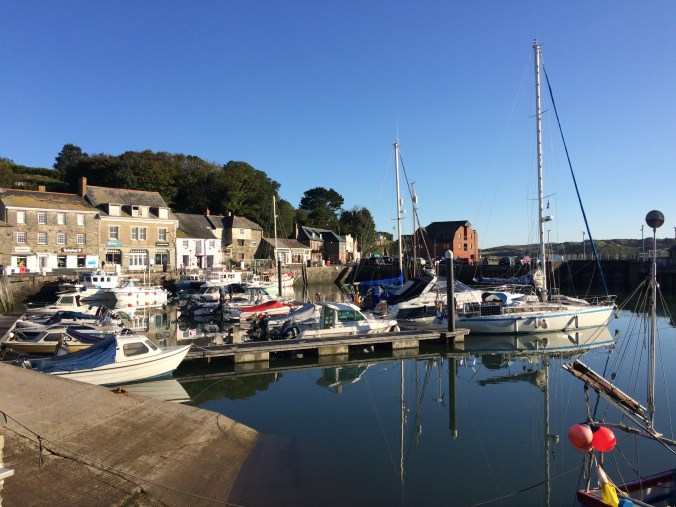
IMG_5675

It seemed a pretty and peaceful place. A trickle of people were up and about already, looking into the shops and cafes that circled the harbour, but as it was Sunday most businesses were still closed. I headed towards a promising looking café that turned out to be jam packed full of breakfasters, grabbed a quick pasty and headed back out again.

There is something special about being out and about in the morning. After the sun is up but most people are not, except for the keenest joggers and dog-walkers and those whose industries require them to be up with or even before the sun – in this case the fisherman. There is a sort of peace that descends, or perhaps it rises with the sun, to be inevitably broken by the hustle and bustle of daily life, or perhaps the first ring of a phone. But it happens every morning, and although I’ll admit that I miss is most days, when I am up to see it – especially in a new place – and the weather is kind, the day that stretches out ahead is one of endless possibility. I found a path that led past the shops and the harbour and out to the beach, and set off.

IMG_5678

I walked for about half an hour along the headland, then climbed down and walked back along the beach. The tide was out, and others had come down by then, obviously making the most of the Sunday sunshine. As well as many dogs and their humans, I saw a family making a small campfire, and a little girl in a kayak being pushed along by her father. Further along,  two very small, naked children were running around in circles, squealing with delight as they evaded their mother, who was brandished a towel at them in a hapless sort of way.  As I walked along the waterline, shoes slung over one arm and trousers rolled up to my knees, I felt like I had stumbled upon a moment in time – I felt separated, but not it a bad way – it was like looking at snapshots of another life.

I put my shoes and socks back on somewhat reluctantly (why is it so impossible to get all the sand off?) and wandered back into the town. It was now almost 11 and it was full of people, bustling and buzzing like any seaside tourist town. I grabbed a couple of souvenirs and extricated myself from the crowded harbour, and drove up to the top of the headland where I enjoyed another lovely walk, this time from a very cosy looking hamlet called Smuggler’s Cove up to a lighthouse, which was no longer functional but in good condition all the same. I sat for a while enjoying the sunshine and the views, feeling a bit uncomfortable in all my layers but enjoying the peace and quiet. The wind whistled through the grass in a pleasant, cheery way as some cows looked on, chewing lazily behind a low stone wall. I began to wish I had brought a picnic with me.

IMG_4025

I walked back to my car and was in the midst of doing some Mr Bean-esque removal of layers when suddenly there was a face peering in the passenger window.

“Excuse me, do you know where the Cosy Cove café is? Only we’re going for afternoon tea.” Now there were about five of them peering in.

“Um, no sorry, I have no idea, sorry, I’m just here for a walk,” I replied as I hurriedly stuffed my arm back through my sleeve. Fortunately they disappeared, and, one layer down, I headed south, this time towards St Merryn. I had been told by a friend to go there and so I did, hoping that I would find somewhere pleasant to have lunch. When I arrived I was disappointed to find not much to the place at all except a garage, a pub and a small convenience store. I had just decided on the pub when an enormous coach pulled up outside of it and disgorged an entire load of pensioners in through the front door, so instead I grabbed a snack from the convenience store and followed a sign to Constantine Beach.

I found it eventually, down a winding road, past a posh looking golf club and down a hill, which I then had to reverse back up again as there was no parking. Instead I had to pay £4 to park up in a nearby field, which I wouldn’t have resented quite so much if I had planned to spend more than an hour or two. I walked down to the beach past many people who were clearly well-kitted and planning to spend most of the day there, in wetsuits and with surfboards, buckets and spades in hand.

IMG_5699

Never mind, I thought to myself as I dropped another 60p into a bathroom turnstile so I could remove a couple more layers – Ill still enjoy whatever time I spend here. Which I did, although I spent most of it wishing I had planned the day a little bit better. If I’d known it would be such a nice day, I mused, I could have planned to spend the whole day here, brought a decent picnic and a book and camped out for the day. Still, I found a good spot high up on the beach where I could lean against the grassy dunes and observe all the fun and activity going on around me. I enjoyed a pasty and a Korev – Cornish beer – both of which were about the same temperature by the time I got there – and built a sandcastle, complete with drawbridge, turrets and ramparts, stables, kiln and stairs to the upper walk. I was quite pleased with myself. I finished with an ice cream and yet another walk, and headed off again.

It was at about this point that I realised I didn’t have any accommodation booked for that evening, so I made a quick stop in St Merryn – where there was mobile phone signal – and found a reasonable looking hotel going for a discount rate in Newquay. Newquay was about 40 minutes away from where I was, so I decided I had time for one more stop. Marvelling at the wonders of modern technology, I drove off in search of the village of St Mabyn, home to Haywood Farm Cider.

I had found the flyer for Haywood Farm Cider and one or other of the pubs I’d stayed in, and it caught my attention because it promised me I could ‘experience’ traditional cider, relax and enjoy the cider in a pleasant, orchard setting, and that on some select weekend days in summer, one could sit outside in the sunshine enjoying cheese and cider and listening to some local live music. That all sounded very enticing, so I was somewhat bemused when I emerged from the windy, muddy drive, onto a gravelly, muddy parking area, in front of an old barn. I had to laugh.
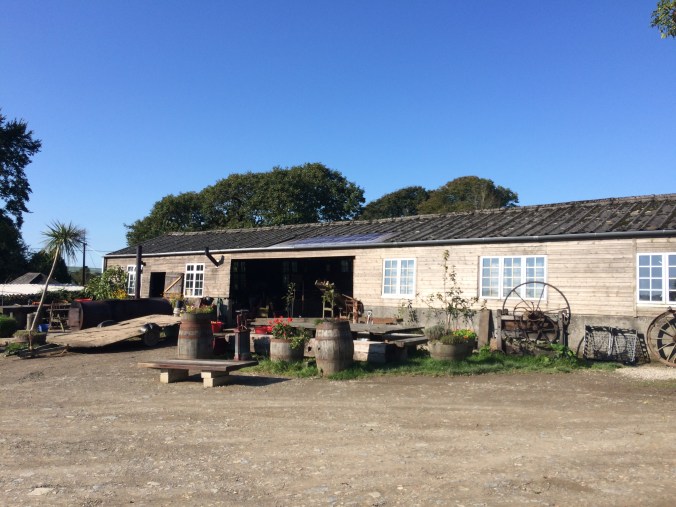
IMG_5704

It was really quite charming. In front of the barn, strewn around the carpark were various bits and pieces of machinery in varying states of rustiness, upside down old crates and barrels and a very scruffy looking dog. There was a door at either end of the barn – one was small and looked like it led into a kind of office, the other was an enormous sliding door of rusty iron, and it was wide open. I wasn’t sure which one I should head for, but fortunately a man emerged through the open door and saw me. He looked every bit the farm labourer – his trousers were torn off and fraying at the knees, his polo shirt was covered in bits of paint and plaster and who knows what else, he had a curly beard as long as his neck, and was grubby from head to foot.  Turned out he was the manager.

I followed him into the barn, where there were two more workers, who looked more or less the same, but with slightly less facial hair, and were working an old apple press. A radio in the corner was blaring out hits of the 60’s, there was a very beaten up sofa against the back wall, and an enormous pile of apples was stacked up against the corner nearest the door – some of them had tumbled away and the dog, who had followed us over, was sniffing at them furtively. Not for the first time on this trip, I felt as though I’d walked into somebody’s backyard.
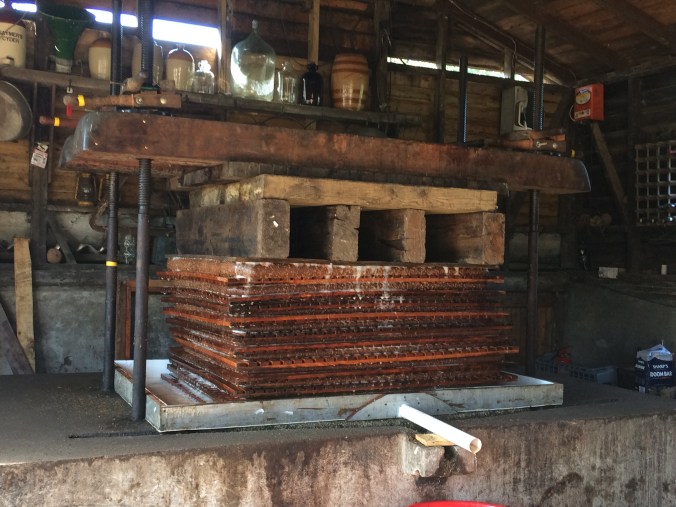
IMG_5703

The two workers, it turned out, were a kiwi, who had turned up in January to work for a week and was still there, and a Frenchman who didn’t speak any English. I waved at them from the door and turned to follow the manager to the tasting room, just in time to see the dog snatch an apple in his jaws and disappear. I discovered that the room at the other end was an office, but it was a tasting room as well. There were cider barrels stacked up against one wall and I sampled all of them before deciding on a carton of the sweet version. I thanked my ‘guide’ for his time and headed back to the car with my purchase, and the last thing I heard was him calling, “but ignore the use-by date on it, the French guy did them and he got it all wrong”. Chuckling, I headed off for Newquay.

My hotel, as it turned out, was on the beach slightly out of town. I went for a wander and found a cosy looking bar where I sat and wrote some postcards and made friends with a local cat. Then I headed up to the very edge of the beach, where I found a trickle of people all heading up the same hill. I followed them, and found, to my delight, the most perfect open spot for watching the sunset. It was a clear night and we had a spectacular view of the sun sinking down into the ocean.  I reflected, as I sat there feeling not-too-cold, that this was a rare sighting in England – for me, anyway. I was grateful.

IMG_5708

I walked back to the hotel and couldn’t be bothered driving anywhere else, so I had a lazy dinner in the restaurant, and, because I could, did a few laps in the hotel pool. Then, as there was nothing else to do and I had a long drive the next day, I went to bed early. I had a disappointing breakfast in the hotel – how do you make an egg that doesn’t taste like an egg? – then drove down to Newquay Harbour for a walk along the beach before heading home. It was quiet and pleasant, and I really wasn’t looking forward to the drive, but it had to be done, so I climbed back up and off I went.

I just had one more stop to make – just off the main road a little outside a small town called Winterbourne Abbas, is yet another bronze age rock formation, this time another stone circle known simply as 9 Stones. I pulled up in a small layby, took my life in my hands crossing the A road, sidled along a bank for about 20 metres and climbed over some brambles to get to it, where I discovered a lovely iron fence with a gate, at the end of a long path leading back into the town. I let myself in and looked at the stones for a bit, but the busy road right next door did spoil the ambience somewhat. I made it back to the car in the same risky fashion and headed home.
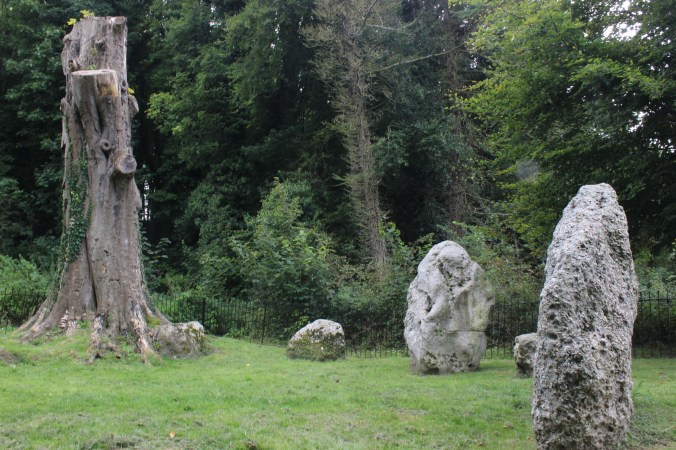
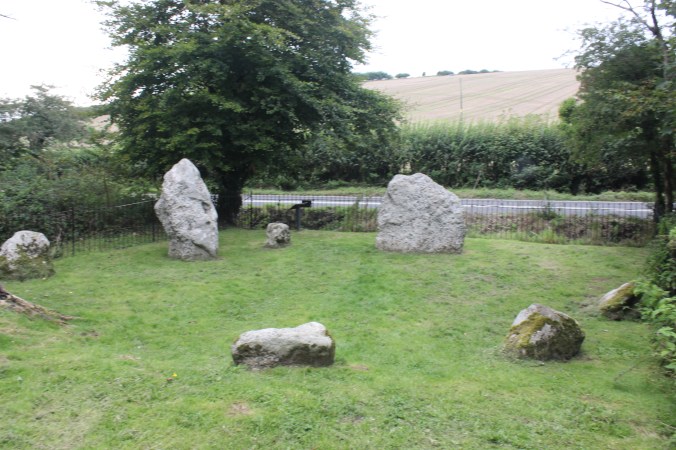
IMG_4063IMG_4069

So now it’s finally the end of my Devon and Cornwall road trip and I suppose I have to summarise it all and draw my conclusions. It was a brilliant trip, full of lucky finds and surprising discoveries. I can’t wait for the next one, wherever that may be. There are a lot of interesting places and people in this country, and lots of little corners hiding fascinating things, and it just takes a little bit of effort to find them. Sometimes plans don’t work, and sometimes they backfire completely, but mostly it’s worth it. And one thing’s for certain – there’s no need to ever feel bored or lonely if you’re travelling in Britain – all you have to do is find the nearest pub.
Tintagel

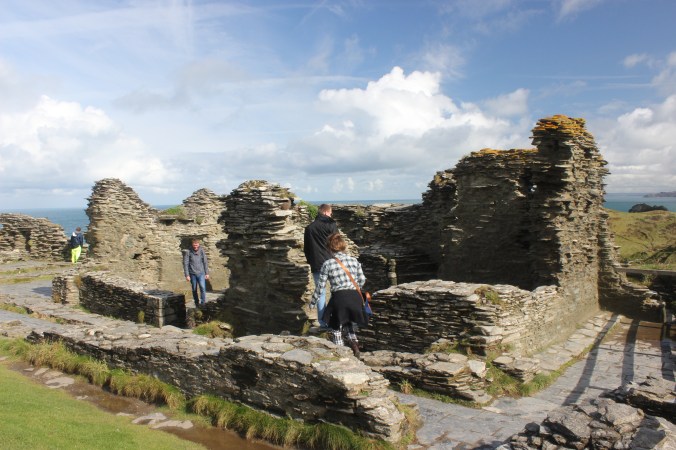
Those of you who are familiar with the legend of King Arthur will know that there are several versions of the story – however, you will also know that they all begin in Tintagel. Tintagel, or so the legends say, is the place where Arthur was conceived, thanks to the magic of Merlin. There is, of course, no evidence that any King Arthur ever existed, or that any king or Arthur is linked to the place we now call Tintagel. But standing there, on the windswept headland and rocky outcrops on the exposed north coast of Cornwall, it’s easy to see how so many legends have sprung up about this place – mysterious caves and waterfalls, dramatic sea and skyscapes – and the fact that much of the evidence of human settlement has, over time, been claimed by the sea.

Let’s consider the facts of this place. Some sort of settlement existed here during the dark ages, probably the residence of some local Cornish ruler. Archaeological evidence suggests the site was in use from the 5th to 7th centuries, and trading with ports as far away as Greece and Turkey – but by the 8th century it seems to have fallen into ruin. A few centuries later, in about 1138, Geoffrey of Monmouth wrote his History of the Kings of Britain, and in it, he mentions a King Arthur, a ‘youth of unparalleled courage and generosity’ and victorious battle leader. He places him in sixth century Britain, where he was apparently conceived in an island fortress named Tintagel. Roughly a century later, in 1233, Richard, Earl of Cornwall (younger brother of King Henry III) bought the headland, had his castle built on it, and called it Tintagel – probably to associate himself with the legendary king and knight of old, as there is no evidence that this piece of land is in fact the Tintagel mentioned in Monmouth’s essay.  The ruins we can now see on this sight (and there are still plenty left) are the remains of Richard’s castle.

IMG_3931

The site is now run by the National Trust and despite the fact that tourists arrive busloads at a time, it’s still worth seeing. To get to it, you have to park in the village and then either walk or pay for a jeep to take you down a long driveway. I arrived on a Saturday morning just before it opened and snuck past the first load of tourists who were still at the top of the driveway, presumably getting their ‘you’re about to see a historical site and let me tell you all about King Arthur before we go down’ talk – I can’t be sure though, as it was in German. But anyway I felt quite pleased with myself for getting there first, and as I had no time limit on my visit – and I was cold – I went first to the café and treated myself to a coffee. Then I went exploring.

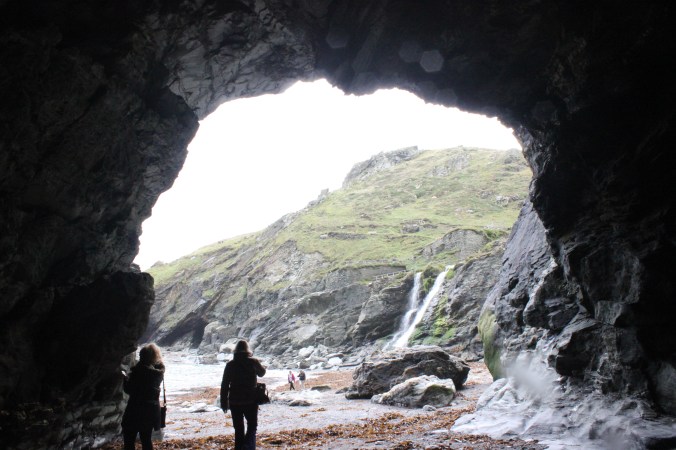
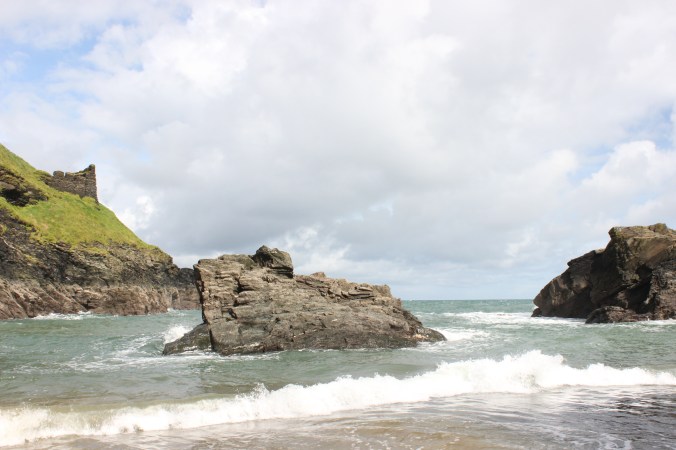
The Germans by this time were heading up to the cliff top so I headed down to the beach. It’s a marvelously secluded cove, with two small headlands reaching around it like arms with the cliff face at its back. On one side a waterfall tumbles down joyfully, and on the other is Merlin’s Cave, which I wandered into as the tide was low. The most popular story of the conception of King Arthur is of the King of Britain, Uther, who fell in love with Igraine, the wife of Gorlois, Duke of Cornwall. When Gorlois was away, fighting Uther’s army elsewhere, Uther, disguised as Gorlois by the magic of Merlin, stole into the castle and seduced Igraine. There is another story, however, of Merlin finding the baby Arthur washed up on the shore by the sea.


Standing in the cave, I could easily see how it has inspired such legends. It has a wide opening, exposing a rocky floor and walls which glistened in many colours, but would be mostly submerged during high tide. In the distance the walls tapered to another opening, leading out of the rock to the south, but it was cut off from the beach side by water. From inside the cave looking out, I could see mostly sand and the cliff face, and a small piece of the sea, hinting of far horizons. I could hear water tricking down the rock surfaces, and the wind whistled in and echoed around the cave, hinting at fiercer weather to come.

IMG_3865IMG_3910

By this time the tide had started coming in, and several more people had ventured down, so I headed back up again to explore the castle ruins. The sun was out, and quite warm by now so I removed my middle layer – a woolly jumper and tied it round my waste. I had chosen wellies that morning and was feeling a bit uncomfortable in them by this point, but I was determined that nothing would bother me – the sun was out, I had plenty of time, and I was exploring the birth place of King Arthur (or so I imagined for the time, since it was much more interesting than imagining it as the never-visited castle of an Earl with a younger-brother complex.

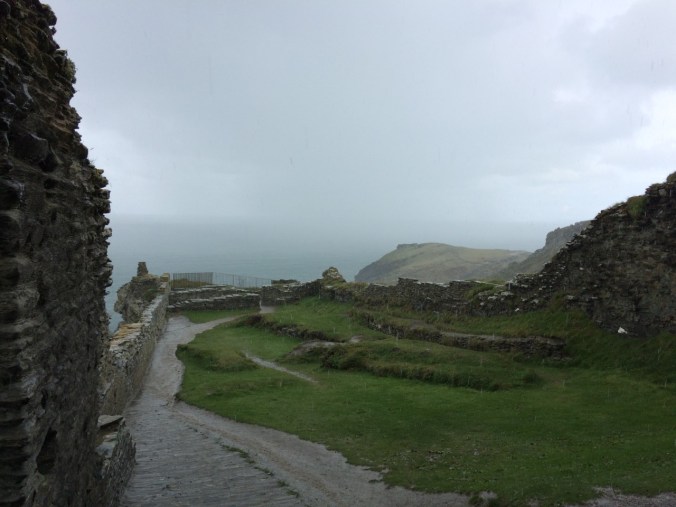
I headed up to the headland and over a modern bridge, built fairly recently as most of the bit of land connecting the headland to the mainland has now collapsed into the sea. Up some more steps, through an arched gate, and I emerged into a stony courtyard, and in front of me stood the remnants of a medieval great hall. Not much is left except the foundations and a few walls, but it’s enough to get an idea of what it would have been like to live here, in this exposed and dramatic setting. It is grand, and intimidating – I could almost imagine sitting in the great hall, with its rough stone walls, probably hung with tapestries, huddled around a fire, and through the small windows hearing nothing but the wind, and seeing nothing but endless, churning ocean.

I spent an hour or so exploring the top of the cliff. There were rows and rows of stone foundations, mostly small rooms which may have been store rooms, stables, or cottages. There were remains of a small chapel, a well and a tunnel through the rock face, its purpose unknown. Perhaps most intriguing was the walled garden, associated with another legend: Tristan and Isolt. It was supposedly in this garden that the two met in secret, away from Isolt’s husband, Mark of Cornwall.

I could see clouds coming in as I wandered around the old settlement, but I didn’t want to miss anything so I crossed my fingers and headed up to the other side of the cliff, to some more buildings, in much more preserved condition, that are believed to be former guests quarters. I was up there when the rain hit, and there was absolutely no cover whatsoever. I whipped my jacket off to get my camera underneath it and got quite wet in the process, then dashed behind one of the higher walls for cover, where I found a couple having a raging argument about something, probably who forgot to pack the umbrella. I waited a few minutes hoping that either the rain or the couple would let up, but neither did, so I decided there was nothing for it but to head back down.

thumbnail_IMG_5660

I arrived in the gift shop dripping wet but with dry feet, and a dry bottom thanks to the woolly jumper that was still around my waist. There were several others there who had clearly made wrong shoe choices that day. Feeling a bit pleased with myself, and now that the rain had finally stopped (mostly), I walked back into the village, where I found a satisfyingly hot Cornish Pasty for my lunch.

I spent the afternoon wandering around the village, which was quite charming and full of the kind of gift shops that sell what I call ‘hippy stuff’. Dragon statues and fairy dust, incense and crystal charms, celtic pattern jewellery and every kind of fortune telling you can imagine. I felt quite at home – apart from the wet clothes. I stopped in a pub for a quick change and a swift half and used my mobile phone to find a book a room for the night in a nearby town called Wadebridge – the wonders of modern technology! Then I headed off from Tintagel.

I had an interesting evening in Wadebridge. I checked into my pub and then went for a walk to see the bridge which gives the town its name. Supposedly it’s famous because it has 17 arches, although I could only count 13.  I grabbed a very nice fish and chips from a restaurant called Barny’s, then headed back to the pub for a drink or two before bed. Unfortunately, it was a Saturday night, and by this time the pub was already full of locals and from the look of things, several of them had already been there a while. No sooner had I sat down to enjoy my ‘Cornish Best’ than there was a polite but slightly crossed eyed local at my elbow. “You can’t be sitting here on your own? Are you sure you’re alright? My name’s Karl – you have amazing eyes!”

Karl and I had that conversation several times before one of his friends called him away, then within 5 minutes he was back again, ordering everyone a round of drinks, including me. Fair enough, I thought, although the conversation was starting to get a bit repetitive by then. “No really, I’m fine, yes, perfectly alright, thank you. Yes – thank you.” Eventually he dragged over to sit with a group of locals at the end of the bar (because I couldn’t possibly be fine sitting on my own), where I learnt that Karl was generally accepted to be the ‘Village Drunk’ and was here doing the exact same thing every weekend. I couldn’t decide if that made me feel better or not.

The group of locals was very polite and put up with me graciously, but once I had finished my drink I decided it was time to make a discreet exit. I made a quick trip to the pub’s bathroom, which was a mistake, because no sooner had I sat down than I heard an almighty clattering in the next cubicle, followed by a series of “oooooh”s and “aaaaah”s that were so loud that indecent is the only adjective I can come up with. I came out to wash my hands and discovered, to my dismay, quite possibly the largest woman I have ever seen, sitting with the door wide open and skirts not quite pulled up enough to hide the underwear around her ankles. I washed my hands as quickly as I could, looking nowhere but straight ahead, and dashed upstairs, where I had a very long, hot shower and reflected that I probably wouldn’t come back to Wadebridge again.

Sloes, Scones and Stones

It was a bright but cloudy Friday morning when I set off from the East Dart Hotel in Dartmoor, and tempted as I was to stay another day and explore the moors a bit more, I had plans for other things, and so I decided to get going. My original plan was to drive to Tinatgel and explore the castle ruins on that day, but as it happened, I got distracted by other, equally fascinating things.

First of all, I headed south towards Plymouth with one destination in mind: the Black Friar’s Distillery, makers of Plymouth Gin. I have toured plenty of wineries, breweries and whiskey distilleries in my travels, but never a gin distillery, and although it was a slight detour, I wanted to go and have a look.

thumbnail_IMG_5589

I’m pleased to say it was definitely worth the side trip. The building, with its very seaside-looking white façade, is tucked in between market shops and cobbled streets in an area called The Barbican, close to the harbour. Quaint though it is, there wasn’t much in the way of parking and by the time I found a space and made my way back to the shop, I had just missed the start of the tour. That was no trouble though, as the very friendly staff member ushered me through a series of locked doors and onto the back of the tour, and told me, very trustingly, that I could pay afterwards. Isn’t it just nice when that sort of thing happens?

The tour turned out to be quite fascinating, although the poor girl giving it had to talk at about 500 miles an hour to cover it all in 40 minutes. I kept expecting her to blow a tire. But anyway, from her I learned that the building has existed since 1431, and was first used as a monastery, hence the name Black Friar’s. The monastery was closed after the disillusion of the monasteries and it was converted to a distillery in 1793. After this very speedy and condensed history lesson we were escorted into the distillery room which has so much alcohol vapours wafting around that we had to turn off our phones and touch an earthing bar on the way in. Inside were three enormous copper vats, two of which are used for making gin, and a third, which no one has any idea what it’s for or how it came to be there, a fact which I found highly amusing. They don’t know how long it’s been there either, as most of their offices, along with all their documentation, were bombed during the war – fortunately they missed the distillery itself. It’s possible that it was brought in to make vodka during the war, but as they have no records, they can’t be sure. They can’t get rid of it either, as it would cost too much. So if there’s anyone out there who wants an enormous Victorian copper vat, and is willing to go and collect it, it’s yours for the taking – or so we were told!

From there we were given a lesson in botanicals and smelling dried things in small jars, all good fun, especially as we had some gin to sample with it. There were lots of other facts and figures all imparted at top speed and most of which I’ve since forgotten, but here’s an interesting fact I did retain – Plymouth Gin have been suppliers of gin for the Royal Navy almost since they opened, but rather than the regular 41% gin, they get the special Navy Strength Gin which is 57% – a significant difference. Apparently this is because once upon a time, barrels of gin were stored on the same level as the cannons, and the lower strength gin would ruin the gunpowder if it spilled. But at 57% – apparently – the alcohol content is high enough that the gunpowder will still light, even if it is doused in spirit.

IMG_3731

We finished the tour with a gin and tonic in the Refectory bar, which has a very stunning, partially restored wooden beam ceiling. By the time I finished I was feeling quite relaxed, not exactly in a hurry but keen to get on with my sight-seeing. I drove out of Plymouth, across the Tamar bridge and into Cornwall.

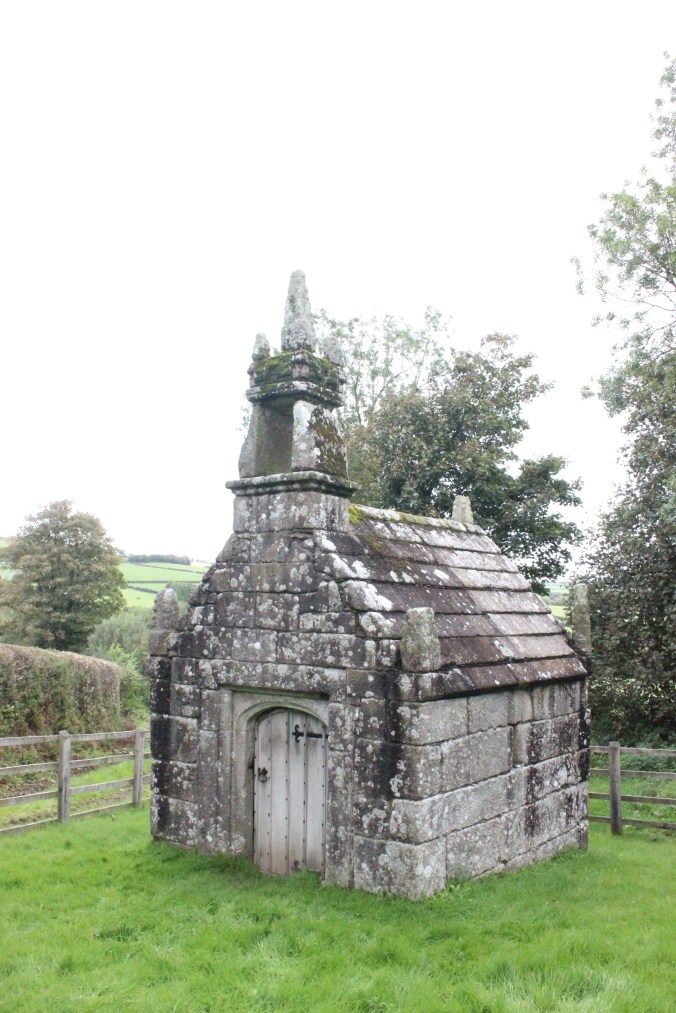
I was heading in the direction of Tintagel but there were a few things I wanted to check out along the way – the first was a small stone structure which I found in one of my guidebooks, which turned out to be another gem well worth the detour. Dupath Well Chapel is a small chapel built over a spring, although apparently it’s quite a large example of its kind. It’s in the middle of a farm, in a small fenced-in field now run by English Heritage. I had to park outside a barn and walk down a short driveway to get to it, feeling like I was intruding on someone’s back yard, but eventually I walked around a corner and there it was, stunning and peaceful, completely out of place and yet eerily separate from the modern life that’s sprung up around it.

IMG_3740

The spring, which has probably been a place of worship since celtic times, is apparently the site of a famous duel between two Saxons, Colan and Gottlieb, who fought over a woman and both subsequently died – or so the legend goes. The current building is thought to have been built by some local Augustinaian monks in around 1510. It’s a simple structure of Cornish granite, with a pretty canopy and bell tower above the door, and I found it utterly charming. I wandered around it, then wandered in and sat down for a while. I leaned against the cool stone feeling as though I could have sat there for hours, as the sunlight slanted in through the narrow windows and the water trickled in merrily – but I had more places to go, so I got up and set off again, feeling grateful that there are still such evocative and untouched places in the world.

IMG_3764

My next destination was Bodmin Moor, but I took another stop on the way to enjoy an essential local delicacy – a Cornish cream tea! Because of my detours the day before, I missed out on one in Devon, but I was determined not to miss out in Cornwall! I found a café up on top of a hill and sat enjoying my scones, taking care to do it the Cornish way – jam first, then cream!! I had given up my plan of making it to Tintagel that day, so as I sat there,  looking out over green fields, criss-crossed with their darker green hedges, I felt as though I had all the time in the world – and the rain drizzling down steadily didn’t dampen my spirits at all.

thumbnail_IMG_5593

From there I drove to the Village of Minions on Bodmin Moor. The highest village in Cornwall, almost all of it was built within a twenty-year period between 1863 and 1880 to service the local mines, quarries and railway. From its centre you can still see the pump houses and other buildings dotted around the surrounding hills and fields, all in various states of disrepair. These were not what I had come for, however – I was looking for the Hurlers – in other words, another pile of ancient rocks.

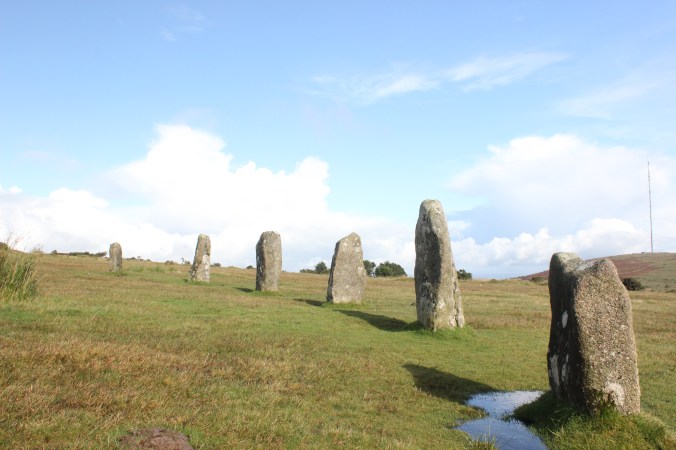
I found a car park which had a lot of fields and walking trails leading off it, but couldn’t find any kind of signpost, map or notice anywhere, so I employed my trusty method of heading in the same direction as other people. I wandered around for a while over the pretty but soggy moor before I found them, and what a sight they are. The Hurlers, one of the largest prehistoric sights in Britain, are a series of three stone circles linked by a 2-metre-wide pathway on a large, flat bit of the moor. According to local legend, some men were out on the moor on a Sunday playing an ancient game called hurling. As a punishment for playing on the Sabbath they were all turned into stone where they stood.

IMG_3797

It’s hard to describe, after the fact, just how mysterious and amazing these stones are. Archaeologists date them to around 1500BC, and believe they were originally all cut to the same size and shape, with a quartzite crystal floor in the central circle. Most of the stones are still there, though some are now much smaller and most of them lean drunkenly one way or the other. There’s no trace of the floor, but from the middle you can see a clear trail of upright stones leading off in one direction and reaching up to the Cheesewring – another gravity-defying stone formation – in the other.

As I approached them and wandered into the first circle, the rain stopped and the sun made a rare appearance, giving them a mysterious and colourful glow. Once again I marveled at the industriousness of our bronze age ancestors, and felt a kind of awe at the faith they must have had in whatever it was they believed in. I wondered what kinds of rites and rituals could have been performed here, what occasions and ceremonies had these stones stood witness to?

IMG_3800

Like the stone rows and formations at Dartmoor, the Hurlers aren’t restricted in any way. They’re just there, standing silently on the moor, for anyone to approach, touch, appreciate. I walked around them for a little while, then squelched back to the car feeling quite satisfied. The Hurlers, I decided, where well worth getting soggy feet for.

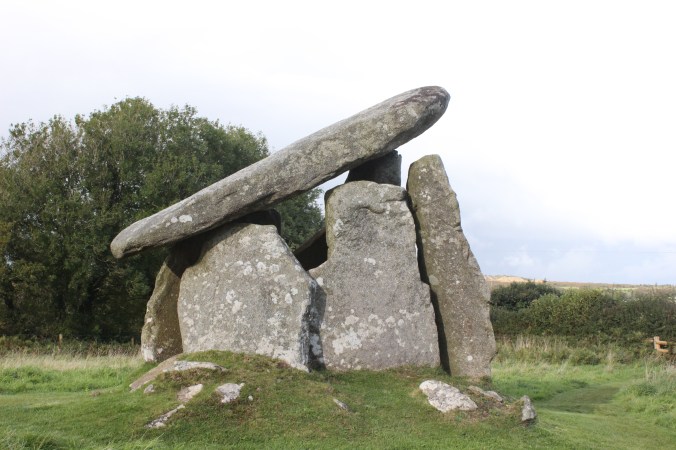
There was just one more stop I wanted to make that day – although I was very tempted to drive towards a village called ‘Harrow Barrow’, purely out of curiosity – and that was to yet another ancient monument:  Trethevy Quoit in the village of Darite. It took me about ten minutes to drive there, and I pulled up in a tiny layby on the top of a very narrow and windy road, with no clue as to anything remarkable being nearby except a small brown sign with the English Heritage logo and an arrow on it. I followed the sign across the road and through a kissing gate, stepped up into a field and there it was – one of the largest Neolithic burial chambers in the country.

IMG_3825

Like the other monuments I’d been looking at, it was not restricted in any way – it was just there, standing at least twice as tall as me, with its large side stones and even larger capstone, which sat at a jaunty angle and gave it the appearance of an oversized outhouse. Originally, most of it would have been buried by a mound of earth, but that has disappeared leaving it mostly exposed. Right next to it is a row of houses, and several of the locals passed by with their dogs, taking no more notice of it than if it were a peculiarly shaped tree. It really was quite remarkable.

IMG_3829

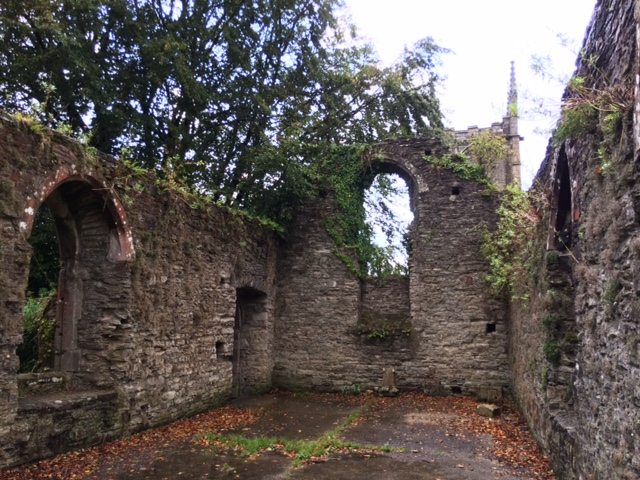
I stayed that night in a small pub in the village of Bodmin, which unfortunately didn’t serve meals, so the girl who showed me to my room sent me to a nearby pub called the Weavers. It was drizzling again, but not cold, so on the way I took a detour around the local church where I discovered yet another ruin, this time most of the walls and floor of an old chapel. The evening light reflecting off the wet stone made it pleasingly atmospheric, and once again I felt a deep gratitude for ancient builders and unexpected discoveries.

IMG_5615

My dinner that night was disappointing, but well supplemented by the local lager, Korev (the Cornish word for beer), and I enjoyed the company of a lively boxer called Dixie, who was in a much more sociable mood than her owners. Although I missed the company of the East Dart Hotel, I couldn’t help feeling, as I hopped into bed later, that it had been a full and satisfying day. And although I hadn’t made it to the place I’d originally been aiming for, where I had been had definitely been worth the side trips. And I was definitely going to Tintagel tomorrow.

Dartmoor Rocks

After a lovely drive down to Devon and a fun, chatty evening in the pub, I woke up feeling optimistic and excited about having a whole day to drive around and explore Dartmoor. After a pot of tea and full English breakfast in the company of my friends from the previous night, I felt ready for just about anything. Our hostess and breakfast cooker extraordinaire, Rosie, turned out to be just as chatty as the rest of us and was full of stories about how many people had crashed their cars either avoiding or not noticing sheep on the road, including one about a young man who was following his father’s 4wd, but was enjoying the view so much that he didn’t notice that the 4wd had stopped and crashed into the back of it. Now there’s a call to the insurance company I wouldn’t want to make.

I soon realised that if I stayed to listen to all her stories I would be there all day, so I extricated myself as politely as I could and headed off. My first plan was to go looking for some particular stone formations which I knew were somewhere on the moors, fortunately not far from where I was, so I set off in the direction of a village called Merrivale. As it turns out, there are quite a lot of stone formations scattered around the moors, and from the road it’s impossible to know which one is the one you’re looking for. I reached the village, which meant I had gone too far, turned around and drove back past all the stone formations again. There were many small car parking areas just off the road, so in the end I picked one which looked more likely than the others, based purely on the fact that it had a tourist coach in it. I crossed the road and found a path leading up a hill towards some stones on the top, and without any better plan, I decided to follow it.

IMG_3519

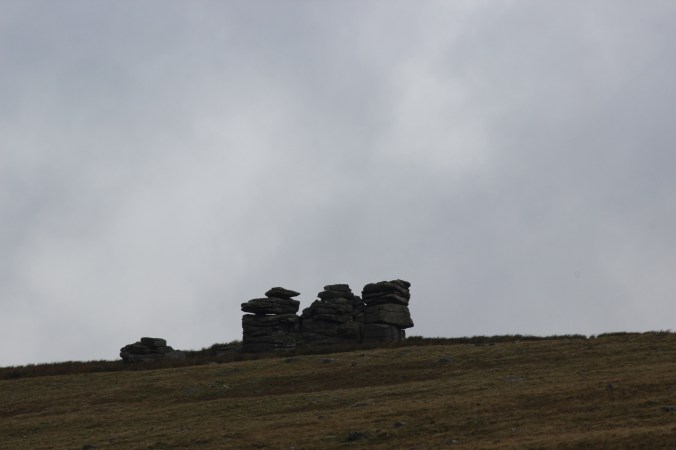
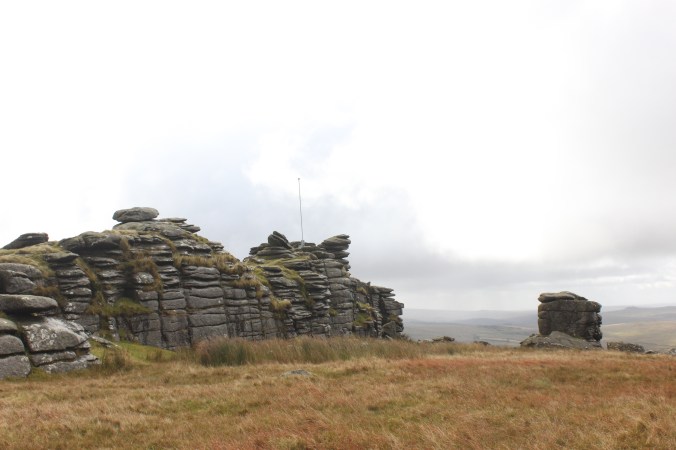
From the bottom of the path, I guessed it would take me about 15 minutes to get to the top. About half an hour later, when I was finally starting to feel I was almost there, I had to concede that looks, and distances, can be deceiving. But when I finally did get to the top, what I found was really quite remarkable. Several stone structures, most of which I hadn’t been able to see from the bottom, jutted out of the hill as if they had been pulled up from the ground with a giant pair of tweezers. Some formed perfect squares, others appeared to be stacked on top of each other precariously, as if one touch from my finger would send them toppling down the hill. The stones were darker than the surrounding earth, as if deliberately painted to look forbidding and dangerous, standing sentinel on the exposed hilltop.

But what were they for? How were they made? Did they occur here naturally, were they shaped from the hill by early settlers, or were they brought here, to serve a purpose? Were they ancient hill forts, build for defence? Ancient burial places? Or were they simply used to shelter those who (like me) sought a higher viewpoint? These were the questions I pondered as I stood amongst the stones, looking out over the moors and to several other hills, where I could see similar stone formations. Could it be that these remarkable structures occurred naturally on the hills, scored and shaped by the passage of time? Or were they perhaps a series of forts and settlements, marking the edge of an early kingdom? Perhaps we will never know – but then, the mystery, in a way, does add to the charm.

IMG_3533IMG_3609

I stood up on the hill for some time, exploring and pondering, watching as the sun moved in and out from behind clouds so the light was continuously changing. I climbed over the stones and sometimes took shelter underneath at the moments when the sun was covered and the rain blew in. It was stark, and desolate – I could see a long way in every direction but nowhere could I see another human being – only a few sheep. Not until I was on my way back down again did I see some other walkers heading up. Unfortunately, it was on my way back down that the sideways rain began again, and the side of the hill was completely exposed. As I had nothing to take shelter behind, and wasn’t about to go down the hill backwards, I was completely soaked on one side by the time I reached the bottom. The battery on my camera was getting worryingly low, as well, but I wasn’t ready to give up just yet. From the car park there was a field out to the left and I could see a group of tourists in the distance, so I headed off in that general direction, thinking that they could only be there if there was something to look at.

I am pleased to say that it was here that I found what I had been looking for all along, and was most determined to find that day – the Merrivale Stone Rows. Two rows of upright stones, roughly a metre apart, stretching for about 100 metres along the valley, apparently to nowhere, with a larger closing stone at the end. About 2 metres to the right was another, smaller row, leading off in the same direction.

IMG_3618

They really are quite incredible – but what on earth were they for? I walked along one and then back up the other, imagining myself in the place of a Bronze Age settler. Apart from the closing stone, and a circle in the middle which may have been a well of some kind, there was nothing at all unusual about them, apart from the fact that they exist. Surely they must have served some ceremonial purpose – at festivals, perhaps, or coming of age rites, funeral processions or perhaps as a connecting route between two rival settlements. It was wide enough for me to walk down comfortably, but it wouldn’t fit two people, and definitely not livestock, so it can’t have been a transport route. Who knows? We probably never will.

I spent some time wandering around the area, which was full of prehistoric surprises. Low stone walls which were probably used for keeping animals, wells, small hut-shaped foundations and great stone slabs that were probably tombs. There was even a perfectly preserved stone circle, which I stood in the centre of for a little while, wondering what rites and rituals might have been performed in that spot. I could see many stone markers dotted over the field and heading off into the distance, any markings they may have had long worn away by time. Were they ancient road signs? Sundials, perhaps, or border markers? It’s another mystery that will probably never be solved.

At this point I could see the tourist group heading back to the carpark so I made my way back and headed off before they could arrive and block the road. As my camera battery was now dead, and my feet still soaked, I popped back to the hotel for a cup of tea while I recharged and dried off. Then I set off for the afternoon. My first stop was in a small village nearby called Bellever, which has a very pretty forest walk and another clapper bridge. Unfortunately, this bridge was missing its middle stone, presumably long since washed away by the river, and the forest walks, although marked on a lovely map with different coloured dots and dashes, didn’t seem to have corresponding paths on the actual ground. I tried one, and ended up at a gate with a ‘private property’ sign on it, and another one which ended at a road with no signs to indicate where it went next. So I gave up on that and moved on.

IMG_3623

I ended up taking a diversion here, which some might call going the long way round, or perhaps simply ‘going the wrong way’. Anyway I ended up taking much longer than I should have done, however I did enjoy a lovely drive through some charming looking villages, with equally charming names, like Lustleigh, Bovey Tracey and Widecombe In The Moor. I even passed a sign post pointing to somewhere called ‘Doddiscombsleigh’. Eventually I did get to where I was going, which was a small pub called the Sandy Park Inn on the outskirts of a village called Chagford, in the north of the national park. I wanted to stop by here because it was where I stayed on my previous trip to Dartmoor, when my grandmother was over for the Olympics. We had a lovely stay there, despite the fire alarm going off at five in the morning, and my nanna and myself stepping out of the room to be confronted by a middle-aged man, sopping wet and with just a towel around his waist, having just dashed out of the shower. Unfortunately, the hotel side of the pub is being renovated at the moment, so I couldn’t stay there, but I wanted to stop by all the same.

I’m pleased to say the bar area hadn’t changed at all, and neither has the setting – it’s on the corner of a cross road, where one of the main roads through the national park meets a narrow road that winds up towards farming areas and the local landmark, Castle Drogo. I have a very pleasant memory of coming back down that road from the castle, to the politest traffic jam I have ever been involved in – it reminded me of one of those wooden puzzles where you have to slide several pieces out of the way before you can get one piece in the right place. People were moving back and forth in turn with remarkable patience, many waves and ‘thank you’s, and a lot of squeezing against hedges. Every so often a car would edge past the other way, and we would all go through the manoeuvres again as we all moved one place forward and started the whole process again. I remember reflecting at that time that this sort of thing would never happen in a city – people would be honking, swearing, and trying to get through as quickly as possible, not necessarily waiting their turn.

I had a swift half at the bar and chatted to the lady behind the bar, Tina, who as it turned out had been working there at the time when I stayed previously. Although we didn’t remember seeing each other, she could at least tell me all the news and gossip since I had been there, and we had a very decent chat. When I got up to leave, however, I found that I couldn’t – because there was a traffic jam outside. This time I could easily see the source of the problem – a bit further up the main road, at a bend in the road, a tourist bus coming down the hill was wedged against a horse trailer going up. They had obviously tried to go around the bend at the same time and they were now very stuck. No traffic, from any of the other three roads, was going anywhere.

The locals seemed to find this all highly amusing and not at all irregular. The locals at the pub had all moved to the outside and were watching with drinks in hand as if they were at a local football match. Those in their cars had all switched their engines off, and some had even got out and were chatting to the pub goers while the bus shunted back and forth to no effect. Everyone was very relaxed – not a single car horn was honked.

Eventually a couple of people gave up and turned around, which meant that the rest of us could move along and I could get my car out. My last stop for the day was a place called Fingle Bridge, a little further up the windy road from the castle. It’s a charming stone bridge over a postcard-pretty English river, with a lovely café and outside eating area. This was another spot I wanted to revisit from my previous trip, and I had hoped to stop for a cream tea, but unfortunately due to my earlier diversion and the traffic jam I missed the café opening hours. I took a few photos of the bridge and headed home, via some more lovely views over the moors with the evening sun slanting down.

IMG_3647IMG_3672

I made it back to the hotel in time for a swift half before dinner and to change my socks again. My friends from the previous night were all there and once again we chatted while we ate and shared stories, this time about the day we’d had. It was a satisfying end to an exciting and full day. I was tempted to book another night and do more exploring the next day, but I had places to go, starting with a stop in Plymouth for one specific thing… but that’s enough for one story, I think, so I’ll save it for the next one.


Road Tripping (and why I travel solo)

Well, it’s been a while. Most days I’ve been waking up thinking, ‘I must write a blog today!’ and then the nagging voice in the back of my mind starts up, with things like, ‘but you must do this other thing first’, ‘you don’t have time’, ‘there’s nothing to write about’, ‘that’s not very interesting’; and it gets louder and louder throughout the day until it moves on to things like ‘you’ll have more time tomorrow’, ‘you’re too tired today anyway’, ‘you’ll be able to do a better job when you’re not so distracted’…

In my defense, life has been a little distracting lately, although I’m pleased to say that some of that distraction did involve some travel and adventures, which I will share with you all over the next few blogs. So thank you all for waiting patiently, and thanks especially to those who kept asking ‘When’s the next blog?’ I haven’t forgotten you, and here I am.

My recent adventure was a 5-day road trip around Devon and Cornwall, which I was very excited about as my plan was to revisit Dartmoor, where I had a very pleasant visit a few years ago, and then go on to Cornwall where I’ve never been before. It was originally intended to be a group trip, but alas, plans change – and so did the weather forecast, on this occasion. But I decided to head off anyway, on my own, but with no plans to be lonely, as you shall see.

I headed off at lunch time on a promising Wednesday, south towards Brighton and then turning west, to drive along the coast. A longer route than taking the motorways, but I decided, since I wasn’t in a hurry, to take the more scenic route. The car was carefully arranged with music, snacks, map, water bottle and other supplies, all in their proper places (although that wouldn’t last long), the tank was full and the open road beckoned. I was off!

IMG_5717

Have you ever noticed how much pleasanter a drive through the country is when you’re not I a hurry? I had decided before I set off that it was going to be a lovely drive, and it was. I came through a tunnel somewhere near Southwick, I think, and there was the sea in front of me with the sun glistening off it. As I groped around the passenger seat for my sunglasses, I thought to myself, ‘yes, this is going to be a good trip!’.

It took me five and a half hours to reach the hamlet of Postbridge, in Dartmoor, with three stops along the way to refuel and stretch my legs, and apart from a few spots of rain, it was lovely. I had the sea on my left for most of the way and rolling hills on my right, the sun moved in and out from behind the clouds, leading the way west.

IMG_5462

When I arrived at my accommodation, which was a charming pub and B&B called the East Dart Hotel, I was shown to a bright and cheerful room which overlooked the road and a park next door. I felt like stretching my legs a bit before dinner so I set off for a short walk through the village, and stumbled upon the one thing I was determined to find in Dartmoor, as I’d missed it last time – the Clapper Bridge. I walked over the road bridge crossing the East Dart River and there it was, standing unassumingly in the river as it has done for the past 700 years. According to the local tourist information, the word ‘clapper’ comes from an Anglo-Saxon word, cleaca, meaning ‘bridging the stone steps’, and it was originally used by pack horses transporting tin from the nearby mines. It’s made of three flat stone slabs, each measuring roughly four metres by two metres – goodness knows how they got them there or made them so flat, but it’s remarkably solid, and all the more charming for the fact that it’s just there, with no distinguishing markings or signposts, for anyone to use and admire.

IMG_3485

Buoyed by this discovery and the fresh Dartmoor air, I headed back to the pub where I passed a very pleasant evening sampling some local ales and chatting with some of the other guests, which included a farming couple from Dorset, a lady from Belgium and a semi-retired couple from Minnesota. From them I learned that in Minnesota there is an annual cat-video festival which takes place in a football stadium, that there is a BBC Christmas Advertising tour each year and that there are such things as diamond hobbyists. It really was a pleasant and companionable evening, and it was well past ten o’clock by the time we all stopped chatting and went to bed.

People often ask me why I choose to travel alone, or say that I am brave for doing so. I guess I’ve been doing it for so long now that I don’t even think about it anymore. And the truth is, it’s not that I prefer to travel alone, but that I prefer to travel alone than not travel at all. And really, if you stay in the right places, and aren’t afraid to strike up a conversation with a stranger, there’s no reason for it to be lonely at all.

Hunger and Hope

Sometimes when traveling among other cultures, we experience things that are so far removed from our own experiences that it’s difficult to put it into any context, and even witnessing it doesn’t seem real.

While I was in Nepal, I spent a few weeks working on a rebuilding project, which was organised through an agency. Something like 52,000 schools were destroyed in the earthquakes, affecting the education of 1.7 million children, so we were there building new classrooms so that children could return to school. It was tough work – most days we were working in blazing heat, laying bricks, mixing cement and moving sand, and most nights it rained, so that we started each day bucketing out water from the foundations we had dug the previous day. We would go home each day covered in a mixture of sweat, sand, sunscreen and cement, but knowing we were doing our part to get children back into school, in classrooms that would be much more likely to withstand another quake. It was tough, but worth it.

As part of the program, we were given a presentation one evening by two members of the Nepal Youth Foundation, which is a local charity that works closely with the organisation I was there with, founded by an American lady named Olga Murray. This is a lady who traveled to Nepal one year, saw children suffering from malnutrition, homelessness and not going to school, decided she could do something about it, and went back to Nepal every year after that. I can still remember the words of a young man in a video they showed us, who said: “My education has given me empowerment and independence. Now I can say I’m a productive member of society. That is a gift no one can put a price tag on”.

Other work of the NYF includes abolishing the practice of Kumlari, the selling of daughters into servitude. The NYF, led by a man named Som, who was here telling us about it, set up a program called ‘Indentured Daughters’, aiming to rescue girls from being sold and instead get them into education. They showed us a video, which I have found the link to, and which I highly recommend you watch now, if you can:

http://www.nepalyouthfoundation.org/media/videos/freeing-enslaved-girls-in-nepal-the-indentured-daughters-program/

I was moved almost to tears watching this video, not just because it made me sad to think of these poor girls pretty much being sold as slaves at such a young age, but because of the success they have had with the program. It works for three reasons: one, by providing an alternate means of income to these families in the form of a goat or a pig; two, because they are working to change the mentality behind the practice, teaching families to value their daughters just as much as their sons, and; three, because there are people, like the ones from the NYF and all those girls who protested against weak law enforcement, who are willing to commit so much time and energy to their cause. It made me feel proud to be a human being, but it also forced me to think of what else I could be doing. I remembered what Olga said at the end of the video about money going so much further in Nepal: “When I think about what it costs in San Francisco, to go out for dinner, or to get a new dress – I can save a child’s life for that amount of money here”. A hundred dollars really doesn’t seem like much, to save a girl from servitude and send her to school. And of course, when a girl gets to go to school, it’s much more likely that her daughters will go to school, and her daughters, and so on and so on.

After the presentation we had dinner and I went over to Som to talk to him about the Indentured Daughters program. “I just wanted to congratulate you on the work you’ve done,” I said as we shook hands. “Saving 11,000 girls from being sold, that’s really something.”

“Oh, it’s more than that now.”

“Really?”

“Oh yes. That video was made in 2011. It doesn’t happen anymore. We’ve completely abolished the practice in Nepal.”

My mouth dropped open and I struggled to find words.

“You’ve abolished it? But that’s amazing!”

“Oh, yes,” he said simply.

What a difference a few passionate people can make. I had to wipe tears from my eyes as I walked out to get on the bus home.

Other aspects of the work of the NYF includes providing education for children with disabilities, who are often shunned by society, and running nutrition rehabilitation centres for malnourished children and their carers, to bring them back to health and educate them about proper nutrition. About half of Nepali children under 5 are malnourished, Som told us, and this is a major cause of death in this age group.

A few days after that presentation, I was able to spend a day at one of these centres, nearby in the Kathmandu Valley. The centre was set on a hill overlooking plains and farmland on one side and mountains on the other. If it wasn’t such a sad and lonely place, it would have been beautiful. There were about 6 or 7 children who were running around, excited to see us, the rest were either too young or too weak keep up. All of them were alarmingly thin, but some, at least, had more of a glow about them, but all of them had a pinched, gaunt look about their eyes. There was one small child lying in one of the nursery rooms, who could have been a month or a year old – it was impossible to tell – lying awake, but unresponsive. It was heartbreaking.

From what I could gather, the centre had taken in a number of children after the quakes who had been injured, orphaned or both, including a teenager who had lost both legs. Most of them had been moved to another centre the day before, but one remained, a young boy suffering from cerebral palsy who had lost both parents. At the time I was there, representatives from the centre were trying to negotiate with people from his village, who did not want to take him back – as he could not work, they did not want the responsibility of caring for him. I listened to one of the other volunteers telling me this while I watched him, watching the others play, laughing and calling out as if he was having as much fun as them. I never found out if he was able to return home.

However, despite all the sadness and despair, there was hope at this centre. On the walls were before and after photos of children and infants who had come in on the point of starvation and left a couple of months later with healthy baby glows and pot bellies. And best of all, the centre also admits the parents of the children, to teach them about proper nutrition. One of the ladies who works for the foundation, Sajini, told me stories about how many of the children come to be there not through neglect, but through ignorance. Much of the food donations they receive, she told me, were things like biscuits and two minute noodles which were cheap, but low in nutrients. And many families were feeding this cheap food to their children and selling their home grown rice and vegetables. There was one lady who was brought in with her child who had diarrhoea, because she thought she shouldn’t feed him anything while he was sick.

It was stories like these that made me fully appreciate what these charities and foundations do. There are some, it is true, that are there mainly to bring in tourist dollars, but some, like the Nepal Youth Foundation, truly are doing life changing work – because they are providing education, and treating the cause, not just the symptoms. Of course, in the aftermath of an event like the 2015 earthquakes, there are many children and families who will fall through the gaps and some that will simply miss out due to lack of resources. But it’s good to know that there are people like Sajini and Som working for a better future for Nepal. It gives me hope.


What’s in a moment?

This week while I was pondering what my blog post would be about, I looked at my page and saw the quote I use as my subtitle – “Be happy for this moment. This moment is your life”, and wondered if anyone had wondered why I put it there. No one has asked me, but I thought it would make a nice blog post topic, so here it is.

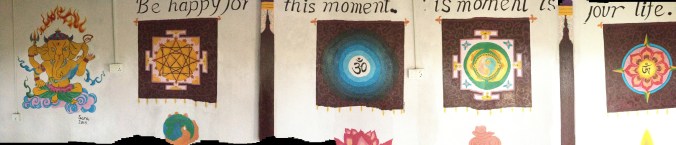
While I was staying at the eco-farm in Meghauli, Nepal, our host asked us to paint the inside of a long room he wanted to use as a meditation room. One day, when I came back from some early morning weeding, I found two of the other volunteers, Sajeena and Alba, sketching some designs for the room. They were both very good – they had come up with a series of mandalas and Buddhist knot designs, but needed something to link it all together. I suggested painting them as a row of tapestries, like I had seen in a monastery I had been staying in the previous week. So they had their link, and I felt pleased because I was able to contribute something.

But we also wanted a quote, a saying of some kind, that we could paint along the top of the wall, for people to read when they entered the room and also to think on when they were using the room for meditation or yoga. We came up with a long list, but the one we finally all decided on was “Be happy for this moment. This moment is your life.”

The job of sketching and painting the words fell to me and I took it on with enthusiasm. Sajeena turned out to be a brilliant artist – she had even brought her own brushes – and so was Alba, and the two of them got cracking on the walls while I got on with the quote. It was a companionable few days, if uncomfortable at times, because we were working in a concrete building in summer, with fans that only worked when the power was on, and the paint fumes were sometimes overwhelming. But we had many stories to share while we worked, we had music playing, and Bishnu our host would often bring us freshly cut pineapple to snack on.

While I painted, I thought about the quote that I was copying, and it got me thinking, what does it mean by ‘this moment’? And so I took a deep breath and made a list of all things I knew at that instant. To begin with, I knew that at that moment I was in Nepal, at a farm in Meghauli, painting a mural. I knew that Sajeena and Alba were also in that room painting. I knew that there were two buffalo grazing outside, because I could see them through a window, and I knew that there was a bird singing somewhere outside, because I could hear it. I knew that it was summer, and the sky was blue, and it wasn’t raining. I knew that I was warm, almost uncomfortably, but not quite, and starting to feel a little thirsty. And I knew that the time was about 2.15 in the afternoon. And that was about it. There were other things I could make a good guess at, of course – like the fact that I had family and friends who were safe and well in their various corners of the world, and possibly missing me. That Bishnu, who had just left us saying he was going into town, was probably now on his way into town. That outside in the world people were still going to work, going home, eating, sleeping, carrying on their usual lives. But none of that I could be sure of. All I could be certain of was what I could see, hear and feel in that room, at that moment. I found it incredibly grounding.

We carried on our painting, and sometimes Sajeena’s husband Neal joined us, or Sara and Justin would join us when they returned from the health post, and Sara’s partner Edgar – and so there were seven of us in there at once, and although it was hot, and sweaty, and messy work, we had good company and the satisfaction of seeing the results as we worked. After I finished the writing, I painted the pillars, in a style something like what I saw at the monastery, and helped Sajeena finish off her tapestries. The work was satisfying and engaging – I had missed that feeling of teamwork and camaraderie while I had been traveling solo, and that week was one of my favourites in Nepal.

The night that we finished the wall, we decided to have a dress up party at the farm. You know, it’s really amazing what you can come up with when resources are limited. Sajeena used a pair of tracksuit bottoms and some gloves to build a kind of octopus on her head; Alba found some banana leaves and attached them to her clothes in the manner of Eve; Sara found a sarong and tied it up like a toga and Edgar borrowed a pair of Sara’s shorts, found a wig and a tennis racquet and called himself Kournikova. It was simple, but fun, and it’s a memory I treasure.

Since that time, I have often used that quote as a kind of meditation when I’m feeling impatient or flustered, like when I’m stuck behind a slow-moving vehicle or find myself stressing about all the things I have to do and worrying about things several steps in advance. I ask myself, what do I know, what can I be absolutely 100% sure of at this very moment? And I think about where I am, what I’m doing, all the things I can see. And there’s usually plenty of good things, even if it’s just that the sun is shining and there are flowers growing along the side of the road. I find it incredibly calming, and a great way of bringing myself back to the present moment. I challenge you to try it, the next time you find yourself losing your temper, or stuck in traffic, or in a flap about your to-do list.

And if you do, I hope you will find plenty of things to be happy about. Just as, when I was dancing and playing games in a silly outfit, in the middle of nowhere in Nepal, I looked around and reflected that this moment was indeed my life. And I was happy for it.

IMG_3085

Getting on my Soap Box

It’s a common theme in country towns, villages and small communities that everybody tends to know everyone elses business, but there are usually at least some people you can rely on for confidentiality – medical practitioners, for example. Not so in Nepal.

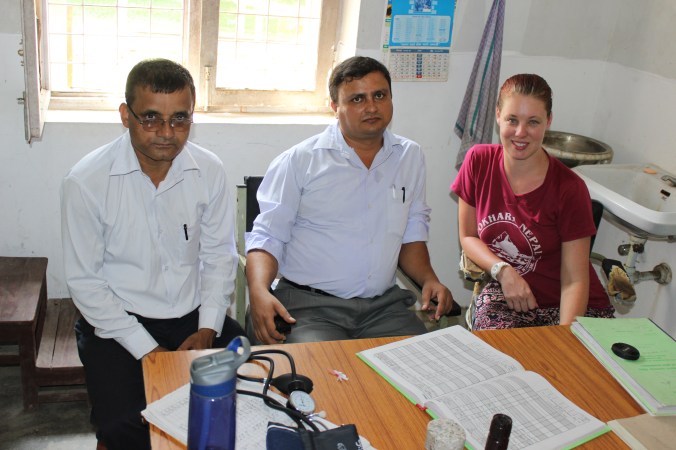
When I was staying on the farm in Meghauli, near Chitwan, there were six other volunteers who were all from Spain and the United States. Among the others were Sara, who was a qualified nurse, and Justin, a trained paramedic. The two of them were volunteering at the local health post, which was at the other end of the village. Each morning they would head off after breakfast (at whatever time that happened to be) and come back a few hours later in the afternoon, often with several horror stories about how basic the facilities were and how backwards some of their methods seem to be. (On one day, Sara came back one day in a mild state of shock after witnessing the doctor remove a boil by injecting it directly with anaesthetic and then immediately piercing it with a scalpel, so that all the anaesthetic drained out with the pus, without any chance to take effect – it must have been extremely painful.) I was curious to see the place for myself, so in the second week, after Sara had left, I headed down with Justin and we told them I was a nursing student so they were happy to have me with them.

The building looked like an old school building. We entered through a side door into a waiting room, with two ladies behind a desk and several people sitting in chairs along the opposite wall. The first thing I noticed, when we entered the doctor’s office, was that there was no door – only a curtain, which was tied up, so that the people sitting opposite the door could see straight in. There was a bed in one corner, which had a curtain that could be drawn around it, but that was the only sign I saw of any possible privacy.  From what Justin told me, people coming to the doctor had to first check in at the desk, where they had to tell the ladies there what their problem was, which the ladies would write on a slip of paper, which they then had to bring into the doctor’s office and place on his desk before going back out to wait. There were even people waiting in the room itself, so basically nothing anyone said to the doctor was private. There was also a sink in the corner, which was filthy, an old set of scales, and a ceiling fan which didn’t work because there was no power. The open window doubled as a back light for examining x-rays. The walls had been painted, but they were grimy and covered in cobwebs. A poster on the wall listed the ten most common complaints, which included mostly recognizable conditions like boils, abscesses, eczema and skin infections, gastritis, conjunctivitis, toothache and chest infections. But underneath that was a chart which listed all possible complaints with their corresponding codes, including quite a few that I’d never heard of, and some that just sounded downright alarming, like ‘Neck Floppy’ and ‘Genital User Disease’.

I was introduced to the doctor, who turned out to be a paramedic and not fully qualified. There was another man, who I think was a doctor but I couldn’t be sure as he spoke with a very high-pitched, nasally voice, and he punctuated all his syllables so much that he reminded me cartoon villain. “Aaare you from Sid-neeee?  Or Melll-boooorn?” He asked me. “My sissss-terrr lives theeeere!” I half expected him to add a sinister “mwahahahaaaaa” on the end.

So here I spent an interesting, if somewhat tedious day. The doctor (if that’s what he was) would pick up a slip of paper from his desk and call out the name, the patient would come in, the doctor would perform a few checks, and then in most cases, write a prescription. There were no individual files for each patient – instead, on his desk was a large ledger, in which he would record the patients’ name, age, caste, ethnicity, whether there was any referral, what was prescribed, and a code for whatever condition they supposedly had (I’m pleased to report that no one was suffering from Neck Floppy or Genital User Disease on that day). I say supposedly, because I witnessed some very bizarre methods of diagnosis, and even with my basic knowledge of physiology and medicine, I was sure they could not be right.

He examined a man’s ear by holding a torch about a foot away, pronounced an ear infection and prescribed antibiotics. He used a stethoscope to examine a lady who complained of stomach cramps, but held it over each spot for about a millisecond like he was doing a speed demo. He didn’t use it at all on the lady who apparently had a lung infection. Several people had their blood pressure measured, but it was never written down. Thermometers went from underarm to underarm without being wiped in between and throughout all this, patients were coming in and out of the room to bring their slips, sometimes putting it at the top of the pile if the doctor wasn’t watching (Justin was on the case, however, and moved them to the bottom). One man had a good read through all of them before adding his own to the pile, and one older woman, slip in hand, came in and sat down at the desk, glaring at the doctor as if daring him to make her wait.

What amazed me the most was that the doctor seemed to be doing so much guesswork. A child was brought in with fever and a runny nose, and without any examination the doctor pronounced that he had pneumonia. He may have been right, of course, but it also could have been so many other things. And it occurred to me, as he wrote this in his ledger, that it must be virtually impossible to train professionals and equip facilities properly if the statistics are all incorrect, which they must be. Everyone who came in, whether it be for a cough, sprain, or even a skin infection, seemed to leave with a prescription for amoxycillin, paracetamol and antihistamines. If there is an extreme opposite to the nanny state, I’m sure I was witnessing it there in Nepal.

I felt quite sorry for Justin, as I could see that there was very little for him to do. Mostly he took people’s blood pressures, and organised the slips on the doctor’s desk. I could see that he wanted to do more, and wanted to make suggestions and share ideas for doing things differently, but the staff were simply not interested. We did spend some time in a small treatment room, which was down the corridor and although it didn’t have a door, was at least at an angle where no one could see in. there was a small bed and a bench equipped with cotton and gauze, gloves, tape, tongs, iodine and saline, the basic tools for treating wounds. We dressed a few infected blisters and replaced a few dressings, then sat watching as one of the nurses re-dressed a wound in the armpit of the old lady (it was the same lady who had had the boil removed without anaesthetic a few days before). It was a hot, humid and sticky day and without the fans on it was swelteringly hot in the surgery, and I can only guess at the state of that woman’s armpit – yet the dressing was removed and replaced without the surface being dried, disinfected or wiped in any way. I would have been surprised if it had still been in place by the time the lady had walked home. Yet there was nothing we could do – as an observer, I could only watch and take note.

IMG_7703

Talking it all over with Justin that evening, I reflected on how much better their system could be if they directed their resources a little differently. So many of the complaints that people came in with were things that could be prevented with proper hygiene and basic first aid. If only they could teach some first aid, and supply households with basics like antiseptic and plasters, then so many visits to the health post could be avoided. And goodness knows how much gets spent on antibiotics, which were being handed out like confetti, and the waste of anaesthetic.

Even the young boy who stayed on our farm ended up with an infected sore on his leg from where he had fallen off his bike and scraped it. His mother, who was a very good cook, clearly lacked knowledge of how to treat it, and it was left uncovered for several days until he came down with a fever, at which point Justin marched him down to the health post, dressed it and wrapped it up as tightly as he could with strict instructions not to touch it. As far as I know he recovered with no problems, but it should never have been that bad, and it was not the only case we saw – in that one day at the health post I saw several infected blisters which had been left uncovered in hot and humid conditions until they became too painful to walk on, and then they had no choice but to visit the doctor. There was one story, of which I will spare you the most gruesome details, of a man who had developed a nasty boil between his buttocks. Poor Justin had to lance it, dress it, and then change the dressing each day for several days afterwards. Justin, who was highly disgusted by the whole thing, reported that the man had returned each day in the same clothes as the day before. Recall what I said about the hot and humid conditions, and you might get an idea of how the boil came to be there in the first place.

I felt very sorry for Sara and Justin who had come to Nepal to help, and found their ideas and suggestions falling on deaf ears. It must have been very frustrating. I found it saddening, and enlightening at the same time – for it was here, more than anywhere else in Nepal, that made me fully appreciate the value of a decent education and a proper health care system – things that we often complain about, and nearly always take for granted. And thanks to Justin, I will never again underestimate the benefit of a simple change of clothes and a bar of soap.

Going West

Have you ever noticed that sometimes the people who appear to have the least, are the most generous? In Nepal, I noticed this plenty, particularly when I headed off the tourist trail and headed out into the country. For example, I spent a couple of weeks in a small village called Meghauli, which is in the Terai region near Chitwan National Park – it’s in the lower, flatter region of the country near the border with India.

I stayed at an eco-farm where I helped out around the farm in return for food and accommodation, along with six other travelers. It was monsoon season, so most days involved a couple of hours of work in the mornings and evenings, resting through the heat of the afternoons and sharing a meal in the evenings.  The monsoon rains came and went most days, and it was always a trick trying not to get caught out in the fields when the rain came in – first you would notice a change in the wind, then the sky would change to a deep blue-grey, and then you knew you had about five minutes to get undercover, or you could forget about staying dry!

Everything was green and lush and the air was clean and fresh. We planted beans and pineapples, pulled weeds and did some painting. In our free time, we helped with cooking, played cards and often walked into the village, where the friendly villagers would always greet us with a smile, if perhaps a curious one, and often the offer of a cup of tea. They lived a simple life, trading their wares or services, growing a lot of their own food, taking the bus to town when they needed to. There was a school, and a health post, and not much else. But they were happy, and they made us welcome. None of the shopkeepers tried to charge us more because we weren’t Nepali. Even the lady who owned the only grocery store kept her generator running so we could get a cold beer and an ice cream in the afternoons.

When I left the farm, I wanted to head west, to a place called Lumbini. It is known to be the birth place of the Buddha, 2,500 years ago, and curiosity was nagging me to go there. I couldn’t go on the day I planned as there was a general strike (that happened at least once a week) and Bishnu, our host at the farm, was concerned about me going at all, because of strikes going on in that part of the country. He wasn’t sure I would be able to get there at all, and was urging me to take the tourist bus back to Pokhara.

I found his concern very sweet, but I was determined to go. So the next day, I packed my bags, said goodbye, and hopped on a local bus, with Bishnu next to me, who was determined to see me off as far as he could. When we got to town, he walked me to the next stop, found the right bus and told the driver where I wanted to go. Three and a half hours later, with very cramped legs, I arrived in yet another town, and here, to my great surprise, the driver took the bus all the way into the bus station to make sure I could get another one. He got off, found my next bus, told the driver where I was going, and paid my fare for me! Nearly an hour later, we arrived in yet another town, the closest one to Lumbini. Here it turned out I couldn’t get another bus, as from this point the country was still on strike. There weren’t even any taxis – the only way to get there was by rickshaw.  To further my surprise, this final bus driver got off the bus, found me a rickshaw and negotiated a good price for me. I hopped in, feeling a little overwhelmed by the kindness of these people, who didn’t know me at all and could have got much more money out of me if they had wanted to – but it was in their nature to be helpful, and I was grateful. Even the rickshaw driver, who hauled me and my backpack along for two whole hours in the blazing sun, insisted on buying me tea and a snack when we stopped half way for a rest. It was a long day of traveling, but thanks to the help of these strangers it was easy and unstressful and I felt blessed to have spent the day among them.

It occurs to me, thinking about it later, that Nepali people live much more in the moment than we tend to in the west. They are never in a hurry, and never stressed about what they have to do or where they have to go next – so taking a few minutes to help someone out is no problem, because it’s not taking time away from something else. It’s the same with hospitality (especially with tea!). Partly it’s cultural – not offering refreshment to a guest would be incredibly rude – but also, I think, it’s because they know that the same will always be offered to them in return, and that they understand in their subconscious that there is always enough to go around. It is so different from the western mentality of lack, and of competition – the idea that giving something away means having less, or that sharing means letting someone get ahead of you. They just don’t think that way in Nepal, and I found it liberating and refreshing.

In Nepal, everyone calls everyone else by a family name. Young men and women are called sister or brother, uncle or aunty, grandmother or grandfather. Up in the mountains, the girl who did our cooking, Jamuna, always called me sister. She would knock on my door in the morning if I wasn’t up, and call out ‘Sister, breakfast!” Our host’s mother also lived at the lodge. She helped to maintain the crops and animals and would tut very loudly if we didn’t finish our meals. We called her Ama, which means grandmother.

Perhaps it is this inherent sense of other people as family that makes the Nepali people so generous – after all, why would you refuse to help your brother, sister, uncle or grandmother? And if everyone you meet is your brother, or sister, your aunt or your uncle, you need never fear that you won’t have enough, or that your kindness won’t be returned. So the young girl traveling on her own from Meghauli to Lumbini isn’t a stranger – she is kin. Surely, this is what it means to live in peace.

Livin’ Like A Local

One of the good things about having friends in other places is that you get to visit them sometimes. And when you’re traveling, there’s nothing like staying with a local. Traveling solo, I do get to meet a lot of locals, but most of the contact I have with them is as a customer, and even staying in hostels, where you are thrown in with everyone, you’re still surrounded by other travelers. This is still a good thing – I’ve made many friends this way, from all over the place – but there’s nothing like actually staying with a local, in a local community, in a local home.

My first experience of this was in reverse. When I was 17, my family hosted an Italian exchange student who stayed with us in our home for two months. She was the same age as me, and we became, and still are, good friends. We hosted others over a period of a few years, and I have been able to visit a few of them since. And there are always, inevitably, those awkward but funny situations when you’re navigating around foreign customs and stumble over what you should do or say, who does what, what happens at meal times and so on. But mostly it’s fun, though challenging, and exciting, though scary. And sometimes, you get to do something really cool that you can only do if you know a local. Like go to a festival.

For example, every year in Venice, on the third weekend of July, there is a festival known as ‘Il Redentore’ – the Feast of the Redeemer.  This festival celebrates the liberation of the city from a devastating plague in 1576. This was when Venice was a republic, independent from the rest of Italy, and the plague killed around 50,000 people – nearly a third of the population. To give thanks for its end, a new church was commissioned by the Doge, to be designed and built by the renowned architect Andrea Palladio. And to celebrate, a great festival was held every year on the Feast of the Redeemer – a tradition which continues to this day and now includes a great firework display on the Saturday night. There is also a great pontoon bridge constructed over the lagoon, which stays up for just 24 hours, so the locals can walk from the main island over to the steps of the Church of the Redeemer on the Island of Guidecca. It happened last weekend. And it also happened ten years ago when I was there, staying with a local.

I was staying in Venice with two friends who had both once stayed with my family in Adelaide. One of them had family in Venice, and they invited us to join them for the celebration. When we arrived his cousin and one of his uncles were busy decorating their gondola with vines and paper lanterns, which were hanging from a string they had set up between poles at either end of the boat. It was the same shape as a gondola, but wider, and it had seating built in around the sides, with various boxes and containers stored in the bottom. About ten of us hopped in, and we set off along the canals heading out to the main lagoon. On the way we had to pass under the famous Bridge of Sighs, which I thought was very cool. We reached the lagoon and joined hundreds of other boats, similarly decorated with flowers, vines and lanterns, all gathering together for the festival. We joined a row of boats and I watched as the people in the boat next to us threw ropes and the boats were tied together, and then again as we threw ropes to the next boat to come up on our other side, so we were all joined in a long row of boats. I thought this was a very practical way of fitting as many boats into the lagoon as possible, while also reducing the amount of bobbing and rocking. But I was struck by the symbolism as well, of all these boats, being tied together for this one occasion, much like the Venetian people, so few of whom are still seen in Venice any more, coming together for this one night of celebrating.

We sat there together in the boat for several hours, as the day turned to evening and the evening turned to night. We had food to share, which was passed around, and drinks, which were warm but welcome, although I was careful not to have too much as the toilet facilities were naturally somewhat limited. There was much talking and laughing, and sharing with the boats around us. I didn’t understand most of the conversation, as they spoke in the local dialect which I couldn’t follow, but I was happy to sit back and relax, taking in the sounds and colours and the festival atmosphere. We enjoyed a small diversion when one of our paper lanterns caught fire – there was an initial cry which caused everyone to jump up suddenly, which caused several more cries as the boat, and the ones next to us that we were tied to, started rocking, followed by a general panic as the flame grew bigger and bigger. Eventually it was put out by someone simply ripping it off and throwing it into the lagoon. And so the party went on.

Finally, when it was fully dark, there was a spectacular firework display lasting nearly an hour. It really was something I’ll never forget – sitting in a gondola, bobbing in time with boats tethered to us on either side, watching a glorious array of fireworks and their reflections in the lagoon.

It was a quiet ride back – the Italians seemed to have worn themselves out and I was tired from translating in my head all day. But it was an experience I am still grateful for, because it is one I would never have had as a tourist. So here is my advice if you ever go traveling – don’t just travel with people from your own country. Make friends from everywhere – from places you’ve always wanted to go and from places you’ve never even heard of. And if they invite you to visit – say yes.