It’s a common theme in country towns, villages and small communities that everybody tends to know everyone elses business, but there are usually at least some people you can rely on for confidentiality – medical practitioners, for example. Not so in Nepal.
When I was staying on the farm in Meghauli, near Chitwan, there were six other volunteers who were all from Spain and the United States. Among the others were Sara, who was a qualified nurse, and Justin, a trained paramedic. The two of them were volunteering at the local health post, which was at the other end of the village. Each morning they would head off after breakfast (at whatever time that happened to be) and come back a few hours later in the afternoon, often with several horror stories about how basic the facilities were and how backwards some of their methods seem to be. (On one day, Sara came back one day in a mild state of shock after witnessing the doctor remove a boil by injecting it directly with anaesthetic and then immediately piercing it with a scalpel, so that all the anaesthetic drained out with the pus, without any chance to take effect – it must have been extremely painful.) I was curious to see the place for myself, so in the second week, after Sara had left, I headed down with Justin and we told them I was a nursing student so they were happy to have me with them.
The building looked like an old school building. We entered through a side door into a waiting room, with two ladies behind a desk and several people sitting in chairs along the opposite wall. The first thing I noticed, when we entered the doctor’s office, was that there was no door – only a curtain, which was tied up, so that the people sitting opposite the door could see straight in. There was a bed in one corner, which had a curtain that could be drawn around it, but that was the only sign I saw of any possible privacy. From what Justin told me, people coming to the doctor had to first check in at the desk, where they had to tell the ladies there what their problem was, which the ladies would write on a slip of paper, which they then had to bring into the doctor’s office and place on his desk before going back out to wait. There were even people waiting in the room itself, so basically nothing anyone said to the doctor was private. There was also a sink in the corner, which was filthy, an old set of scales, and a ceiling fan which didn’t work because there was no power. The open window doubled as a back light for examining x-rays. The walls had been painted, but they were grimy and covered in cobwebs. A poster on the wall listed the ten most common complaints, which included mostly recognizable conditions like boils, abscesses, eczema and skin infections, gastritis, conjunctivitis, toothache and chest infections. But underneath that was a chart which listed all possible complaints with their corresponding codes, including quite a few that I’d never heard of, and some that just sounded downright alarming, like ‘Neck Floppy’ and ‘Genital User Disease’.


I was introduced to the doctor, who turned out to be a paramedic and not fully qualified. There was another man, who I think was a doctor but I couldn’t be sure as he spoke with a very high-pitched, nasally voice, and he punctuated all his syllables so much that he reminded me cartoon villain. “Aaare you from Sid-neeee? Or Melll-boooorn?” He asked me. “My sissss-terrr lives theeeere!” I half expected him to add a sinister “mwahahahaaaaa” on the end.
So here I spent an interesting, if somewhat tedious day. The doctor (if that’s what he was) would pick up a slip of paper from his desk and call out the name, the patient would come in, the doctor would perform a few checks, and then in most cases, write a prescription. There were no individual files for each patient – instead, on his desk was a large ledger, in which he would record the patients’ name, age, caste, ethnicity, whether there was any referral, what was prescribed, and a code for whatever condition they supposedly had (I’m pleased to report that no one was suffering from Neck Floppy or Genital User Disease on that day). I say supposedly, because I witnessed some very bizarre methods of diagnosis, and even with my basic knowledge of physiology and medicine, I was sure they could not be right.


He examined a man’s ear by holding a torch about a foot away, pronounced an ear infection and prescribed antibiotics. He used a stethoscope to examine a lady who complained of stomach cramps, but held it over each spot for about a millisecond like he was doing a speed demo. He didn’t use it at all on the lady who apparently had a lung infection. Several people had their blood pressure measured, but it was never written down. Thermometers went from underarm to underarm without being wiped in between and throughout all this, patients were coming in and out of the room to bring their slips, sometimes putting it at the top of the pile if the doctor wasn’t watching (Justin was on the case, however, and moved them to the bottom). One man had a good read through all of them before adding his own to the pile, and one older woman, slip in hand, came in and sat down at the desk, glaring at the doctor as if daring him to make her wait.
What amazed me the most was that the doctor seemed to be doing so much guesswork. A child was brought in with fever and a runny nose, and without any examination the doctor pronounced that he had pneumonia. He may have been right, of course, but it also could have been so many other things. And it occurred to me, as he wrote this in his ledger, that it must be virtually impossible to train professionals and equip facilities properly if the statistics are all incorrect, which they must be. Everyone who came in, whether it be for a cough, sprain, or even a skin infection, seemed to leave with a prescription for amoxycillin, paracetamol and antihistamines. If there is an extreme opposite to the nanny state, I’m sure I was witnessing it there in Nepal.


I felt quite sorry for Justin, as I could see that there was very little for him to do. Mostly he took people’s blood pressures, and organised the slips on the doctor’s desk. I could see that he wanted to do more, and wanted to make suggestions and share ideas for doing things differently, but the staff were simply not interested. We did spend some time in a small treatment room, which was down the corridor and although it didn’t have a door, was at least at an angle where no one could see in. there was a small bed and a bench equipped with cotton and gauze, gloves, tape, tongs, iodine and saline, the basic tools for treating wounds. We dressed a few infected blisters and replaced a few dressings, then sat watching as one of the nurses re-dressed a wound in the armpit of the old lady (it was the same lady who had had the boil removed without anaesthetic a few days before). It was a hot, humid and sticky day and without the fans on it was swelteringly hot in the surgery, and I can only guess at the state of that woman’s armpit – yet the dressing was removed and replaced without the surface being dried, disinfected or wiped in any way. I would have been surprised if it had still been in place by the time the lady had walked home. Yet there was nothing we could do – as an observer, I could only watch and take note.
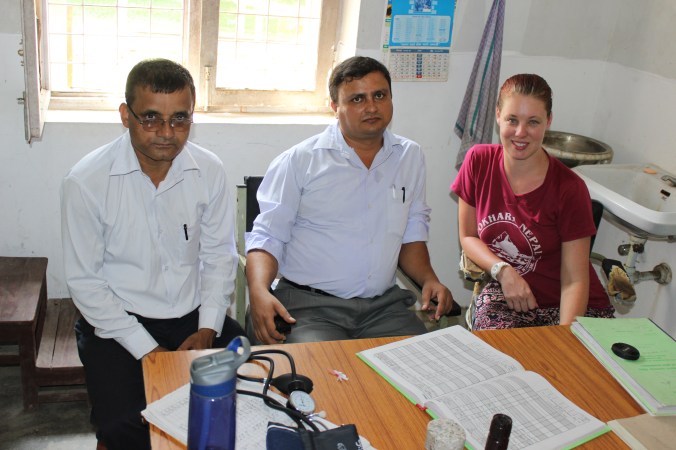
Talking it all over with Justin that evening, I reflected on how much better their system could be if they directed their resources a little differently. So many of the complaints that people came in with were things that could be prevented with proper hygiene and basic first aid. If only they could teach some first aid, and supply households with basics like antiseptic and plasters, then so many visits to the health post could be avoided. And goodness knows how much gets spent on antibiotics, which were being handed out like confetti, and the waste of anaesthetic.
Even the young boy who stayed on our farm ended up with an infected sore on his leg from where he had fallen off his bike and scraped it. His mother, who was a very good cook, clearly lacked knowledge of how to treat it, and it was left uncovered for several days until he came down with a fever, at which point Justin marched him down to the health post, dressed it and wrapped it up as tightly as he could with strict instructions not to touch it. As far as I know he recovered with no problems, but it should never have been that bad, and it was not the only case we saw – in that one day at the health post I saw several infected blisters which had been left uncovered in hot and humid conditions until they became too painful to walk on, and then they had no choice but to visit the doctor. There was one story, of which I will spare you the most gruesome details, of a man who had developed a nasty boil between his buttocks. Poor Justin had to lance it, dress it, and then change the dressing each day for several days afterwards. Justin, who was highly disgusted by the whole thing, reported that the man had returned each day in the same clothes as the day before. Recall what I said about the hot and humid conditions, and you might get an idea of how the boil came to be there in the first place.
I felt very sorry for Sara and Justin who had come to Nepal to help, and found their ideas and suggestions falling on deaf ears. It must have been very frustrating. I found it saddening, and enlightening at the same time – for it was here, more than anywhere else in Nepal, that made me fully appreciate the value of a decent education and a proper health care system – things that we often complain about, and nearly always take for granted. And thanks to Justin, I will never again underestimate the benefit of a simple change of clothes and a bar of soap.


Great story Karleen, we should all those that complain lots of things here in Australia over there for while!
LikeLike