Towards the end of last year I had to travel to Bristol for a weekend event, so I booked an extra day and took the opportunity to cross a destination off my list that I’ve been wanting to see for years – Avebury.
Avebury, as it turned out when I looked the place up, is the name of the village, as well as the enormous stone circle that surrounds it – although which one is named after the other I’m not entirely sure. Anyway pictures in books surely didn’t do it justice, and descriptions such as ‘like Stonehenge, only without the tourists and rope fences’ greatly appealed to my sense of the mysterious. I simply had to check it out for myself.
I stayed overnight in a very pleasant village called Wootten Basset, just off the M4. I checked into a charming little pub called the Angel and went for a wander around, enjoying the last of the evening light, which at that time of year was a little too early for dinner, but definitely not too early for happy hour, so I wandered back to the Angel and settled myself downstairs for the evening. One of the things I love about staying in pubs and hotels on my own is that I can’t get distracted by anything that might count as ‘work’, so I sat in the bar with a pint and my book while I waited for dinner time. I had a lovely meal and headed up early, thinking that I would get an early night and therefore an early start on the next day. My bed was incredibly comfortable – too comfortable in fact, as I over slept and only just made it down for breakfast. No harm done, really – and the sausages were excellent.
I drove for about 20 minutes before I reached Avebury, and the moment I saw the first standing stones I realised how impossible it really is to describe the place in a book. Suddenly they were just there, still, solid and enormous – taller than my car – flanking the road leading into the village like silent, square sentinels. I craned my neck from side to side as more and more stones came into view as I drove past, winding my way through the village until I found the public carpark on the other side.
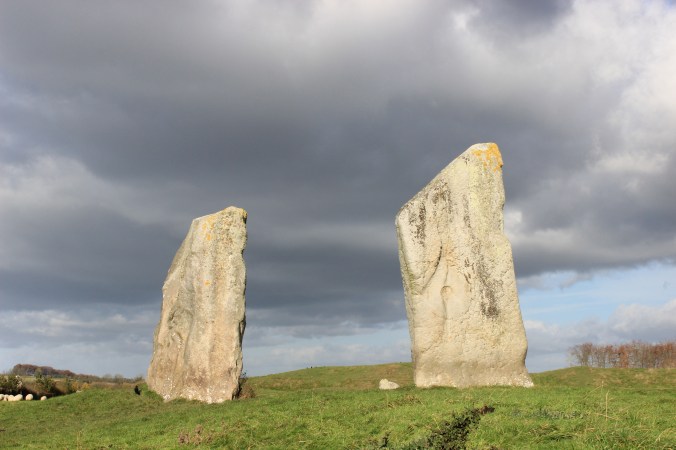
Avebury Stone Henge, Wiltshire
Avebury, as far as villages go, is quite small. There’s a church, school, and a convenience store, as well as a few trinket and souvenir shops selling everything from incense sticks to reiki-infused body lotions. There’s one pub, a museum and an old barn that has been converted into a tourist information and exhibition space. Its real charm is, of course, the stones, which circle and enclose the entire village. It’s really quite astonishing. From the carpark, I made my way to the tourist info where I found a map and a friendly villager to point me in the right direction, and set off to explore.
There are two main roads going through the village, roughly at right angles, dividing the village and the circle roughly into four quarters. Spotting a school group some way ahead of me on the right, I set off to the left, heading clockwise, ready to be amazed.
I was. The stones are immense. Most of them are still standing, which is amazing in itself, and most of them are taller than me. And best of all there are no ropes and no fences, so you can walk right up to them, touch them, lean on them and, in my case, wonder about the hands that crafted them. Why did they do it? Where did they come from, and what was it for? Was it simply an ancient sundial, designed to follow the sun and stars on their ancient paths? Or perhaps some sort of Bronze Age Colosseum, where great spectacles and rituals took place? Probably we’ll never know. But perhaps that’s a good thing, because it allows us to imagine.
As I wandered, a bright sun and ominous storm clouds glared at each other from opposite ends of the sky, casting an eerie glow on the ground and the stones, which glimmered enigmatically. I could feel their immense presence almost as a tangible thing – what sort of energy had the ancients imbued them with, I wondered. They reminded me a bit of suits of armour in castles – you feel as though they’re watching you, even though you know they’re not.
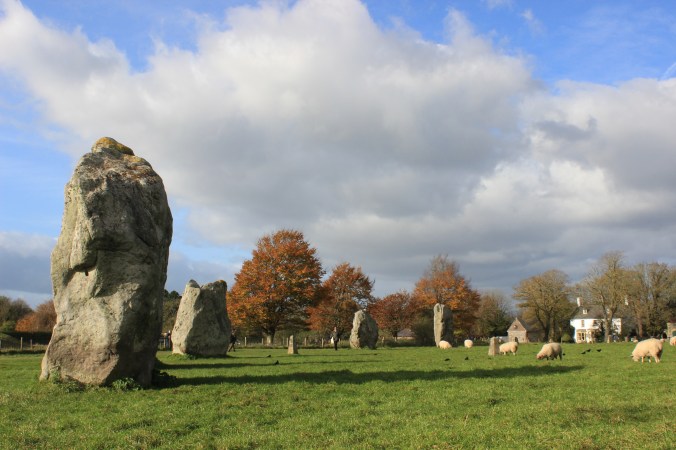
The Stone Circle circling the village of Avebury
I made my way around the circle, marvelling at the weather, which seemed determined to show the stones off in the best possible light, and passing some very pretty and extraordinary trees all adorned with ribbons and trinkets fluttering in the breeze. I stopped for lunch at the Red Lion, which claims to be the only pub inside a stone circle, which it probably is. It is most certainly the only pub in Avebury, so I was pleasantly surprised when the meal was both reasonably priced and reasonably tasty. I washed it down with an Avebury Water Well Ale and set off for my afternoon’s exploring.
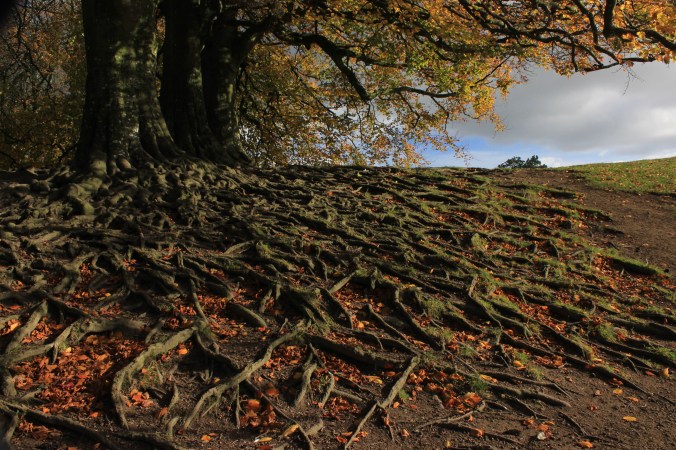
Pretty Trees and Intricate Roots
I set off out of the village and past the tourist carpark following a footpath which seemed also to be imbued with the magic of Avebury, as it kept disappearing and reappearing again, sometimes underwater, sometimes through a tree, or even on the other side of a fence. It didn’t matter though, as I could see my destination clearly in the distance – the vast, peculiar structure that is Silbury Hill.
Silbury Hill is, at first glance, just a hill. It juts out abruptly in the middle of a flat field, like an upturned bowl. That’s because it’s man-made, one of the largest of its kind in Britain, in fact. It’s an enormous chalk mound, built in steps, which they filled in as they went. All except the top step, that is, so that the top of the hill is flat, as if someone sliced it off with an enormous knife, or as if a giant hand turned over his sandcastle and then patted it down a bit too vigorously. Remarkably, it’s very similar to the Egyptian pyramids – it dates from roughly around the same time (2400BC) it’s built in the same way, (only the sides were filled in to make them smooth) and they are roughly the same height. It’s main distinguishing factor – aside from the fact it is an entire continent away – it that there is absolutely nothing in it.
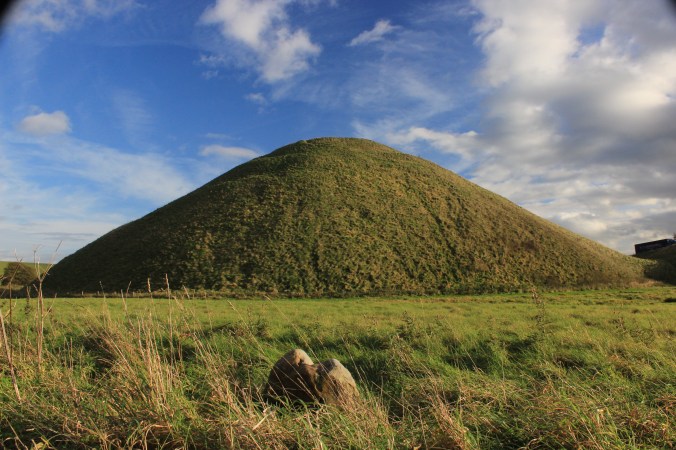
Silbury Hill
There are no tunnels, no chambers (burial or otherwise), no treasure cache or remains of anything of any kind. So what on earth was it for? Flint and antler tools have been found on it, suggesting at least that people spent time on it, and excavations around the site show a series of moats were built at various stages as the mound was enlarged over time. Did they intend to use it as a fort or look out? Well, perhaps – but there is another perfectly good hill, much higher, about a hundred metresto the east of it. Was it an unfinished project? Possibly. A statement of some kind, from one tribal chief to another (my hill’s bigger than yours!)? Chances are we’ll never know.
The reason we know there is nothing in it is because in the last 300 years or so there have been at least three attempts to tunnel into the hill, and none of them found anything. Unfortunately, they also forgot to fill the holes in when they left, causing the inside of the hill to collapse and a 14-metre crater to appear in the top. It was finally propped up and filled in in 2007, so it’s now back to being as close as possible to its original state.
I walked right up to the base of the hill, where I was confronted by a nasty looking fence and a notice threatening dire consequences if I attempted to climb the hill (actually it just said ‘climbing prohibited due to ongoing research’), but to me the idea of falling down a 14-metre crater was as much of a deterrent as disturbing some research into rare plants), so I set off around the base. I figured if I couldn’t walk to the summit then I might as well walk around the base, but I don’t think I was supposed to do that either as I reached a point where the ground became very overgrown and prickly and I had to maneuver myself over two very threatening bits of wire, not to mention the path had long since disappeared and I was on a very inhospitable slope with a busy road on one side and a ditch on the other. By the time I realised this, of course, I had gone so far around that I figured I might as well keep going. Fortunately there weren’t many other people about so there was no one to witness me emerging from the wilderness trailing brambles and barbed wire from my hair and boots. I brushed myself off and continued down the disappearing path to my next destination.
I crossed a road and trudged up a hill and I finally reached West Kennet Long Barrow, which is one of the biggest Bronze Age burial chambers in Britain. It’s believed to have been in use by the ancient Britons for around 1,000 years, and the skeletons of at least 46 people have been found inside, along with flints, beads, animal bones and bits of pottery. You can walk right up to it and even inside (the bones have been removed,fortunately), where I found five large excavated chambers, some of them big enough to stand up in. There were scatterings of flowers, tea lights and pine branches, and the smell of incense hung in the air. I didn’t see any druids or hippies, but they must have been around recently.
The Barrow, despite having an obvious purpose, still has a sense of mystery about it. Who was buried here? Was it members of one family? Or one tribe? What rituals did they perform, and what did they believe about life and death? I climbed up to the top of the impressive 100-metre-long mound and looked around the countryside, over Silbury Hill and back towards Avebury. Is this what they saw when they came up here – minus the A4, obviously – or has the landscape changed? And I wonder if anyone ever wandered up to the top of the hill, and wondered about the people who would come after them, and what those people would think of what they’d left behind.
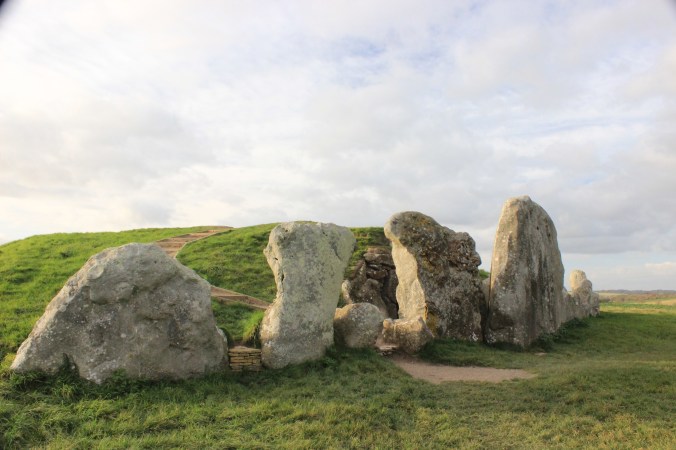
West Kennet Long Barrow
I stayed up there until the sun started getting low and I began to think about Friday evening traffic. I made it back to my car and got on my way again just in time to get stuck in a traffic jam heading into Bristol. It didn’t matter though – except that I was very thirsty by the time I reached my accommodation – because I was in such a good mood from all my exploring. I wonder if anything we build will last for 5,000 years, or if by then there’ll be any mystery left in the world for people to wonder about. I hope so.
 karleenstevens.blog
Kas, another great Story!! Keep them coming!
Have you had a chance to write anything with Nanna Loon’s interviews?
Love Dad.
From: “karleenstevens.blog” Reply-To: “karleenstevens.blog” Date: Monday, 14 May 2018 at 12:46 am To: Subject: [New post] Wondering and Wandering in Wiltshire
karleenstevens posted: “Towards the end of last year I had to travel to Bristol for a weekend event, so I booked an extra day and took the opportunity to cross a destination off my list that I’ve been wanting to see for years – Avebury. Avebury, as it turned out when I looked t”
LikeLike
Love this. It’s a famous site but one person’s take, written with a happily light touch, is fun to read. It makes me want to set off and try the circumnavigation of Silbury Hill myself . . . Likewise, the photos. I absolutely agree about that stormy yellowish light so characteristic of the English landscape showing some things at their best, and showing up the stones in all their peculiar splendour; but the individuality of the tree roots shot brings the day to life too. Beautiful.
LikeLike